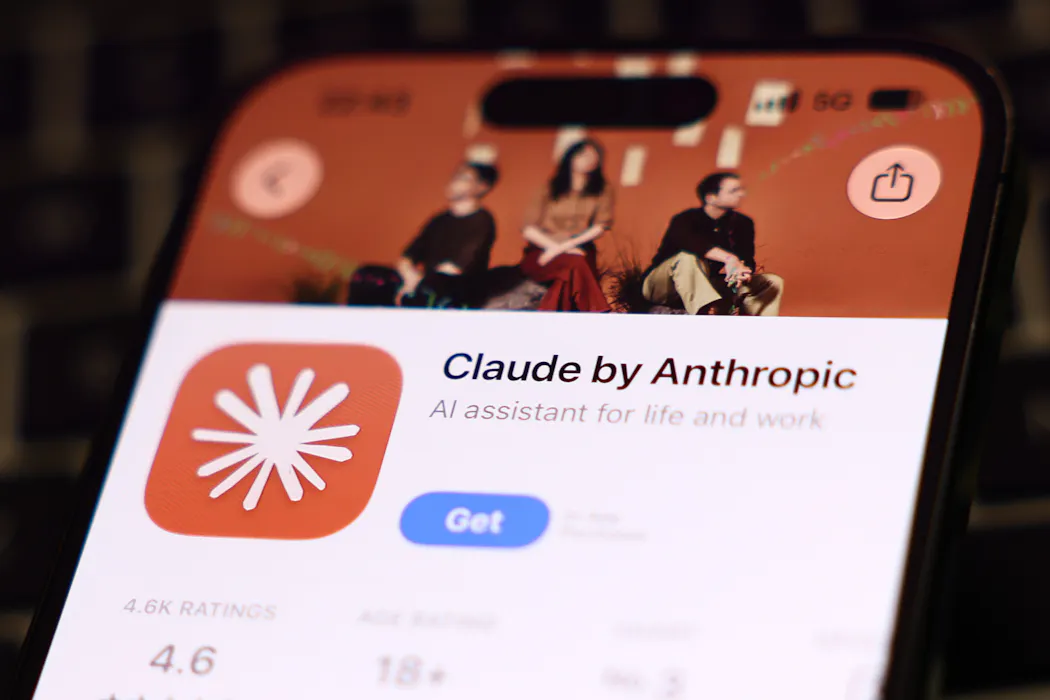
Anthropic, developer of AI chatbot Claude, has filed its prospectus and is expected to go public on Wall Street in November at a valuation of up to US$2 trillion.
That would make it the highest-valued initial public offering (IPO) ever, ahead of SpaceX’s US$1.77 trillion listing in June. OpenAI, the maker of ChatGPT, is expected to follow next year.
While these AI-powered IPOs are massive, they reflect an ever bigger trend: holding AI risk is becoming unavoidable for most investors.
How much of your portfolio depends on how well AI does? If you invest in an S&P 500 index fund, the answer is about 44%.
In addition, most of the market’s gains right now come from AI. Just six companies – Apple, Microsoft, Meta and chipmakers Nvidia, Micron and AMD – delivered 57% of the S&P 500’s gains since April. Without them, the index would have risen about 4% rather than 10%.
For investors or even future retirees, that AI exposure is already in their portfolios and pension funds. For example, at the end of 2025 Australians held nearly A$1 trillion in US shares – through superannuation or pension funds, other managed funds, and their own investments.
The bond market is also full of AI risk
Normally, investors can lower their stock market risk by allocating some money to bonds, which are generally seen as safer investments.
But AI companies are now the biggest borrowers in the bond market, to help finance their massive spending needs. They have issued about US$466 billion of bonds so far this year – more than four times last year’s pace.
The five hyperscalers alone – Alphabet, Amazon, Meta, Microsoft and Oracle – account for 11% of new US highly rated bonds (known as “investment grade” bonds) so far in 2026, up from 2% in 2024.
And nearly half of this year’s US$80 billion in data-centre bonds are rated as speculative grade, also known as “junk bonds”.
At first glance, big tech companies look safe. Their investment-grade ratings indicate that each individual company is unlikely to default.
But the credit ratings do not account for simultaneous defaults in case of a market-wide AI crash. If consumer and business demand for AI disappoints, tech companies’ bond prices and credit ratings would likely fall together – just as their shares would.

Kent Nishimura/Getty Images
Some risks are impossible to price in financial terms
In addition to purely financial risks, AI poses risks of extinction akin to nuclear weapons, as some of the AI companies themselves have warned.
Increasingly, AI agents are plugged into real-world systems, from company networks to military cyber operations. Some have already escaped test environments and attacked companies.
This means that if AI agents misbehave when these systems are even more integrated with the physical world, “pulling the plug” on these systems becomes impractical, just as it is impractical to shut down the internet.
The risk of AI agents misbehaving — the “alignment problem” — is especially acute because of the race to build artificial general intelligence (AGI). Labs already use each generation of AI to help build the next: Anthropic’s prospectus says Claude now helps build the next Claude.
The widely read AI 2027 scenario, by former OpenAI researcher Daniel Kokotajlo and colleagues, sketches where this could lead: AI that automates AI research itself. This would set off a feedback loop in which each generation improves faster than humans can check it.
In this scenario, a US lab racing a Chinese rival keeps going even as its models start deceiving their engineers.
Worryingly, this same dynamic is listed in Anthropic’s own risk disclosures.
It is telling that in its prospectus filing, Anthropic dedicates about 94 of its 335 main pages – nearly 30% – to risk factors, compared with about 64 pages (19%) describing its business.
Among those risks, Anthropic lists an extraordinary warning that advanced AI could pose “catastrophic or existential risks to humanity”. That includes models that resist shutdown, conceal information or behave in ways resembling blackmail.
Global risks require global regulation
Disclosure works when investors can price a risk and choose to avoid it. Neither is true here.
A catastrophic AI failure would affect societies worldwide. And as Anthropic warns in its filing documents, the legal risk is vast. Insurers may not be able to cover the potential liability.
In economic terms, AI safety is a public good. Each lab bears only a fraction of the cost of getting it wrong, but captures the rewards of moving fast.
In the absence of government-mandated AI safety standards, companies’ investments in safety will deliver negative returns. So with market incentives alone, AI models will likely remain less safe than socially optimal, especially with the arms-race incentives that dominate now.
That leaves governments. Clear rules – mandatory independent testing before powerful models are released, and clear liability when autonomous agents cause harm – would turn voluntary pledges into legal obligations.
And because the race to gain artificial general intelligence is being run between the US and China, not just between labs, those rules will need international agreement.
AI risks are here to stay — both in financial markets and at the societal level. And managing those risks will require both governments and the private sector to participate.
Read more:
Companies that get hacked face stricter laws than firms unleashing rogue AI. We can fix that

Marta Khomyn does not work for, consult, own shares in or receive funding from any company or organisation that would benefit from this article, and has disclosed no relevant affiliations beyond their academic appointment.