
Most students now use AI in their tertiary studies. AI can also, under certain conditions, answer at least 65% of questions correctly in STEM subjects.
In the humanities, where the whole aim is critical and creative reflection, educators face a thorny question. How do you develop and measure thinking of the kind that a machine could not genuinely imitate?
AI has proved it can answer questions well. But can it ask questions? And can it ask the right questions?
This is the philosophical method at the heart of the work of the Ancient Greek philosopher, Plato. His Socratic method of teaching is, perhaps, the mode of thinking we need to emulate in our teaching and learning today.
The great questions
Plato wrote dialogues: texts that read (in nearly every case) like a conversation between Socrates (Plato’s teacher) and a partner drawn into conversation by Socrates after claiming to know something about living a good and virtuous life.

Goodreads
There is a dialogue for all the great philosophical questions: what justice is; what courage or love really requires; what makes a good friend; and even how we acquire knowledge.
In each case the conversation is set by Socrates, who questions someone who seems to possess knowledge about a certain thing, or who has come to Socrates for advice.
It is not just the content of these dialogues that has prompted centuries of discussion, but their form. Plato’s dialogues are extraordinary literary achievements, drawing on a range of genres and placing characters, historical and fictional, inside deliberately constructed settings.
These are challenging and strange texts in many cases. They ask of their readers not just to read them as dialogues, but to call into question what we think we know.
The Euthyphro
Take the Euthyphro, the dialogue students most often meet first, which opens the sequence of dialogues dramatising Socrates’ trial and death.
Socrates is on the way to his own trial, over (politically motivated) charges of failing to honour the gods of this city, introducing new divinities and corrupting the youth. He meets a man called Euthyphro, who is on his way to court to accuse his own father of murder. Euthyphro insists this is the pious thing to do.
To Socrates, this is evidence that Euthyphro must know something about what piety is. Dialogue ensues. Socrates leads Euthyphro through a frustratingly methodical discussion using elenchus, also called the Socratic method.
The method proceeds roughly like this.
- One person, Socrates, mostly asks the questions.
- The partner must respond to every question.
- A definition or principle relevant to the discussion is sought from the partner.
- Socrates seeks clarification, gaining assent to various propositions.
- Those propositions are used to show that the definition under examination is unsatisfactory.
- This continues until the partner flees, erupts in frustration, or admits to being in a state of perplexity, called aporia.
It is this final step, the experience of aporia, that sits at the centre of the early dialogues. Aporia teaches us that we don’t know what we thought we knew, and we are all the better for finding out.
After all, it is better to have knowledge of our ignorance than to be ignorant of our ignorance. This is the product and achievement of the method, though Socrates’ partners rarely saw it that way.
His incessant questioning of often prominent Athenians earned him a bad reputation. Ultimately, he was sentenced to death.

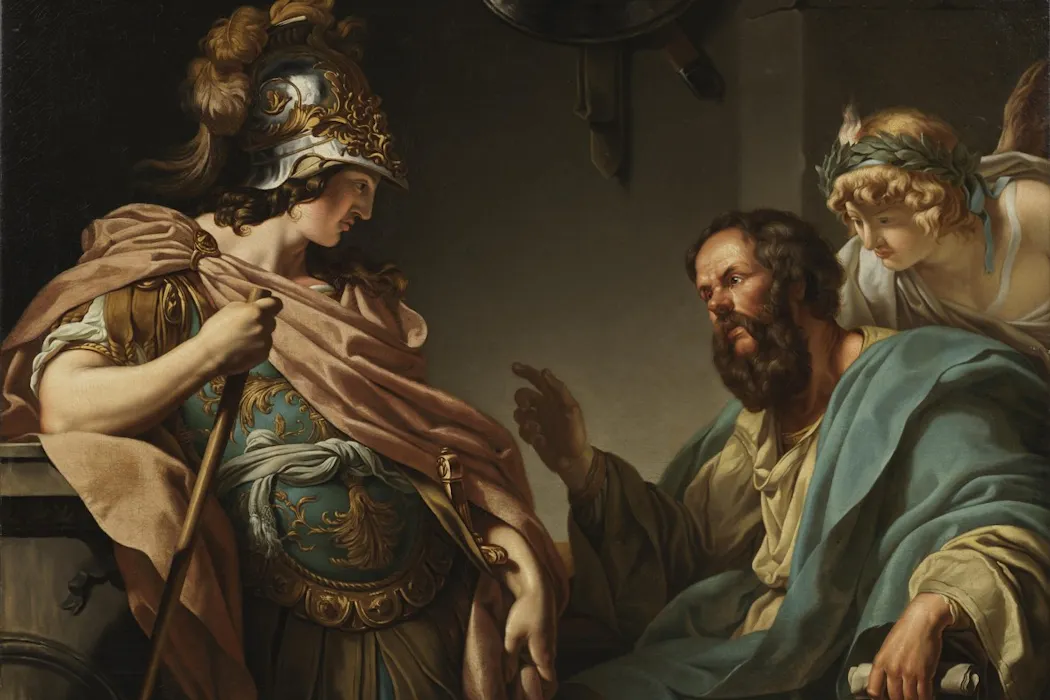
Wikimedia Commons, CC BY-NC-SA
An invitation
But there is more to the Euthyphro, and to all of Plato’s dialogues, than what the characters say. As modern readers of them, we are set a challenge.
We can read along while Euthyphro falters at every turn, unable to show that he knows anything about piety, until he storms off and the dialogue ends. We can then close the book and go on with our lives. But to do this would be to be no better than Euthyphro who, after having his ideas of piety brought under examination, realises he must not know as much as he thought.
Plato’s invitation, through the dialogical form, is to bring us into the conversation with Socrates. What do we think piety might be? Each dialogue puts us in touch with a question about an idea in this way.
The dialogues ask what love, friendship, knowledge, and so on, could be. And to be properly engaged with these texts, we have to follow Socrates’ successive attempts to define the thing under examination. The aporia at the close of the dialogue is often shared, too, by readers joining this conversation more than 2,000 years later.
This is one of the great lessons of studying Plato. Plato’s texts are not decrees or collections of aphorisms as they are sometimes treated to be. They are the beginning of a philosophical conversation with ourselves.
They portray far more than the ideas of one Ancient Greek philosopher. They set out a way of doing philosophy, of thinking critically and creatively about who we are, our relationship to the world and to each other, and what we really know.
This is not just the Socratic method, but Plato’s central teaching. Philosophical dialogue as a way of knowing.
Uses today
What Plato’s dialogues show is that learning takes place through the to-and-fro of reflective thought and that much of learning is really unlearning. Socrates picks his partners because they claim to know something and the discussion shows that claim to be hollow.
But, crucially, the result of the discussion is to arrive at a question that is now far more refined.
The question is where learning begins. To want to know something, you must already have some grip on what it is that you don’t know. You have to recognise the shape of the gap in your knowledge.
If I want to understand how plants photosynthesise, for example, I must first have noticed there is a process behind the plant’s survival, something about its need for sunlight, that I don’t yet understand. The desire to know begins in acknowledging what I don’t know and this is why the aporia Plato directs at his reader is not a dead end. It is where philosophy, and all of our seeking and learning, begins.
A student who asks AI to explain the causes of the French Revolution (simply because this was a question assigned to them) has asked a question, but not one that costs them anything. Nothing in their own understanding was at risk in the asking.
The question that matters, philosophically, is the one that exposes a gap in the knowledge of the one who is asking – and this is precisely what AI cannot do on the asker’s behalf. AI can fill gaps. It cannot locate them for you in any way that counts as learning.
This is exactly what is foreclosed when a student turns to AI before they have sat with their own aporia or confusion. AI answers before the question has been sharpened, and often before the student has worked out what they were really asking in the first place. The danger is not that students get answers. Students have always sought answers, from textbooks, from teachers, from each other.
The danger is that the experience of aporia is skipped entirely and the authentic and generative question that might have led somewhere is never found.
The difference between asking a question, and asking the right question, is in the proper determination of the limits of our knowledge. So, although the adage goes, “there is no such thing as a silly question,” some questions are seemingly more meaning bearing than others. They are the questions that genuinely express our wanting to know the answer.
I am suggesting this is what reflective, question-posing teaching and learning could recover. To develop and assess a student’s learning today, we could find ways for students to identify and then evaluate the gaps in their own knowledge.
This means, as some universities have started to do, encouraging and assessing dialogue in the classroom and utilising reflective, as opposed to purely descriptive, assessments. From here, the teacher’s task is to encourage the student to pose new meaningful questions, which are interconnected with the student’s own learning journey.
Now, of course, this cannot replace every other mode of teaching and learning. The descriptive and practical training that a chemist or a mechanic receives cannot simply wait for students to ask the right questions, and explicit teaching and demonstration remain indispensable for the development of technical skill. But it would be a mistake to think only the humanities benefit from the Socratic method.
Every profession contains moments where the expert must make a moral judgement and the answer cannot simply be looked up. But the deeper contribution the Socratic model makes beyond philosophy is not confined to ethics. It is the cultivation of judgement itself, the capacity to find the right question, which sits at the heart of expertise wherever it is found.
Socrates made this point when he claimed his only advantage over his fellow Athenians was knowing that he did not know.
We now have a tool that seems to know almost everything. The task for tertiary education is not to compete with AI at answering. It is to protect the conditions under which students still recognise what they do not know. That recognition cannot be outsourced. It is where genuine learning begins.

Oscar Davis does not work for, consult, own shares in or receive funding from any company or organisation that would benefit from this article, and has disclosed no relevant affiliations beyond their academic appointment.


.jpg)
