
This article includes examples of antisemitic hate speech.
The men accused of carrying out high-profile antisemitic attacks in the United States in recent years shared an important characteristic: They posted hate speech on their social media accounts beforehand.
The FBI said the man who drove his truck into a synagogue outside Detroit in March 2026 posted on Facebook that “Israel is a cancerous/malignant growth” and “Israel is pure evil.” The online footprint of the gunman charged with shooting and killing two Israeli Embassy staffers at the Capital Jewish Museum in May 2025 contained anti-Israel comments. The shooter sentenced to death for killing 11 worshippers at the Tree of Life synagogue in Pittsburgh in October 2018 frequently used antisemitic hate speech in his social media.
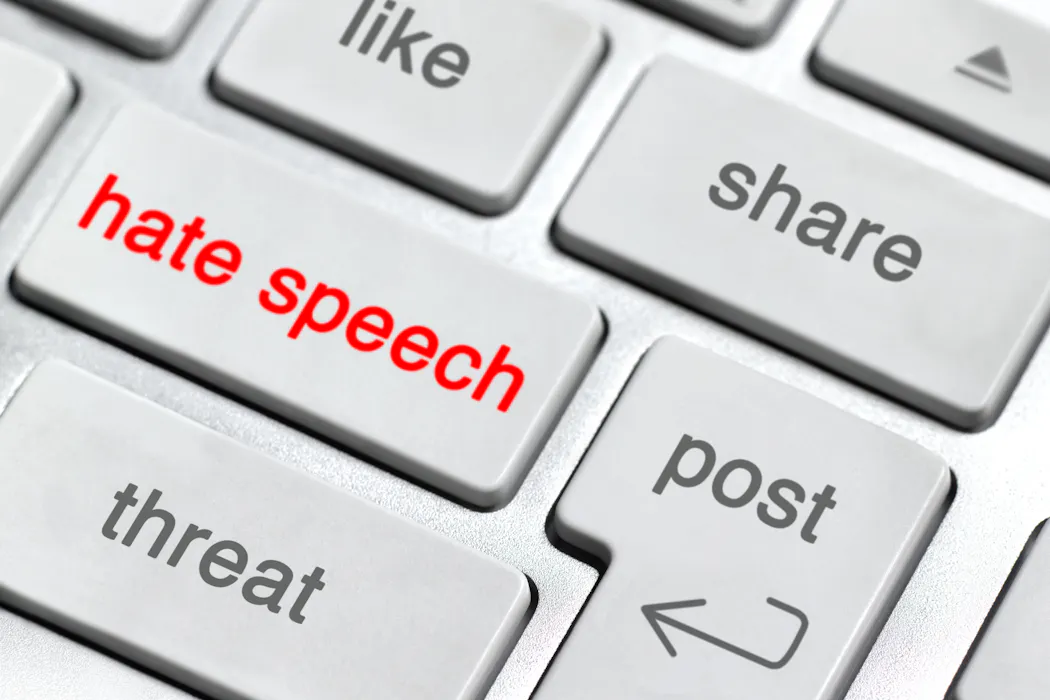
Hate speech uses feelings, emotions and attitudes that seek to dehumanize individuals or groups. At times, animosity is clear. But it can also take a more hidden form, using code words or terms understood only by like-minded people. Coded hate speech can evade online content censors and recruit people who might balk at more clearly discriminatory speech.
There are an estimated 5.7 billion social media accounts worldwide. Even when hate speech is explicit, content moderators struggle with the volume and deciding how much to monitor users’ speech. There are also alternative – some argue extremist – sites that limit content moderation, including 4chan, BitChute, Gab, GETTR, Parler, Rumble and Truth Social.
We are a group of interdisciplinary researchers at American University who study the rhetorical strategies behind overt and coded hate speech on social media. Our Unmasking Antisemitism project uses artificial intelligence, qualitative analysis and survey experiments to develop studies and tools to detect both types of terms. This article discusses examples of antisemitic hate speech that are disturbing but illustrate types of terms and how to counter this dangerous influence.
Two types of hate speech
To understand the difference between direct and coded hate speech, consider shooter Robert Bowers’ language before the Tree of Life massacre. On Gab, he used older, virulently antisemitic slurs such as “kike,” a “highly offensive term used to insult and denigrate people of Jewish faith or ethnicity that is widely considered to be a form of hate speech,” according to the American Jewish Committee.

Jahi Chikwendiu/The Washington Post via Getty Images
Other extremist terms are just as offensive but less obvious, such as “oven dodger,” which Bowers also used on Gab: a reference to how German Nazis systematically exterminated Jews during the Holocaust. Like overt phrases, coded terms often draw on older, well-researched antisemitic tropes, such as “Jews have too much power,” repacking them in new words and phrases.
They can also have double meanings, which makes hate speech harder to moderate. The original definition of “globalist” refers to a person who believes that policies should be planned with the whole world’s interest in mind rather than just one country. But globalist also has an antisemitic connotation.
As the American Jewish Committee “Translate Hate” glossary puts it, antisemites often use “globalist” to disparage Jews, promoting a conspiracy theory that “Jewish people do not have allegiance to their countries of origin, like the United States, but to some worldwide order – like a global economy or international political system – that will enhance their control over the world’s banks, governments and media.” This repackages long-standing Nazi and Soviet propaganda about Jews based on historical antisemitic tropes.
How terms develop
In the early days of social media, companies responded to criticism of the more hateful content on their platforms by using a combination of AI and human analysis to moderate content. The automated tools use natural language processing to analyze context, detect slurs and flag content. Human workers analyze more complex language, such as irony and slang.

Ilana Panich-Linsman for The Washington Post via Getty Images
But keeping up with the volume of posts is challenging, especially for more subtle hate speech. Our team’s goals are to identify coded antisemitic terms, understand how they develop, and create technology to track them.
The key is to understand that hate terms have a life cycle. Some take a path toward more public use, while others disappear.
New terms tend to emerge from a small set of people considered leaders or influencers in antisemitic circles online. In some cases, their communities adopt the term and normalize it; other times, it’s dropped from use.
The term “cultural Marxism,” which has its origins in the antisemitic belief that Jewish intellectuals seek to subvert Western culture, was adopted into wider use. “Jew jab,” on the other hand – a white supremacist conspiracy theory claiming that COVID-19 vaccines were a Jewish plot to harm people – soon disappeared.
Tracking hate
In our initial pilot project we started with 46 antisemitic terms, both overt and coded, from the American Jewish Committee’s glossary. We entered the terms in Pyrra, now called Alert Media – a private software company that allows users to scrape posts from a collection of social media sites.
Researchers trained in definitions of antisemitism, historical antisemitic tropes and hate speech detection identified 24 additional terms. White supremacists use the symbol “1488,” for example, to identify each other. The first part, “14,” references the “14-word” slogan of white supremacist leader David Lane. The “88” stands for “Heil Hitler,” based on “h” being the eighth letter of the alphabet. Other coded terms are less well known, such as “DOTR” or “Day of the Rope,” a reference to the 1978 book “The Turner Diaries,” which was written under a pseudonym by neo-Nazi William Pierce.
To track which coded terms have spread to the general public, we scrutinized mainstream media content and ran survey experiments to see whether people recognized them. We also developed an AI software tool designed to automatically track how coded language evolves. The app is trained on data from Pyrra and learns to identify new antisemitic terms based on the context in which they appear.
First, the app identifies distinctive terms based on how frequently they appear in each post, versus how rare they are on the platform in general. To find out whether these terms have an antisemitic connotation, we encode their context, such as other words in the post, and calculate whether it is close to the context of already known antisemitic terminology. Some of the terms our app has identified are explicit, while others are coded.
This approach can also be applied to hate speech targeted at other groups, such as Latinos, LGBTQ+ people and women. We aim to create a tool kit that can be distributed to nonprofit groups, think tanks and policymakers considering legislative efforts to curb hate speech.
Humans and machines
Given the massive number of posts on social media every day, our work illustrates how detecting new hate speech requires an interdisciplinary group of researchers working with machines.
One academic discipline working independently is too siloed, and humans alone can’t handle the scale. But machines alone can’t understand sophisticated human language, slang or context.
History shows that at every moment of profound technological change in our communication systems, incidents targeting Jews or other minority groups go up dramatically. This era’s technical innovation is unprecedented – but unfortunately, hate speech now travels around the globe almost instantly. Technology may be part of the problem, but its immense power can be harnessed to create a solution.

We received internal funding for this project from American University as part of its Signature Research Initiative.

