Live wire Humanoids · Autonomous vehicles · Drones · Industrial robotics · Embodied AI research

Blog

  • Mitigating vendor lock-in with Sakana AI Fugu multi-agent models

    Mitigating vendor lock-in with Sakana AI Fugu multi-agent models

    Sakana AI launched Fugu to orchestrate multi-agent operations and mitigate single-vendor dependency risks in enterprise deployments.

    Enterprises face operational vulnerabilities when relying entirely on monolithic AI APIs. Japanese AI firm Sakana AI designed Fugu as a response to these concentration risks by creating an orchestration language model that calls upon a pool of varied models to complete multi-step tasks.

    Users access this ecosystem through a single OpenAI-compatible endpoint. Fugu routes queries internally, deciding whether to resolve a prompt directly or to assemble a coordinated team of expert models for deeper analysis. The system handles model selection, delegation, verification, and synthesis internally. Engineering teams interact with what appears to be one model while a background system of specialists executes the actual computation.

    Sakana AI targets the geopolitical and regulatory risks associated with AI sourcing. Recent export controls affecting Anthropic models like Fable and Mythos demonstrated that access to specific foundational architectures can vanish based on foreign policy decisions.

    Fugu functions as a hedge against these sudden supply chain disruptions. The platform relies on a completely swappable agent pool. Fugu dynamically routes traffic around any restricted or degraded provider to maintain service continuity. Sakana AI states this capability provides the resilient architecture required for AI sovereignty.

    Fugu deployment tiers

    Two tiers are available to accommodate different operational latency requirements.

    The standard Fugu model prioritises low latency for daily tasks, integrating into standard developer tools like Codex for live coding and code review. Organisations subject to strict data governance or privacy mandates can manually opt specific underlying models out of the standard Fugu routing pool.

    Fugu Ultra targets complex, multi-step analytical problems that demand maximum accuracy. The Ultra variant coordinates a deeper pool of expert agents for intensive tasks such as academic paper reproduction, literature investigations, and patent analysis.

    Sakana AI reports that Fugu Ultra performs competitively against leading closed models like Fable 5 and Mythos Preview across scientific, engineering, and reasoning benchmarks:

    Benchmarks of Sakana AI Fugu standard and Ultra compared to rival frontier models.

    The orchestration method ensures companies can access top-tier computing capabilities without carrying the vendor concentration risk or export control exposure inherent to those closed models.

    Implementation in cybersecurity

    Almost 500 early users tested the system during an extended beta program focused on lengthy, multi-step computational workflows. With cybersecurity such a focus for models like Claude Mythos, engineering teams deployed Fugu Ultra to automate complete security assessment cycles.

    Human operators issued one scoped instruction, and the orchestration engine executed the entire reconnaissance phase. The model successfully conducted cross-site scripting and SQL injection checks alongside thorough authentication reviews.

    A participating cybersecurity engineer confirmed the model stayed strictly within its operational parameters and avoided initiating destructive actions against the target infrastructure. Fugu concluded the automated engagement by generating a clean vulnerability report complete with verifying evidence and exact retest steps for human remediation teams.

    The implementation demonstrated that multi-agent routing maintains strict compliance boundaries while executing complex penetration testing sequences.

    Software development teams also integrated Fugu Ultra into their primary code review pipelines to compare defect detection rates against established monolithic tools. The orchestration engine consistently outperformed baseline models in identifying logic flaws and security vulnerabilities within complex enterprise codebases.

    “For code review, Fugu Ultra is significantly better than GPT-5.5. It gives comprehensive answers and finds the bugs others miss,” reported a software engineer involved in the beta deployment. “Where other tools flag about three issues, Fugu surfaced more than twenty. It’s become the model I run all my reviews through.”

    Automated research and persona stability

    Data science units deployed the system in an almost fully-automated research mode. Fugu Ultra successfully explored mathematical hypotheses, executed experimental code runs, interpreted failure states, and revised its own approaches to sustain progress over extended periods with minimal human intervention. This capability directly addresses the operational limitations of single-call models that require constant human prompting to recover from logic errors.

    Leadership at an unnamed enterprise platform company identified long-term persona stability as a primary advantage during these extended sessions. Conventional monolithic architectures often suffer from context degradation and identity drift when processing extensive conversational histories.

    “Raw output quality is on par with top frontier models, but Fugu showed unusually strong persona stability across long sessions, holding its identity where other models drift,” the executive stated. “For agent products, that may matter more than raw benchmark scores.”

    Extended benchmark validation

    Sakana AI built the internal routing logic upon extensive research into learned model orchestration. The technical foundation for the product stems from findings published in the company’s ICLR 2026 papers, specifically the Trinity and Conductor frameworks.

    These academic foundations allow Fugu to process requests by understanding precisely when a task requires delegation versus direct resolution. The internal language model dictates communication protocols between the individual agents and structures the final synthesis of their separate computational outputs.

    Validation testing against frontier AI competitors covered complex, open-ended disciplines ranging from financial time series prediction to mechanical design. Fugu also demonstrated high proficiency in niche physical logic tests and visual interpretation tasks, including solving the Rubik’s Cube and performing Japanese handwriting analysis. The capacity to excel in both quantitative financial modelling and qualitative image processing confirms the efficacy of the multi-agent orchestration approach.

    Sakana AI designed the system to scale organically as the broader AI hardware and software market matures. Because the product relies entirely on learned orchestration logic rather than fixed operational rulesets, it automatically benefits from third-party innovations. Sakana AI plans to continuously expand the available pool of expert agents.

    The engineering team will fold newly-released open-source tools and proprietary Sakana AI models into the routing pool as they become available. Both the standard Fugu and Fugu Ultra models are available to enterprise clients today.

    See also: SAP and Google Cloud deploy agentic commerce architecture

    Banner for the AI & Big Data Expo event series.

    Want to learn more about AI and big data from industry leaders? Check out AI & Big Data Expo taking place in Amsterdam, California, and London. The comprehensive event is part of TechEx and is co-located with other leading technology events including the Cyber Security & Cloud Expo. Click here for more information.

    AI News is powered by TechForge Media. Explore other upcoming enterprise technology events and webinars here.

    The post Mitigating vendor lock-in with Sakana AI Fugu multi-agent models appeared first on AI News.

  • 1,250 hp hybrid Corvette shatters the Pikes Peak production record

    1,250 hp hybrid Corvette shatters the Pikes Peak production record

    COLORADO SPRINGS, Colo.—If you drive the 12.4-mile (20 km), 156-corner route up Pikes Peak, abiding by the posted speed limit of 25 mph (40 km/h), it will take you a good 30 minutes to reach the top. That’s assuming you resist the urge to stop and gawk at the infinite vistas that surround you along the way.

    On Sunday, professional racer JR Hildebrand covered that same distance in just 9.5 minutes, ignoring the scenery all the while. He did it in a 1,250 hp (932 kW) hybrid-powered Corvette ZR1X, a car that you can take home yourself for about $210,000. It set a new production car record for the hybrid on a day when EVs and combustion-powered cars fought for mountain supremacy.

    2026 marked the 104th running of the Pikes Peak International Hillclimb, one of the most historic races on the planet. Since its inception, competitors have struggled not only to string together all those corners but to maintain speed all the way to the 14,115-foot (4,302 m) summit.

    Read full article

    Comments

  • A US military exercise in space got underway with barely anyone noticing

    A US military exercise in space got underway with barely anyone noticing

    Rocket Lab quietly launched a small satellite from New Zealand on Friday in a high-flying military exercise to test the US Space Force’s ability to rapidly respond to a crisis in low-Earth orbit.

    The launch was scarcely announced in advance. The only public indication of an impending launch was the release of a warning for pilots and sailors to steer clear of the rocket’s flight path. Rocket Lab did not provide a livestream of the launch, as it does for most of its missions. As of Monday morning, officials from Rocket Lab and the Space Force had not acknowledged the launch in any official public statements.

    But the US military’s catalog of space objects was updated over the weekend to reflect the launch. A new satellite, designated Victus Haze Puma, showed up in the catalog with a launch date of Friday from Rocket Lab’s privately run spaceport at Māhia Peninsula in New Zealand. The Space Force cataloged the spacecraft in a polar orbit ranging between 215 miles and 286 miles (347-by-461 km), with an inclination of about 97.5 degrees from the equator.

    Read full article

    Comments

  • Lucid lays off 1,500 workers in second big cut of the year

    Lucid lays off 1,500 workers in second big cut of the year

    Just three months ago, Lucid Motors showed off a new midsize electric vehicle platform that it said would give rise to a number of new vehicles in the coming years. The Saudi-backed startup is now selling its Gravity SUV alongside the ever-improved Air sedan and plans to reach profitability with smaller and cheaper models sold in higher volumes. But things are far from rosy at Lucid; today, the automaker is laying off approximately 1,500 workers—18 percent of its workforce.

    These aren’t the first layoffs of the year, either; In February, Lucid let go of 12 percent of its workforce.

    In a filing with the Securities and Exchange Commission, Lucid wrote that the layoffs were “designed to advance the Company’s path toward profitability and positive cash flow generation by streamlining its organizational structure, optimizing operating expenses, and aligning production plans with anticipated demand.”

    Read full article

    Comments

  • ‘We Will Fight to Our Very Last Breath:’ Township Leaders Vow to Fight Nuclear AI Data Center

    ‘We Will Fight to Our Very Last Breath:’ Township Leaders Vow to Fight Nuclear AI Data Center


    'We Will Fight to Our Very Last Breath:' Township Leaders Vow to Fight Nuclear AI Data Center

    Board members of a small township in Michigan agreed to “fight to our very last breath” against an AI data center planned in their community. America’s nuclear scientists and the University of Michigan want to build a massive data center in Ypsilanti Township, Michigan. If built, the data center will, among other things, run simulations to help America build nuclear weapons.

    The residents of Ypsilanti Township overwhelmingly oppose the construction of the data center and voiced their opposition to the computer warehouse during a public board meeting on June 16. In a show of support that’s often rare from local leaders in communities with data centers, Ypsilanti Township’s board vowed to fight UofM and Los Alamos National Laboratory, which is partnering with the university, with everything they had.

    Throughout most of the three hour board meeting, a photograph from a data center groundbreaking in nearby Saline Township was projected onto a wall behind the board. The photo showed a grinning Michigan Governor Gretchen Whitmer standing in line with Oracle CEO Clay Magouyrk. It was taken at the June 1 groundbreaking of an Oracle and OpenAI data center in nearby Saline Township, one of several Stargate projects. Saline Township is a community of only 2,300 people and the fight against the data center was so contentious that the Township treasurer resigned in tears during a public meeting in May.

    During the groundbreaking, a videographer caught Whitmer talking with Magouyrk. In the video Whitmer appeared to tell the billionaire, “We’re used to people saying no, and doing it anyway.” Whitmer’s office has officially denied she said that, but many of the residents of Michigan—including the people of Ypsilanti Township—believe she did.

    Cilla Cresswell shot the video of Whitmer and was present at the Ypsilanti Township board meeting on Tuesday. “On June 1 I was standing just to the left, right there,” Creswell said, referring to the photo that loomed behind the board during the meeting. “I was there. I recorded that clip [… ] I was right there. And they want to say it’s fake, but I just want to let you guys know it’s real. You can play it on my camera.”

    Members of the board and the community referenced the photograph often during the meeting. “You have people in that photograph worth billions of dollars. Not just millions, we’re talking trillions. Soon to be trillionaires. Yet this state, in its zeal to become the data capital of the country, has extended unprecedented tax credits to the richest corporations in the world,” Douglas Winters, a lawyer representing Ypsilanti Township, said in the meeting.

    “Having to stare at this picture during this meeting has my blood boiling,” said Ypsi resident Laura Witowski. “I did not realize how emotional I would be. The waste of space. The complete lack of regard for humans and animals and for what?”

    During the hours of community comments, residents stepped forward to voice complaints that have now become common about data centers in America. The people of Ypsilanti Township worried about the rising cost of electricity, how much water the building will use, and how noisy the data center would be once finished.

    They also called on the Township board to do everything in their power to stop it from even being built. “Put yourselves on the line. Those people will listen to you better than they will listen to us. Please put yourselves, your jobs, and your comfort on the line to stop this for us,” Ypsi resident Jane Wolf said. “Get creative. Tear up the road. Block the road. Break the law. Do whatever you need to do for us. You will be remembered better in history for the job that you did if you can get creative and really put yourselves out there.”

    Jill Warren, the wife of a Methodist pastor, suggested residents brush up on the OSS’ Simple Sabotage Field Manual. “Simply slow things down bureaucratically,” she said. “Make sure we block where we can. Use very slow agendas and response times and do, within your power, the work that you are entitled to do. For those who aren’t familiar with it, please look up the Simple Sabotage Field Manual and use it in your own lives of action as well […] they may not care about us, but we care about us and we’re here and we’ll continue to be here and support the work that you’re doing on our behalf.”

    Alyssa, an Ypsilanti resident, cited long passages from John Hershey’s Hiroshima—a 1946 book that focused on the victims of the first atomic bombing. “We don’t need simulations to know what a nuclear strike looks like,” she said. “We have pictures, videos, and audio of what happens. We know what it does to bodies. We know what it does to children and what it does to life.”

    Board supervisor Brend Stumbo vowed to fight. “This is going to harm our community in our future. We will fight to our very last breath, but we need help. And we need it from the people who have the power to stop things,” she said.

    Stumbo explained that, early on, she and other members of the board were ignorant about data centers and that she was grateful to the Township’s residents for informing her. “Now we know and we’re thankful for the residents and non-residents that came to our meetings early and told us, ‘don’t trust UofM,’” she said. “We do not love nor do we appreciate what the board or regents is doing to our community. It needs to stop. And everyone that showed up here today, we greatly appreciate it and we will keep going, like everyone has said, by doing it together […] I will stand with you. I will fight with you. And I know this entire board and our Township attorney will as well. So let’s keep doing it together.”

    The Township has, so far, made good on its word and it’s been creative in its opposition. In April, the board voted to institute a 365 day moratorium on supplying water to data centers so it could conduct a scientific study into how hyper scale data centers might affect the community water supply. In response, UofM threatened to sue and claimed that withholding water from an AI data center meant to power nuclear weapons research was unlawful discrimination.

  • Compete to survive, cooperate to exist: the sovereignty paradox at the heart of Europe’s defence industry

    Compete to survive, cooperate to exist: the sovereignty paradox at the heart of Europe’s defence industry

    At the ILA Berlin Air Show on June 11, eight German aerospace and defence companies signed a strategic positioning paper committing to build a sixth-generation fighter jet without France, under the banner “Team Gen 6”. Airbus called it “an existing step for European sovereignty”. Spanish industry is already lining up behind the initiative.

    Three days earlier, France and Germany had officially abandoned the joint fighter jet program at the heart of the Future Combat Air System (FCAS), the €100-billion initiative that was supposed to embody that very sovereignty. Spain’s defence minister, Margarita Robles, called the outcome a policy failure for Europe: “Industrial interests have been prioritised over Europe’s security and defence interests.”

    The question raised by the collapse of the program is the following one: can better management of coopetition by European institutions prevent sovereignty-driven projects from collapsing?

    The FCAS collapse is a call to better understand the success factors of a strategic concept that sits at the heart of Europe’s strategic autonomy: Coopetition, the idea that European competitors can and must cooperate to build sovereign capabilities that none of them can build alone. FCAS was not facing difficulties because the idea was fundamentally flawed. Rather, it struggled because coopetition, when it involves competing firms, competing states, and contested interests over critical technologies, is structurally prone to collapse without the governance architecture needed to sustain it.

    When Aerospace competitors become necessary partners

    The logic is straightforward, even if the practice is not. National champions, the historical model for European industrial sovereignty, are increasingly unable to sustain alone the scale of investment that frontier technologies demand. No single firm, and no single state, can credibly mobilise sufficient skills and resources to produce and operate a next-generation combat aircraft, a a competitive semiconductor ecosystem, or European AI infrastructure.

    The response, across defence, space, energy, and critical technologies, has been to combine forces, including with direct competitors. This is what researchers call coopetition : strategies that are simultaneously cooperative and competitive. Partners pool costs and share knowledge to create value together, while each tries to capture as much of that value as possible individually.

    The European satellite navigation system Galileo is an early instructive case . Launched in 2001 with a budget of 13 billion euros, it brought together firms, including Airbus Defence and Space, Thales Alenia Space, and OHB, that compete in the same markets. Pooling their R&D capacities allowed Europe to build a system capable of rivalling GPS. No single actor could have done it alone. The coopetition, carefully orchestrated by the European Space Agency as a neutral third party, worked (Rouyre and Fernandez, 2023).

    FCAS has proved far harder to manage. The contrast is worth dwelling on.

    The sovereignty twist

    Coopetition always generates tensions (Tidström, 2014). Companies that cooperate to create value also compete to appropriate it. This produces a structural paradox: each partner must share knowledge to advance the joint project, while simultaneously protecting the knowledge it does not want to transfer. The line between the two is rarely obvious, and incentives to cross it are constant.

    When the stakes are commercial, managing this is hard. When national sovereignty is involved, it becomes acute.

    In the FCAS case, Dassault and Airbus Defence and Space are not merely industrial competitors, they are the industrial embodiments of French and German defence interests respectively.

    Dassault’s Rafale and Airbus’ Eurofighter compete directly on the global arms market. Their collaboration in FCAS thus runs directly against their competitive interests, and neither partner can afford to be the one that transfers more than it receives.

    This is not irrationality. It reflects what research literature calls asymmetric learning: the risk that, in any cooperative arrangement, one partner learns more from the other than it contributes in return. In standard industrial coopetition, this is a governance problem. In coopetition involving rivals from different states, however, it takes on a harder edge: strengthening your partner’s knowledge base may, in certain scenarios, amount to strengthening the capabilities of your competitor’s country.

    The Galileo project itself offers a cautionary tale here. In 2003, China joined the program, investing €230 million and taking a substantial share of the work. “China will help Galileo to become the major world infrastructure for the growing market for location services”, commented Loyola de Palacio, the late Spanish former energy and transport commissioner.

    Over time, Chinese actors absorbed enough of the technology to develop BeiDou, their own independent gps-equivalent positioning system, which they have since used to interfere with Galileo signals. The coopetitive project had, inadvertently, helped subsidise a rival. The lesson is not that cooperation is naive; it is that knowledge flows must be governed.

    Spain, or the third partner’s dilemma

    Spain joined FCAS in 2019 as its third partner. For Madrid, the program was never only about an aircraft: it was a vehicle for upgrading an entire defence-industrial ecosystem. When the Franco-German relationship turned into a learning race and then hit deadlock, Spain faced the classic dilemma of the junior coopetition partner: stay loyal to a stalling project, or hedge.

    It hedged. Before the divorce was final, Madrid had approved funding for a joint Airbus–Indra study on a future national combat air system. Within three days of the official cancellation, Spanish industry had aligned itself with the German-led Team Gen 6, while Robles publicly lamented that industrial interests had trumped European security.

    Belgium, an observer to the program, had reached the same conclusion months earlier: its defence minister declared the project “dead” as early as February.

    Spain’s behaviour is not opportunism. It is the rational response to a coopetitive project without credible governance: when partners cannot trust the rules of the game, each discounts the project’s future and invests in alternatives. The trouble is that hedging accelerates the very fragmentation it is meant to insure against.

    Governance determines if coopetition lives or dies

    Neither of the Galileo or FCAS cases argues against coopetition. Rather, they argue for coopetition management to be taken seriously.

    Why was Galileo successful, and why are we struggling to bring the FCAS program to completion? What FCAS has lacked is credible governance architecture: mechanisms that allow partners to cooperate intensively while limiting undesired knowledge transfers, distributing costs and gains in ways that each partner considers fair, and resolving disputes before they become public threats to quit.

    Research on coopetition identifies several such mechanisms: structural separation between collaborative and competitive activities, formal protocols governing what is shared and what is ring-fenced and, perhaps most importantly, a neutral orchestrator capable of holding the process together when bilateral tensions escalate. The European Space Agency (ESA) played this role in Galileo. In FCAS, the three partner states have struggled to find an equivalent partly because the governance question is also a sovereignty question: who leads, and on whose terms?

    The same dynamic is at work, though less visibly, across Europe’s other strategic technology bets.

    Semiconductor supply chains require collaboration across firms that compete fiercely in end markets. AI infrastructure demands data-sharing between actors with strong incentives to hoard. Quantum computing development in Europe involves national research ecosystems that are as jealous of their advances as they are dependent on each other. In each case, coopetition is necessary; in each case, European governance needed to sustain it remains underdeveloped.

    The uncomfortable conclusion

    In sum, in the space industry the European states accepted the coordination role of the ESA. This coordination by ESA explains the success of the Galileo project. (Rouyre and Fernandez, 2023). In the defence industry, the European Defense Agency (EDA) does not play this role mainly because the European states do not want to delegate their defence capabilities to an European entity. The other European institutions such as the Organisation for Joint Armament Cooperation (OCCAR), European Defence Fund (EDF) do not play this role neither. Coopetitive projects are launched by European companies pushed by their governments without a strong coordinating mechanism at European level.

    This is a pity for European sovereignty!

    Once again, ESA’s strong coordination explains the success of Galileo and the lack of European coordination explains the failure of the FCAS program.

    The will of each European state to shape its own defence industry creates tensions. However, no one national state in Europe can support alone the costs and the risks of highly innovative products required by the present and future battlefields and no-one has the innovation capabilities and the market scale to go alone.

    Furthermore, the aerospace and the defence industries are becoming increasingly intertwined. As the war in Ukraine has demonstrated, the defence capabilities are increasingly based on connection with satellites.

    This change in warfare does seem to be taken into account by European states. Paradoxically, the success of European cooperation in the aerospace industry finally provides the tools for assuming European defence by European states. These states build their defence capabilities in space on ESA success whereas they refuse to delegate their traditional defence capabilities to EDA.

    The rules of war have changed but the mindset of European leadership seems not to be able to change fast enough to follow! It is now evident that cooperation between competitors requires institutional infrastructure that Europe is yet to build, mechanisms to govern knowledge sharing, equitable distribution of gains, and the ability to absorb the tensions that are inherent to any relationship that is simultaneously collaborative and adversarial.

    The risk is not that Europe will refuse to cooperate. Europe will keep launching coopetitive projects while lacking the governance capacity to see them through.

    The FCAS totally collapsed and it is not simply a program failure. It signals that European industrial sovereignty remains, for now, more ambition than architecture.

    Learning to manage coopetition at scale, across firms, across states, across sectors, may be one of the defining organisational challenges of European strategic autonomy. It deserves more attention than it currently receives.

    This article draws on a chapter of the book “Coopétition et souveraineté” (Éditions EMS, 2025), co-authored by
    Chloé Zanardi and Fredric Le Roy.

    The Conversation

    Les auteurs ne travaillent pas, ne conseillent pas, ne possèdent pas de parts, ne reçoivent pas de fonds d’une organisation qui pourrait tirer profit de cet article, et n’ont déclaré aucune autre affiliation que leur organisme de recherche.

  • The hidden costs of scaling AI and how to get ahead of them

    The hidden costs of scaling AI and how to get ahead of them

    Your AI spend is growing. Most of it is invisible.

    The hidden costs of scaling AI and how to get ahead of them

    As AI tools spread across your teams, the costs and risks aren’t showing up where you’d expect. They’re buried in which models your teams default to, which tools your agents are connecting to, and which workflows are quietly running more than they should.

    By the time most IT and security leaders spot the problem, the bill has already grown.

    Join our live session with Barndoor AI as they walk through real-world examples of where AI costs and access risks hide, and the practical approaches leading teams are using to find and fix them.


    What you’ll walk away with

    Visibility into where your AI costs are actually hiding
    See how defaulting to expensive models and over-provisioned agent access drives up spend in ways your team can’t currently see.

    A clearer picture of where MCP tool access creates risk
    Learn from real scenarios where broad agent access created security exposure that standard reviews never caught.

    A way to identify which workflows are costing more than they should
    Surface the agent behaviours and tool calls burning the most resources before they compound.

    A framework for the capabilities your org actually needs
    Understand what it takes to manage model access, tool permissions, and cost visibility at scale across technical and non-technical teams alike.


    Why attend?

    If you’re responsible for AI infrastructure, security, or platform strategy at a mid-to-large organisation, this is for you.

    You’ll leave with:

    • A clear view of which model choices and agent configurations are most likely driving unnecessary spend
    • The right questions to ask about your current MCP tool connections and where they might be creating exposure you’re not seeing
    • A practical framework for evaluating the tech stack you need to govern AI access and costs going forward
    • An approach to applying consistent policies across technical and non-technical teams, without building separate systems or adding overhead

    Your speaker

    Neil Mansilla
    VP of Platform, Barndoor AI

    Neil leads platform strategy at Barndoor AI. Previously, he led Developer Experience at Atlassian, supporting the global ecosystem of developers and partners building on the platform. Before that, he worked as a software engineer across e-commerce, real estate, and healthcare.

  • Why build a bigger model when you can just loop twice for twice the power?

    Why build a bigger model when you can just loop twice for twice the power?

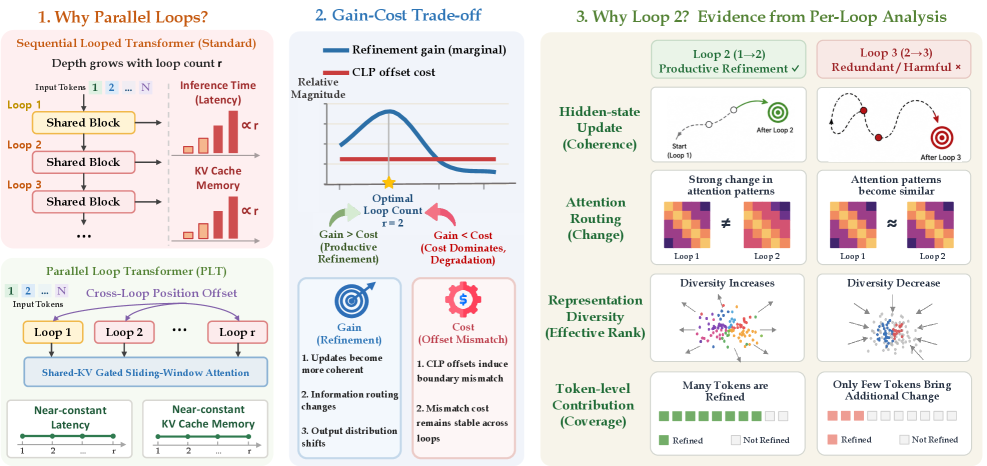
    Modern language models can refine their reasoning by looping back through their own computation, repeatedly applying the same layers to polish an initial answer. In theory, this is powerful. A model that thinks twice should produce better code than one that thinks once. But practice has a stubborn cost: if you loop sequentially, each additional pass multiplies both latency (time to first token) and memory usage (the KV-cache that stores what the model has attended to). For real-time applications, this trade-off is brutal. You gain refinement at the cost of responsiveness.

    This tension sits at the heart of test-time computation scaling. The question isn’t whether models benefit from extra thinking, but how to let them think without breaking latency. Parallel Loop Transformers (PLT) were designed to solve exactly this problem: instead of looping sequentially, run all loops simultaneously on different hardware. Use position offsets to tell the model which iteration it’s in, and add gating mechanisms so the model can decide whether to use fresh computation or rely on what it already learned. In theory, this lets loop count become a design choice rather than something imposed by speed constraints. You could loop 10 times if it helped.

    But should you? That question led researchers to train LoopCoder-v2, a family of 7-billion-parameter code models with loop counts ranging from one to five. What they found was counterintuitive enough to demand explanation: two loops was optimal. Three loops got worse. Not incrementally worse, as diminishing returns would suggest, but genuinely regressed. The model produced worse code despite having more refinement opportunity.

    How parallel looping actually works

    The standard approach to test-time scaling is straightforward: take a transformer layer and apply it repeatedly to the hidden states. Each pass refines the computation, pushing the model’s hidden states through the same learned operations again and again. But if you do this sequentially, you’re blocked. Loop two can’t start until loop one finishes, so latency scales linearly with loop count. The KV-cache, which stores attention patterns from each position, grows proportionally too.

    Parallel Loop Transformers invert this constraint by running all loops in parallel. The trick is telling the model which loop it’s in. This is where cross-loop position offsets (CLP) come in: instead of using the same position indices for every loop, shift them. Loop one uses positions 0, 1, 2… Loop two uses positions N, N+1, N+2… The model learns that different position ranges correspond to different refinement stages. Because loops run simultaneously, latency stays roughly constant regardless of how many you add. Memory cost scales too, but far more gently than sequential looping.

    AIModels.fyi is a reader-supported publication. To receive new posts and support my work, consider becoming a free or paid subscriber.

    The second component is shared-KV gated sliding-window attention (G-SWA). Instead of recomputing everything from scratch in each loop, position-by-position gates decide whether to use fresh computation from the current loop or rely on what was cached from loop one. This is subtle but crucial: it gives the model fine-grained control over when it refines versus when it reuses.

    Together, these mechanisms solve the engineering problem: loop count is no longer constrained by latency. But solving the engineering problem creates a new scientific one. If you can loop 10 times at nearly the same cost as looping twice, why don’t you? That’s the question that defines the rest of the paper.

    Overview of PLT loop-count selection. Left: standard sequential looping increases latency and KV-cache memory with the loop count, whereas PLT uses a cross-loop position offset and shared-KV G-SWA to keep both costs nearly constant.

    Overview of PLT loop-count selection. Left: standard sequential looping increases latency and KV-cache memory with the loop count. Right: PLT uses cross-loop position offsets and shared-KV gated sliding-window attention to keep both costs nearly constant.

    Empirical surprise

    LoopCoder-v2 was trained from scratch on 18 trillion tokens across a family of models with one, two, three, four, and five loops. All models were the same size (7 billion parameters), trained on the same data, and evaluated on the same benchmarks: code generation, code reasoning, and agentic software engineering tasks including SWE-bench Verified and Multi-SWE.


    Read more

  • How Anthropic may have talked itself into an AI export ban

    How Anthropic may have talked itself into an AI export ban

    Anthropic has warned about the dangers of advanced AI far more often than rival OpenAI this year, according to FT analysis, as critics accuse the company of helping to trigger a US ban on foreign access to its newest models.

    Five in every 1,000 words used by Anthropic in 2026 related to risk, regulation, or restrictions, according to FT research that analyzed official statements, social media posts, and articles written by the company or its chief, Dario Amodei. The equivalent figure for OpenAI and Sam Altman was eight times lower, at 0.6 words per 1,000.

    The comparison has become politically charged after Washington last week barred foreign nationals from using Anthropic’s latest models, Mythos and Fable. Some technologists have blamed the decision on the $965 billion AI group’s repeated warnings about AI’s risk to society—particularly in relation to Mythos.

    Read full article

    Comments

  • This former hacker saw the light—and now wants to collect all of it

    This former hacker saw the light—and now wants to collect all of it

    BLUEMONT, Va.—From an overlook in the foothills of the Blue Ridge Mountains, Dan Roelker gazed across the green splendor of the Shenandoah Valley. With the pleasant spring afternoon drawing toward evening, the Sun lazily crossed the sky, casting light all around.

    The pleasing environs had put Roelker, who was drinking rye whiskey procured from a local distillery called Catoctin Creek, in an expansive mood to talk about one of his favorite subjects, light.

    “If you can control light, you can control space,” he said. “So it’s basically a race for who is collecting the most light.”

    Read full article

    Comments