This week Joseph speaks to Jake Hanrahan, creator of the independent conflict-focused media company Popular Front. They talk all about conflict journalism and how to get your journalism out there when platforms like YouTube make it all that much harder, sometimes.
Listen to the weekly podcast on Apple Podcasts,Spotify, or YouTube. Become a paid subscriber for early access to these interview episodes and to power our journalism.If you become a paid subscriber, check your inbox for an email from our podcast host Transistor for a link to the subscribers-only version! You can also add that subscribers feed to your podcast app of choice and never miss an episode that way. The email should also contain the subscribers-only unlisted YouTube link for the extended video version too. It will also be in the show notes in your podcast player.
Scientists discovered that Heliconius butterflies have evolved an extraordinary lifespan, living several times longer than closely related species. Even more surprising, some show little sign of physical decline as they age. Their unusual pollen-feeding lifestyle may play a role, but the research suggests deeper evolutionary changes are also helping them stay healthy for longer.
A colossal ancient collision may have left some of the Moon’s deepest secrets surprisingly close to future Artemis landing sites. By recreating the impact that formed the giant South Pole-Aitken basin—the Moon’s largest and oldest crater—scientists found that a low-angle strike from a large, iron-cored object blasted material from deep inside the Moon, including mantle rocks.
Earlier this year, an Alaskan assembly member found himself in hot water for introducing a resolution that would have prohibited the Matanuska-Susitna Borough Public Library System from making books and other media available to anyone if deemed “harmful to minors” by the borough manager.
The proposal wasn’t well received. Public records obtained from the Borough Clerk’s Office and shared with 404 Media show that the proposal was wildly unpopular. In emails to assembly members, constituents implored the resolution’s sponsor Michael Bowles to withdraw it, calling it an “audacious and idiotic” attempt at destruction by way of “bureaucratic nightmare.” One constituent likened it to a proposal to “make all libraries children’s libraries.” Another said its adoption could result in countless other books being removed that “are not sexual in nature” but which may contain “passing references to sex or adult themes.”
A week went by before Bowles withdrew the request, seemingly to recalibrate. The Mat-Su Sentinel reported in May that the assembly member introduced and again withdrew a resolution that would have forced the system to pull the book Let’s Talk About It: The Teen’s Guide to Sex, Relationships, and Being a Human from shelves. This teen book has been in the adult section of Mat-Su’s borough-run libraries since 2023 when it was relocated from the teen section following a challenge.
404 Media has obtained records from dozens of public libraries, which include Requests for Reconsideration of Materials forms (RFRs) and official decision letters to challengers, along with draft versions of updated collection development policies. Much has been written in the last five years about the blatant efforts to suppress access to books that could contain any remotely challenging ideas or that deviate even slightly from cis white heterodoxy, but there’s been little talk about what that means from the rest of us. What my reporting confirms is that there are more books intended for children and young adults in adult sections because challengers didn’t believe it was appropriate for children and young adults to read about people of color and/or people who are queer, trans, or both, while also showing that a large-scale reorganization of public library collections is currently underway, that its application varies by state and locality, and that it’s been very hard to measure because it’s totally chaotic.
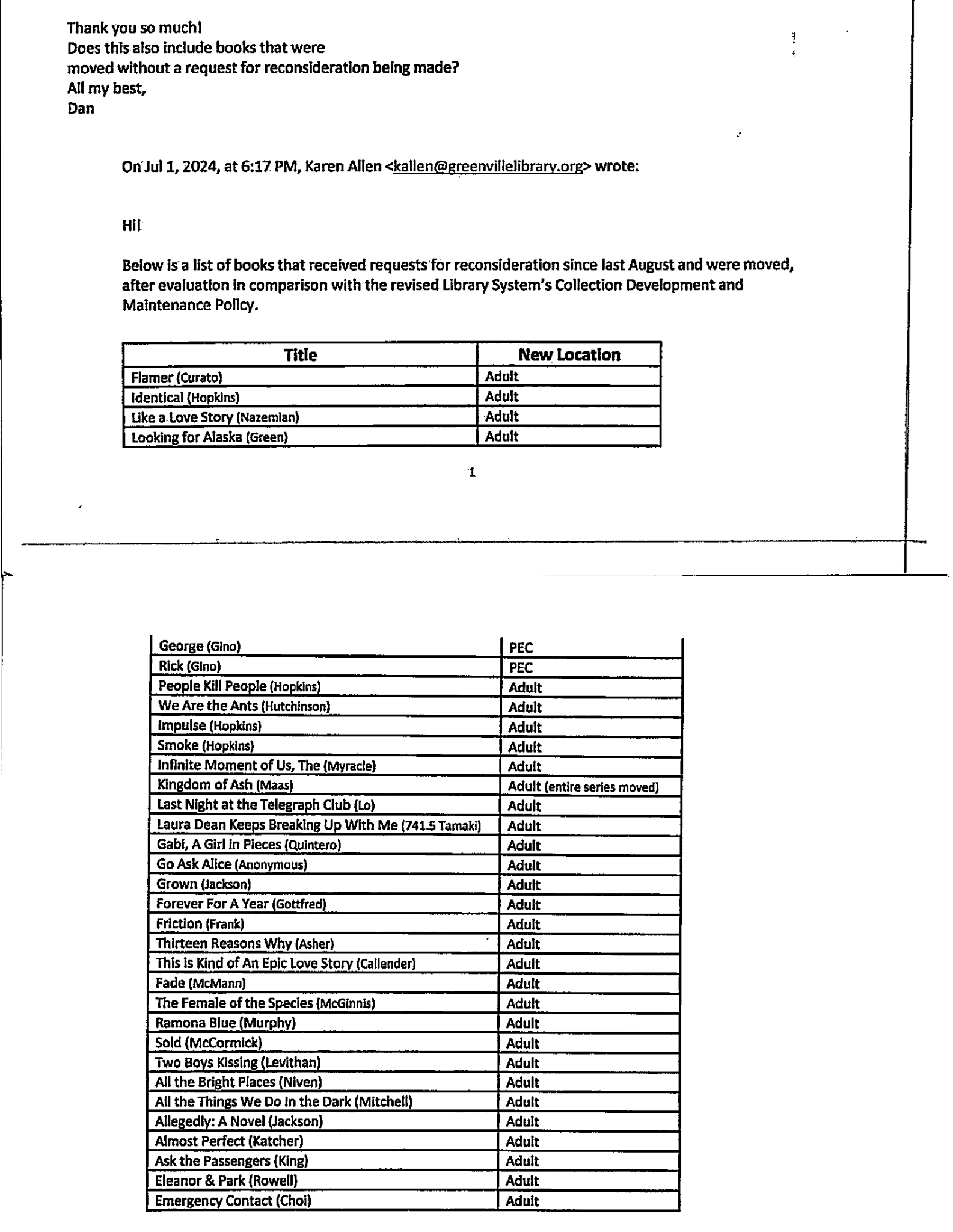
Records obtained from one South Carolina public library system show that between June 2024 and August 2025, more than two dozen young adult books were relocated to the library’s adult section. Before that, the system had already resectioned more than two dozen other YA titles. The ACLU sued Greenville County Public Library System in 2025 for its board-adopted policies from 2024.
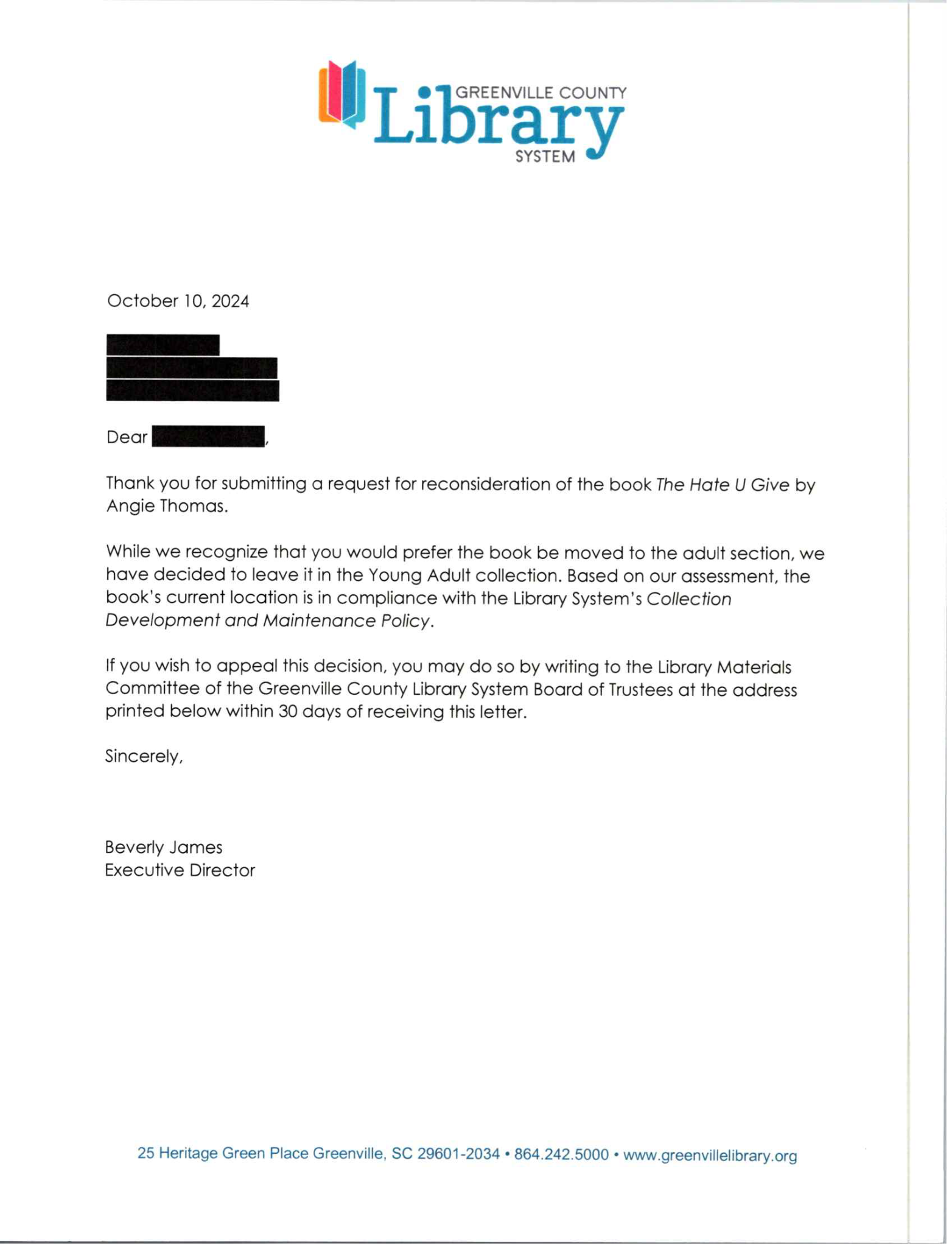
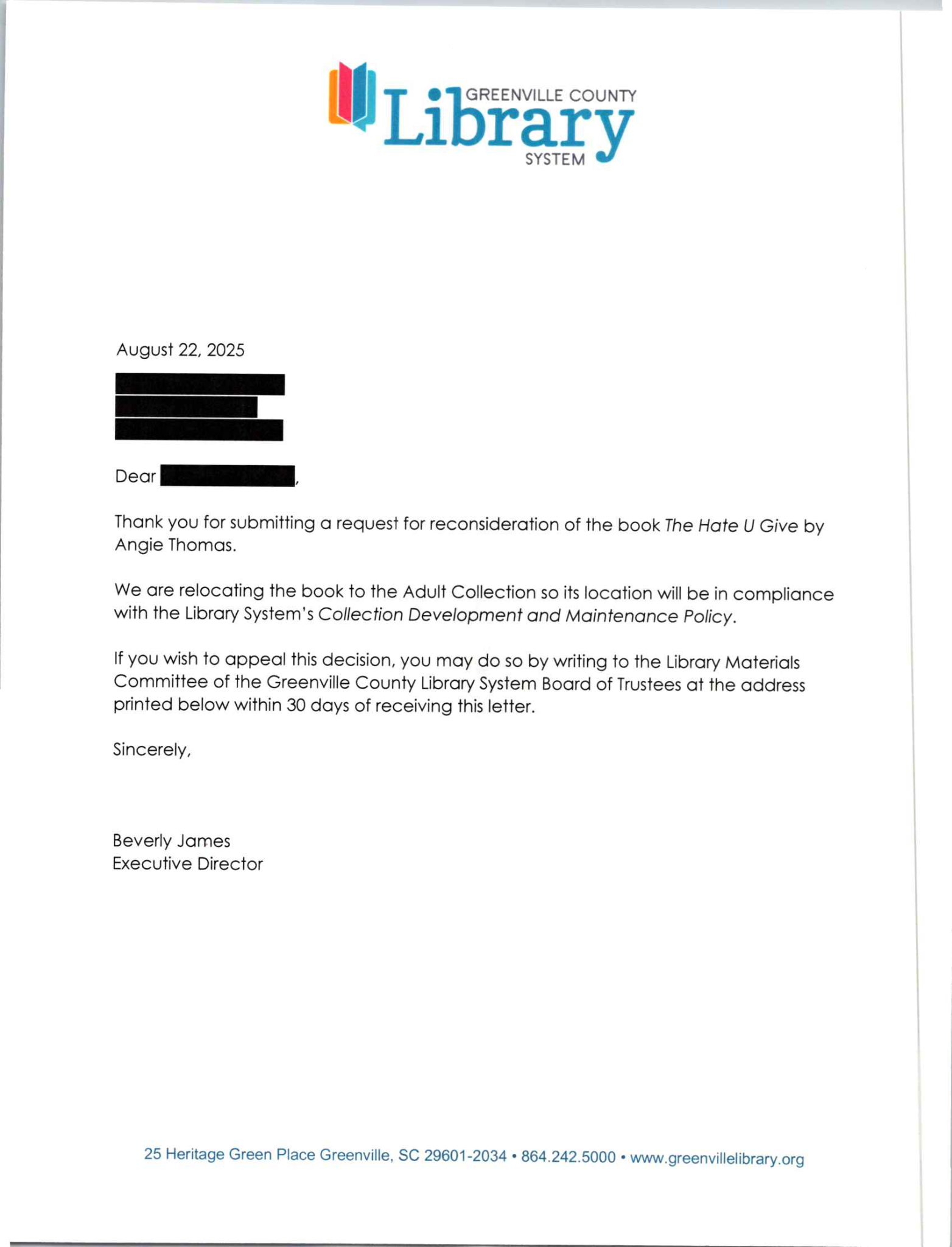
Most letters from the library’s executive director didn’t include any reason for the relocation. However, more recent letters reference the library’s updated collection development policy.
One frequently challenged title caught up in the mix at this library was The Hate U Give a YA book published in 2017 about a teenager who has to witness her friend—an unarmed Black man—be murdered by a police officer during a traffic stop. In 2024 at the Greenville County Public Library System, the book was challenged and retained before, in 2025, the book was again challenged and relocated to the library’s adult section. What happened in between these two events, the library’s board adopted policies making this and other books easier to remove.
The majority of U.S. anti-library laws introduced from 2022 to now have largely focused on school libraries. Only a few states have laws that affect municipal and county public libraries, and so far, most of these efforts have either failed to pass or were struck down by governors. That’s not to say state governments haven’t found other ways to do censorship. As of now, at least two states have mechanisms tying public library funding to content restrictions. One of them happens to be South Carolina, which has a legislative requirement that threatens to strike the system from its budget unless the system certifies with the State Librarian that they don’t keep books in the children, youth or teen sections that could be of “prurient interest” to a 17 year old. A more aggressive version of state library-agency rulemaking comes from Alabama.
In 2024, the Alabama Public Library Service (APLS) amended its administrative code to withhold funding to public libraries that don’t do enough to restrict minors’ access to “sexually explicit” or otherwise “inappropriate” material, and has only continued to broaden its scope since. APLS has since gone on to broaden the criteria for what is “sexually explicit” before adding a provision to treat content dealing with the “concept of more than two biological genders” as inappropriate for youth sections.
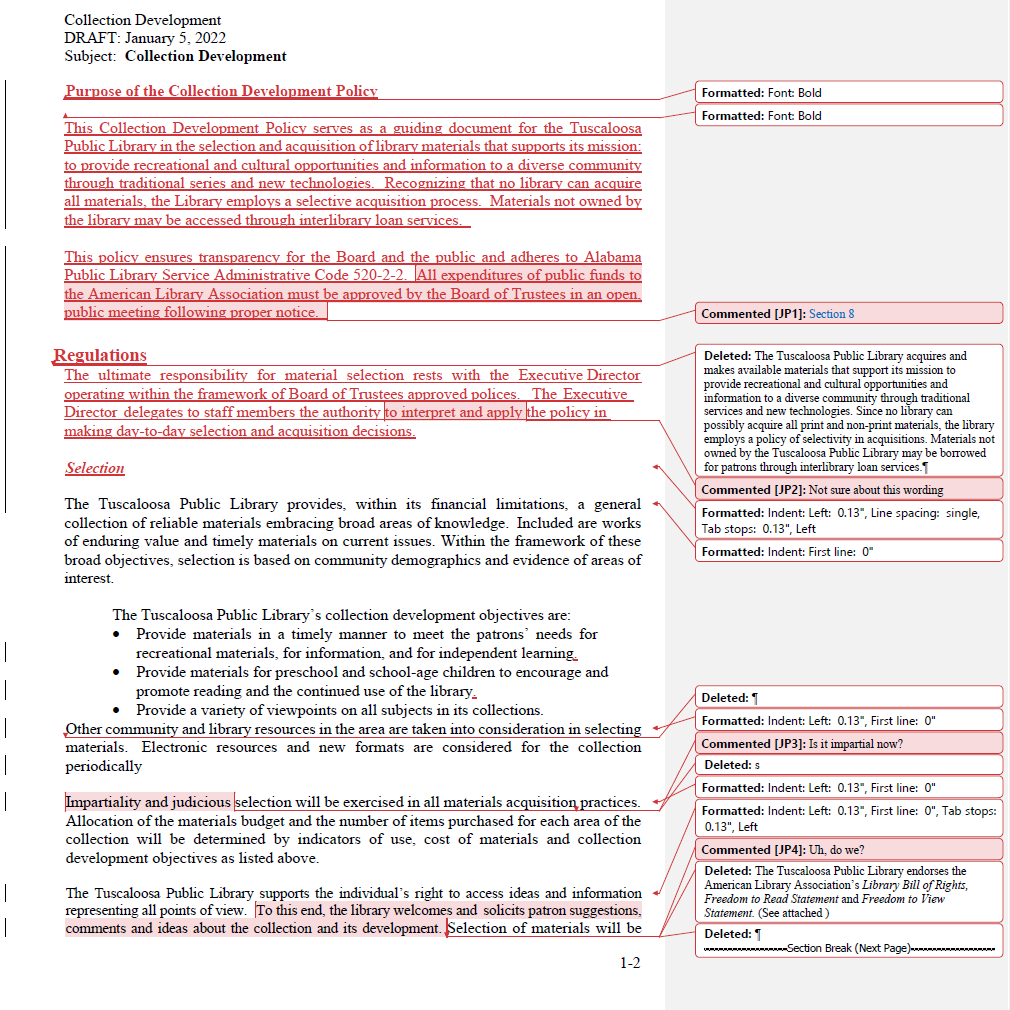
Tuscaloosa Public Library released records to 404 Media in response to a public records request that included tracked edits to the library’s 2025 collection development policy—initially based on a 2022 version—to meet APLS funding requirements. These changes appear to have been accepted. A line about the library welcoming community feedback on collection development, which an editor appeared to question, was also retained.
The motives behind these changes to collection policies and funding incentives raise serious questions about who public libraries are for in America. William Rodick, who researches representation and culturally responsive teaching in Pre-K and primary education for the nonprofit EdTrust, says the mass relocation of diverse books from developmentally appropriate sections of public libraries into adult sections is a form of “intellectual condescension,” or the idea that young people aren’t capable of dealing with hard topics through literature.
“That becomes manifest by removing opportunities for demonstrating honesty for students,” Rodick told 404 Media.
Rodick says that students already have disproportionate access to spaces outside of classrooms where students can access reading materials. Regardless of where they’re getting their books, students of color and students who are LGBTQ+ aren’t presented in the majority of the books they do have access to—much less so now than just a few years ago.
“And when they are presented, quite often those representations are stereotypes through really negative portrayals that are certainly not going to use the kind of motivation students need to engage with reading,” Rodick said. “The fear that I have is that at some point, we are going to see even greater disparity in outcomes than we already do for literary rates because of perpetual inaccess to quality materials.”
Nadja Young is chief brand officer with MetaMetrics, the company that developed the widely-adopted Lexile Reading Framework because it measures both reader ability and text complexity to match readers with books that are appropriately challenging. She says the focus for upper grades in high school is really about vocabulary in contexts that are authentic.
“Reading whole books absolutely helps to build that stamina,” Young told 404 Media.
There are, of course, other factors to weigh when making widesweeping generalizations about literacy rates in adults. Young notes that adults with dyslexia, neurodivergence, and English language learners have historically and continue to have difficulty finding books they can parse that also honor their maturity and intellect. Lexile only measures a text’s complexity, not the content or themes a book contains. And yet, books are being relocated based on content or theme. Whether text complexity is an afterthought or conflated with content or theme is only something the most prolific censors can know.
“I don’t think we could take the stance that it’s going to bring the population up or down because as long as these books are still in the library somewhere, people can find them and the librarians can help direct them,” Young added.
Tasslyn Magnussun, an independent researcher and consultant with organizations like PEN America and EveryLibrary was an early chronicler of the current rise of modern-day book banning. She says book relocation in public libraries is really just a roundabout way of eliminating diverse representation from children’s literature entirely.
“We may end up with collections that have weird pockets of literature in them, but I think the more likely scenario is the books won’t circulate,” Magnussun told 404 Media.
When library books don’t circulate, they’re more likely to get weeded so the library can circulate new titles based on their collection policies. Collection policies, however, are being rewritten across the country to eliminate intellectual freedom and privacy for minors by targeting titles that can fit into a broad category called “sexually explicit,” which is synonymous with “harmful to minors.” This, Magnussun says, prompts publishers to argue that books with same-sex couples, transgender protagonists and people of color encountering racism, brutality—even genocide—don’t sell, because libraries are getting rid of them.
Where the hypothesis holds up, Magnussun said, is that a young person’s constitutional right to access information is dependent on where they live and whether the adults in their lives recognize them as having free will or not. For adult sections of libraries, a disproportionate number of young adults will need some form of parental permission to check out books that deal with sensitive subjects that, like it or not, teens deal with.
Unfortunately, the modern-day parental rights movement is predicated on a belief that children are the property of their parents, and therefore parents, “should be able to do anything they want to them,” including restricting their right to read and explore their interests to their fullest potential. Instead, Magnussun says, adults are blocking children from accessing developmentally appropriate material in instances that deal with sensitive subject matter. She takes YA books that grapple with hard topics, like suicide and child sexual abuse as examples, as these are issues censors frequently cite in RFRs for why a book should be relocated.
The illusion of control is obviously not working and will have devastating consequences for the rest of us, which people do not want and vehemently reject. This means the answer likely lies somewhere between meeting your kids where they’re at, even when where they’re at bears no resemblance to the Devil You Know. Which is scary and sucks, but that’s also what parenting is, and which a lot of parents don’t seem to get.
“We talk about parents’ rights, but what we really need is parent remedial education,” Magnussun added.
A photograph of Earth glowing in deep space, the Moon’s cratered horizon stretching across its foreground, caught many people’s eyes in April 2026. Astronauts captured the image while aboard NASA’s Artemis II mission, and like the famous Apollo 8 “Earthrise” image, the picture felt instantly real and inspiring for many.
But when almost anyone can fabricate a visually similar image in seconds from a text prompt using artificial intelligence, how do people decide which image is real?
The proliferation of AI-generated science images in public spaces is not simply a misinformation problem. As a researcher who studies visual science communication and public trust, I believe it also contributes to a crisis of trust in science in the age of AI, and the tools scientists have long relied on to establish visual credibility are losing their grip.
While AI can help scientists communicate complicated ideas more creatively and efficiently, these same tools blur the lines between illustration, enhancement and fabrication.
Academic publishers are beginning to adopt AI-detection tools. However, systems designed to detect fake images will almost always lag behind systems designed to create them. Many detectors can identify only image patterns they were trained to recognize. As new AI models emerge, developers must constantly obtain new data and retrain detectors to catch up.
For decades, scientific images carried authority partly because they were difficult to produce. Creating microscope images, climate graphs and space photographs required expensive equipment, institutional resources and specialized expertise. Most people assumed such images represented true observations because very few people could make them.
Today, anyone can create a polished, scientific-looking image from a text prompt. Images are also detached from their original source when circulating online. When visual quality and institutional attribution become unreliable cues for judging the credibility of science images, people tend to fall back on something else: their own prior beliefs.
This image of the Earth taken from the Artemis II mission in April 2026 is very much real. Does everyone believe it? NASA
As a result, authentic scientific images that challenge someone’s existing beliefs can now be dismissed as AI-generated, whereas fabricated images that confirm them are easily accepted as evidence. AI, in this way, may amplify motivated reasoning – that is, people’s tendency to accept what they already agree with and question what they do not.
If audiences stop trusting visual evidence altogether, science loses one of its most powerful tools for public communication.
Transparency, not restriction
AI tools offer real benefits for researchers communicating their work to diverse audiences. The challenge is using these tools without quietly transferring AI’s credibility deficit onto the science the images are meant to convey.
One practical path forward is for researchers to treat image provenance – where an image came from and how it was created – with the same seriousness they already apply to data provenance.
Scientists routinely disclose funding resources, study methodologies and conflicts of interest. Similar standards may now be necessary for scientific images. Was AI used to generate or modify this image? Is it a direct observation, a simulation or an illustration? What exactly does the image represent, and how was it verified? Can it be replicated by other researchers?
A particularly inaccurate scientific image of a rat that was published in a journal went viral.
My colleagues and I found that people’s familiarity with AI significantly shapes how they judge the credibility of AI-generated visuals. Those familiar with AI tools were more likely to view AI disclosure as a sign of transparency, and some rated clearly labeled AI-generated content as more credible than unlabeled content.
Transparency gives audiences the necessary context to evaluate what they are seeing, but it may not resolve every dispute about how images are made. Responsible use of AI-generated scientific images will require honesty, adherence to professional norms and the collective development of evidence-based standards across fields.
Why authentic images remain powerful
The original Apollo 8 “Earthrise” photograph of 1968 carries significant emotional impact. So do the Artemis II images of 2026.
What makes them meaningful is not simply their beauty. It is their traceable connection to scientific reality. When people look at these photographs of planets, they also know there are astronauts, physical cameras, documented missions and verifiable observations behind the images. In this sense, authenticity is a documented relationship between an image and the world.
In the age of generative AI, scientific institutions can no longer assume audiences will automatically trust their visuals. Trust now depends on transparency, documentation and clear communication about how visual evidence is produced.
Without guidelines and standards, science risks entering a world where every image can be questioned and no image carries inherent credibility.
Nan Li does not work for, consult, own shares in or receive funding from any company or organization that would benefit from this article, and has disclosed no relevant affiliations beyond their academic appointment.
Signal agencies in Australia, the US, the UK, New Zealand and Canada sound alarm after Trump blocks foreign nationals from Anthropic’s Fable AI model
Powerful AI models capable of taking down governments and businesses are mere months away, cyber intelligence agencies for the Five Eyes have warned in a rare joint statement, urging leaders to “act now”.
AI-focused Super Pacs are spending heavily in midterms, and nearly half has gone to a single Manhattan district race
The artificial intelligence industry is spending heavily in the 2026 midterms, hoping to secure influence over the technology’s first generation of legislation – and New York City’s primary has emerged as the key battleground.
AI-focused Super Pacs have raised roughly $100m this cycle, of which $44m has been spent so far, in dozens of congressional races across the country. Nearly half of all spending has converged on a single Manhattan race: Tuesday’s Democratic primary in the district of NY-12.
Will Craft and Andrew Witherspoon contributed reporting
AI Control Tower delivers runtime Trust Posture Management for agentic AI on HPE Private Cloud AI
Trustwise, a provider of runtime AI control through Trust Posture Management, today announced it has joined the HPE Unleash AI partner program. Now, customers leveraging HPE’s portfolio of integrated AI solutions can control, enforce, and verify AI behavior at runtime across models, agents, and workflows with the Trustwise AI Control Tower running on HPE Private Cloud AI.
Trustwise will deliver enterprise-grade runtime control for agentic and generative AI systems, leveraging HPE’s AI ecosystem and infrastructure portfolio to help organizations rapidly identify and operationalize high-value AI use cases while reducing deployment complexity and risk. This enables customers to access AI-ready infrastructure, strategic guidance, and accelerated pilot execution to address their most challenging AI adoption and operationalization needs.
Customers in financial services, healthcare, public sector, and other regulated environments can now discover, evaluate, and control AI behavior at the moment of inference and action, with every agent and every group of agents operating within defined risk and policy boundaries.
Lack of Agentic AI Trust Is Now a Deployment Blocker
Agentic AI is the first technology where the system can independently take action, spend money, and create liability on the enterprise’s behalf. Without runtime control, off-policy behavior, unauthorized tool use, hallucinations, prompt injection, and drift stop being research problems and become board-level financial, regulatory, and reputational risks.
The HPE Unleash AI partner program is a curated ecosystem, combining ISV solutions that go through comprehensive validation testing with engineered HPE AI systems, including HPE Private Cloud AI and the broader HPE AI Factory with NVIDIA solutions, to deliver the performance, security, and scalability enterprises need for production AI. By joining the program, Trustwise provides the runtime control layer enterprises need to deploy agentic AI safely at scale, controlling every prompt, tool call, and agent decision as it happens and producing the audit-grade evidence required for internal risk committees and external regulators.
“Enterprises are moving rapidly from AI pilots to production deployments, and control is now the gating factor,” said Gina Carfagno, Chief Revenue Officer, Trustwise. “With Trustwise AI Control Tower on HPE Private Cloud AI, organizations gain real-time Trust Posture Management across every model, agent, and action, giving them the confidence to deploy agentic AI at scale.”
Trustwise AI Control Tower on HPE Private Cloud AI delivers a set of capabilities critical to scaling AI in production. Customers can:
Enforce runtime controls for agentic and generative AI, applying safety, compliance, and cost policies at the moment of inference and action
Discover and classify agents, cataloging AI systems and assessing their risk posture against frameworks including the NIST AI Risk Management Framework, the OWASP Top 10 for Agentic AI, the EU AI Act, and ISO 42001
Evaluate and red team models and agents before and after deployment
Apply runtime guardrails that block unsafe outputs, prompt injections, and policy violations in real time
Monitor performance and behavior continuously for drift over time
Generate the governance and audit evidence required by internal committees and external regulators
These capabilities map directly to 17 global AI security, regulatory, and risk management frameworks. Trustwise AI Control Tower is deployed today across Global 500 enterprises and delivers measurable outcomes at production scale, including more than 90%1 alignment of AI system behavior with enterprise policy, more than 25%2 reduction in AI operating costs, and up to 64%3 reduction in the carbon footprint of AI workloads.
To accelerate adoption on HPE Private Cloud AI, Trustwise offers Forge AI, a production-grade evaluation environment that is cloud, model, and agent framework agnostic. With Forge AI, enterprises validate use cases against their own data and policies; test risk, control, and compliance requirements in real conditions; and shift to production with runtime enforcement in place from day one.
“The Unleash AI program is designed to empower innovative software providers like Trustwise to speed and simplify AI deployment for our customers,” said Robin Braun, Vice President of AI Business Development, Hybrid Cloud, HPE. “By adding runtime control and enforcement to HPE Private Cloud AI, Trustwise gives enterprises the confidence to operationalize agentic AI in regulated environments.”
Ketch earns 22 badges across 41 reports, including top honors in Privacy, Consent Management, Cookie Tracking, and Data Subject Requests
Ketch, the AI Privacy Company, today shared it has been named a Leader by G2, the world’s largest and most trusted data source on B2B software, in its Summer 2026 Reports.
Ketch earned 22 badges across 41 reports, including Momentum Leader designation in the categories of Consent Management Platforms (CMP), Data Privacy Management, Cookie Tracking, and Data Subject Access Request (DSAR), reflecting platform excellence and increasing migration to Ketch from legacy privacy tech.
Ketch has seen exponential growth among enterprise customers, with accelerating adoption across retail, media, and financial services — industries where permissioned, AI-ready data is a competitive requirement.
From an Enterprise Customer G2 Review: “I love Ketch for its ease of use, incredible scalability, and rapid implementation. The ability to seamlessly layer across all platforms like Web, Mobile, CTV, and OTT gives us a unified view of the customer. I’m impressed with how it really understands our industry needs, allowing us to deploy across multiple platforms in just a few days. The initial setup was very easy, and we got our pilot sites up within a few hours.”
“We’re so grateful to our customers for sharing their experiences on G2,” said Maxwell Anderson, Co-founder and Head of Product at Ketch. “What they consistently highlight — deep integrations, end-to-end automation, and world-class support — is the foundation we’ve built deliberately. As data becomes the fuel for AI across every business, the companies that win will be the ones that get permissioning and governance right. That’s exactly what Ketch is here to do.”
Ketch’s standout performance includes Grid Leader designations across core privacy categories:
Grid Leader – Data Subject Access Request (DSAR) (Overall)
Additional awards include:
Best Usability – CMP (Enterprise)
Best Meets Requirements – CMP (Enterprise)
Best Results – CMP (Enterprise)
Best Relationship – CMP, DSAR (Enterprise, Overall)
Best Support – CMP (Enterprise, Small Business)
Easiest To Do Business With – CMP (Small Business)
High Performer – Sensitive Data Discovery (Overall)
High Performer – Cookie Tracking (Overall)
These distinctions are based entirely on authentic customer reviews and market presence data gathered by G2.
“Earning a Leader position in a G2 Report is highly competitive and rooted in verified customer reviews,” said Godard Abel, co-founder and CEO, G2. “Congratulations to Ketch for achieving this distinction. Buyers can be confident this ranking reflects the authentic experiences of real users.”
To see why customers are choosing Ketch, read their reviews on G2: https://www.g2.com/products/ketch/reviews
The new model combines virtual assistant support, zero-cost customized CRM (Customer Relationship Management) application, zero-cost website, and operational workflows for entrepreneurs building serious businesses before they can hire full internal teams.
Affordable Virtual Assistant, owned by Maandukya Corporation, today introduced its Solopreneur Operating System, a business support model designed for mompreneurs, influencerpreneurs, gradpreneurs, and solo founders who need more than task delegation. The model brings together trained virtual assistant support, CRM organization, website presence, lead follow-up, and operational workflows to help solo entrepreneurs operate with the structure of a growing company.
Affordable Virtual Assistant ecosystem for startups, mompreneurs, entrepreneurs, gradpreneurs and influencerpreneurs.
The announcement comes as entrepreneurship continues to shift toward a more personal, digital, creator-led and solo-driven economy. Across the country, founders are building businesses from home offices, kitchen tables, college campuses, content platforms, and side hustles. Yet many of these entrepreneurs are still running their businesses through inboxes, spreadsheets, direct messages, and memory.
Affordable Virtual Assistant is addressing that gap by giving solo founders an affordable operating layer before they are ready to build an internal team. The company’s model is designed to help entrepreneurs organize customer records, follow up with leads, manage administrative tasks, improve scheduling, support website needs and create repeatable workflows.
“Solo founders are not short on ambition,” said Varun Khanna, Founder of Affordable Virtual Assistant. “They are short on operational capacity. The market has plenty of virtual assistant providers selling hours. We built Affordable Virtual Assistant to give entrepreneurs their first operating layer — the people, custom and affordable technology systems, and follow-up automations that they need to run like a real company before they can afford to hire a full team.”
The need for this type of support is growing as new founder segments reshape small business ownership. Women-owned businesses now represent a major share of the U.S. business landscape and generate trillions in annual revenue. Younger founders are also entering entrepreneurship at high rates, while creator-led and solo businesses continue to turn personal brands, services, content and digital products into real companies.
Affordable Virtual Assistant’s Solopreneur Operating System is built for this new founder class:
Mompreneurs who are balancing family, business growth, customer communication, scheduling, marketing, operations, and daily administrative demands.
Influencerpreneurs who are turning content, audience attention, brand partnerships, affiliate income, digital products and services into businesses that require systems behind the scenes.
Gradpreneurs who are launching ventures earlier and need affordable support with research, organization, outreach, follow-up and digital presence.
Solopreneurs who are managing sales, service delivery, admin, CRM updates, customer communication and online visibility without a team.
Unlike traditional virtual assistant companies that focus primarily on completing hourly tasks, Affordable Virtual Assistant positions its service as a business support ecosystem. The company’s approach combines people, process and practical technology tools so founders can move from scattered daily activity to a more consistent operating rhythm.
“Entrepreneurs are constantly told to start, scale and build their brands, but many are still operating without the basic technology and AI infrastructure that larger companies take for granted,” added Varun Khanna. “The next evolution of virtual assistance is not just performing tasks. It is helping founders create operating consistency using affordable customized technology and AI to scale.”
Affordable Virtual Assistant’s model includes virtual assistant support, CRM assistance, lead follow-up, administrative help and website support, with transparent monthly plans designed to make structured business support accessible before founders are ready to hire internally.
For mompreneurs, that can mean support with inboxes, scheduling, customer records and follow-up while protecting time for family and growth. For influencerpreneurs, it can mean organizing brand inquiries, content administration, CRM updates and business opportunities. For gradpreneurs and young founders, it can mean having a first support system before they are ready to make a first hire. For solopreneurs, it can mean moving from hustle to a more organized and scalable business foundation.
The company’s message to the market is clear: virtual assistance should not be limited to busywork. For today’s solo founder, the right support system can become the bridge between ambition and operational growth.
Affordable Virtual Assistant serves early-stage business owners, coaches, consultants, creators, local service providers, online sellers, startup founders and professionals who need reliable support without the cost of building a full internal team.
For more information, visit AffordableVirtualAssistant.com.