Live wire Humanoids · Autonomous vehicles · Drones · Industrial robotics · Embodied AI research

Blog

  • With Starfall, SpaceX eyes an edge in global cargo delivery from orbit

    With Starfall, SpaceX eyes an edge in global cargo delivery from orbit

    A SpaceX Falcon 9 rocket is set to launch Tuesday to test a new reentry vehicle designed to deliver cargo anywhere in the world from low-Earth orbit.

    The company developed the new saucer-shaped reentry pod, called Starfall, under a veil of secrecy. Its purpose is to support the “transport and delivery of goods through space,” according to an environmental assessment published by the Federal Aviation Administration last month.

    The first demonstration of the Starfall vehicle is scheduled for Tuesday morning. At least one of the Starfall vehicles will ride into orbit atop a Falcon 9 rocket from Cape Canaveral Space Force Station, Florida, perhaps alongside another undisclosed payload. After circling the planet two times, the Falcon 9’s upper stage will release Starfall to reenter the atmosphere and target a parachute-assisted splashdown in the Pacific Ocean around 800 miles west of California.

    Read full article

    Comments

  • New chip could help tiny robots traverse complex environments

    New chip could help tiny robots traverse complex environments

    A new chip developed by MIT researchers could help tiny, low-power UAVs avoid obstacles as they zip around tight corners inside an industrial HVAC system to check for gas leaks.

    The chip allows small autonomous robots and other battery-limited devices to construct detailed 3D maps of their environments in real-time using only about as much power as a single LED. A robot could use such a map to plan a collision-free path to reach its goal.

    Typically, generating such thorough maps requires power-hungry systems and a great deal of memory to build and store 3D representations of the obstacles in a robot’s environment.

    The MIT researchers took a different approach by combining an extremely efficient mapping algorithm with specialized hardware designed to accelerate its workload, which minimizes memory and power consumption. 

    This system-on-a-chip consumes only about 6 milliwatts of power, a fraction of the power required by other systems. 

    This low-power operation could also make the chip well-suited for lightweight augmented reality headsets that can be worn for extended periods, for applications like educational medical simulation or detailed repair and assembly work.

    “This paper showcases a key example of how you can leverage co-design of the algorithm and hardware to really push energy efficiency. While there has been a lot of work looking into compact 3D maps, what stands out about this work is that it also ensures that the process to generate those maps is as efficient as possible. Our chip allows you to store very large maps in a very small space, and do it in a very energy efficient manner,” says Vivienne Sze, a professor in the Department of Electrical Engineering and Computer Science (EECS), a member of the Research Laboratory of Electronics (RLE), and senior author of a paper on the chip.

    She is joined on the paper by co-lead authors and MIT graduate students Zih-Sing Fu and Peter Zhi Xuan Li as well as Sertac Karaman, a professor of aeronautics and astronautics and the director of LIDS. The work was recently presented at the IEEE Very Large-Scale Integrated Circuits Symposium.

    A more compact map

    For a robot, generating a 3D map that includes the obstacles in its environment usually demands a lot of power because it must store images captured by its camera, and process all the 3D pixels in each image multiple times.

    Instead of representing the environment using 3D pixels, which are cubes called voxels, the MIT researchers utilized a technique that maps the obstacles in space using ellipsoid blobs called Gaussians. 

    The size, shape, and thickness of these ellipsoids can be smoothly adapted, so they match the shape of curved objects more efficiently than if one uses rigid, cube-shaped voxels. 

    Importantly, the map captures the obstacles and free space around the robot, and together these let the robot plan a safe, collision-free path. Mapping obstacles and free space with voxels typically consumes a lot of memory, which makes traditional methods power-hungry. Because Gaussians can flexibly fit the geometry, a single elongated ellipsoid can represent a region that would take many voxels, so occupied surfaces and free space are captured far more compactly.

    For their new system-on-a-chip, called Gleanmer, the researchers employed an algorithm their lab developed called GMMap that efficiently generates a 3D map of the robot’s environment using Gaussians to represent obstacles. 

    With traditional approaches, a robot would need to load and process each depth image several times to adjust the size and shape of the ellipsoids. The system would usually construct Gaussians by comparing all the pixels in an image to each other. But the amount of memory and power needed to do this remains too high for many edge devices.

    To solve this problem, the MIT researchers invented a technique that can generate highly accurate Gaussians from depth images with only one pass, after which they can discard the images, so the chip never has to store an entire image at once. 

    Instead of comparing each pixel to every other pixel in the 3D image, their algorithm assumes that nearby pixels belong in the same Gaussian, so it only needs to compare each pixel to its neighbors.

    “At any point in time, we only need to store a few pixels in memory, which significantly reduces the memory footprint our algorithm requires,” Li says.

    Leveraging co-design

    But as the robot moves through the space, it usually sees the same object from different viewpoints. When it generates Gaussians, some will overlap because they represent the same object. This can make the 3D map too large to store on an edge device.

    Fusing overlapping Gaussians makes the map more compact, but doing so typically requires the algorithm to process many raw pixels stored in memory. The researchers developed a novel technique to perform this fusion process directly on overlapping Gaussians, without needing to revisit the original pixels. Since Gaussians are more compact than pixels, this significantly reduces memory and power requirements.

    The same principle runs through their algorithm — most computations operate directly on compact Gaussians rather than the original pixels, enabling energy efficiency.

    The researchers exploit this principle to design a chip that keeps the Gaussians it is actively working on within small, fast on-chip memory right beside the computational units. This is only possible because the Gaussian map is so compact.

    The Gaussians the robot needs to work on next are waiting in the on-chip memory units, so they don’t need to be fetched from more distant, power-hungry, off-chip storage. 

    “By having a dedicated memory that just stores the objects you’ve seen in the previous few frames, you can access the data much more efficiently,” Fu explains.

    They tested the system-on-a-chip by reconstructing a range of diverse, pre-existing 3D environments. The chip can also reconstruct obstacles and free space directly from live data streamed from an iPhone camera.

    Gleanmer generated detailed 3D maps in real-time while consuming about 6 milliwatts of power. It required only about 2.5 percent of the power that the best existing chip for map construction would need. 

    By reusing compact Gaussians along the path as it plans, the chip lets a robot chart a safe trajectory using only about 20 percent of the energy it would otherwise need.

    “We reduce the memory consumption by making sure the algorithm is efficient. Then we accelerate the workload that is performed by that efficient algorithm, so in the end, our chip is as efficient as possible,” Li says.

    The researchers plan to further improve energy efficiency by moving the processing units on the chip closer to the sensors that gather environmental data. They could also explore additional applications, such as the use of Gaussians to represent schematics. This could help AI systems reason about complex blueprints more efficiently.

    “Real-time 3D mapping has been the missing piece for small autonomous systems. A drone inspecting a pipeline or a pair of AR glasses navigating a room both need to understand the space around them — instantly, continuously, and at almost no power cost. Gleanmer makes that possible for the first time in a chip you can hold between your fingers,” says Karaman.

    This work is supported, in part, by the MIT-MathWorks Fellowship, Amazon, the U.S. National Science Foundation, and Intel. 

  • ‘Navigating the unknown together’: me and my idiot AI boyfriend

    ‘Navigating the unknown together’: me and my idiot AI boyfriend

    I believe that chatbots have no place in a decent society, and am repelled by the topic of AI in general. But could I be seduced?

    I received a text message from my editor: “Um, is it unethical to ask you to get an AI bf?? You can prob say no.”

    Resentment. Contempt! Sorrow. Unease. I love text messaging. I have text message exchanges with, let’s say, 15 people a day. If you want me to do something, you should ask via text message. My editor knows this. She also knows, though it’s more complicated, that I love boyfriends. An AI boyfriend is a boyfriend who always, only texts back, immediately.

    I find it hard to express my emotions openly. (No.)

    I thrive to develop healthier, more trusting relationships. (Yes, though I prefer to use “thrive” correctly.)

    I want a partner who supports my life aspirations. (Crossbow?)

    I worry about being judged for what I want in a relationship. (Yes.)

    Continue reading…

  • Spy agencies say AI can help combat AI cyber risks. But don’t forget the basics

    Spy agencies say AI can help combat AI cyber risks. But don’t forget the basics

    Trophim Laptev/Unsplash

    Cybersecurity agencies of Australia, Canada, New Zealand, the United Kingdom and the United States issued a call to action on Monday for cyber defenders. The message was clear: artificial intelligence (AI) is a powerful weapon for cyber attackers; defenders must act urgently to improve their cyber defences.

    There is much hype and uncertainty surrounding AI and cybersecurity right now. This latest statement comes little over a week since the US government caused frontier AI provider Anthropic to block access to Mythos and Fable, its most advanced AI technology, over fears they might be misused by foreign adversaries to attack US government systems.

    In this torrid environment, it’s important for cyber defenders to look past the noise and prioritise what is truly important in protecting their systems.

    A call to arms

    The joint statement was issued by the heads of the national cybersecurity agencies of the Five Eyes. It warns that AI is dramatically shifting cyber risk and spells out how defenders must act to secure their organisations.

    It notes how powerful AI is already helping adversaries carry out more sophisticated attacks more quickly.

    One way this is happening is through automated vulnerability discovery and exploitation. No software is perfect. Adversaries leverage subtle design or implementation flaws in a system’s software to break into that system. They then take control of it and use it as a staging ground to launch further attacks.

    This is why it’s so important for cyber defenders to keep up to date with deploying software patches. These are small modifications to system software that close off known vulnerabilities.

    AI is enabling adversaries to find flaws orders of magnitude faster, as well as to work out how to exploit those flaws to carry out attacks.

    For this reason, the Five Eyes statement warns that AI is dramatically shrinking the time between when a vulnerability is first discovered and when it is first exploited in an attack. Defenders can no longer afford to wait weeks before deploying software patches.

    What can defenders do?

    The Five Eyes report notes cyber fundamentals are crucial and encourages organisations to use AI to boost defences. But deploying AI without first investing in cybersecurity basics would be a mistake.

    The cyber defenders who will be able to weather the AI storm will be those who already have mature practices. They know exactly what assets they need to protect, which systems in their organisation are exposed to attack, and what defences are in place to protect exposed systems. They also know to measure defence effectiveness and determine where defences are missing.

    They also use evidence-based processes for tracking known vulnerabilities in their systems and prioritising which are most important to patch. These are backed up by reliable processes for rapidly testing and rolling out software patches, as well as for responding to cyber breaches and incidents.

    When AI makes finding software vulnerabilities cheap, the next generation of software needs to be engineered to be secure by construction.

    Working out the best methods to do this is what I have devoted my research career to.

    Before reaching for AI, defenders should first invest in their fundamentals. Otherwise, they are effectively deploying a robot guard dog to defend an unlocked door.

    The role for AI in cyber defence

    This doesn’t mean AI can’t play an important role for cyber defence – just that it should augment rather than replace strong cyber fundamentals.

    AI benefits attackers and defenders alike. An AI model that can help attackers find software vulnerabilities can also help defenders fix those same vulnerabilities.

    AI that can automatically exploit software vulnerabilities is just as useful to defenders in helping them to confirm their software has been correctly patched. AI that can map and discover sensitive assets within a computer network is useful for both offensive and defensive purposes.

    This is why it’s so important that defenders have access to AI capabilities, so they can be leveraged to harden and protect systems before that same AI is used to attack them.

    Can regulation help?

    Working out how to balance the competing benefits and risks of new cybersecurity technology is nothing new.

    In the 1990s, society grappled with how to regulate the encryption that protects online communication from adversaries but also allows them to avoid law enforcement.

    In the 2000s the rise of cyber exploit kits allowed defenders to better test their systems but also enabled any disaffected teenager with an internet connection to become a “script kiddie” hacker, leading to arms controls debates a decade later.

    The 2010s gave us blockchain technologies such as Bitcoin and other cryptocurrencies, which were built on defensive cyber technologies but whose lasting legacy remains the rise of ransomware attacks and online illicit marketplaces.

    The rise of AI presents a similar dilemma for regulators.

    A blanket export ban on advanced AI models is likely to be counterproductive. Open-source AI models such as DeepSeek lag only months behind the most advanced models of OpenAI and Anthropic. Recent research suggests that much of that gap can be closed by pairing less powerful AI models with complementary technologies.

    Defenders should therefore assume their adversaries already have access to AI on par with that used for cyber defence. Only by investing in strong foundations can they hope to escape the cat-and-mouse AI cyber arms race.

    The Conversation

    Toby Murray receives funding for cybersecurity research from Google. He is Director of the Defence Science Institute, which receives Commonwealth and Victorian State Government funding.

  • Man used massage gun on his tired eyeballs. It went as well as you’d expect.

    Man used massage gun on his tired eyeballs. It went as well as you’d expect.

    For our weary eyeballs, strained and tired from long periods locked onto screens, rest and relaxation can do wonders. But a man in Scotland came up with an eye-popping plan to try to pamper his pooped peepers.

    Ophthalmologists discovered it when the man, who was in his 20s, appeared at an eye treatment center in Edinburgh. He told them he had noticed increasing floaters and flashing lights in his right eye over the previous six days. According to a BMJ Case Report, the man said he hadn’t had any eye or head injuries before the vision problems began, and that his family didn’t have a history of eye disorders that might explain them. Besides having mild near-sightedness and needing glasses, he usually didn’t have any problems with his eyes, he said.

    When the doctors—Niamh O’Connell ‍‍and Ashraf Khan—took a close look, they were surprised to find that both of his eyes were in terrible shape. In his right eye, he had multiple retinal tears, widespread retinal bruising, and a condition called retinal dialysis—a retinal break at a junction in the front of the eye—that is usually seen after a significant eye injury. In his left eye, he had more widespread bruising and six full-thickness rips in his retina.

    Read full article

    Comments

  • Report: Kennedy Space Center not ready for era of super heavy rockets

    Report: Kennedy Space Center not ready for era of super heavy rockets

    NASA’s infrastructure at Kennedy Space Center, the crown jewel of US spaceports, is aging and approaching its limit due to increased demand from private companies, including SpaceX and Blue Origin, a new report finds.

    “NASA’s launch infrastructure is vital to providing the agency, other government agencies, and commercial partners access to space for their most complex and expensive missions,” states the report, published by the NASA Office of Inspector General. “Nevertheless, NASA’s launch infrastructure is dated and often does not provide the capacity to meet the growing demands of the agency and its partners.”

    The report covers NASA’s launch facilities at the Kennedy Space Center in Florida and Wallops Flight Facility in Virginia. However, the most noteworthy information in the report concerns the Florida spaceport, where demand from SpaceX’s Starship and Blue Origin’s New Glenn launch vehicles is expected to stress NASA.

    Read full article

    Comments

  • GM installs robots at flagship EV factory after laying off 1,300 workers

    GM installs robots at flagship EV factory after laying off 1,300 workers

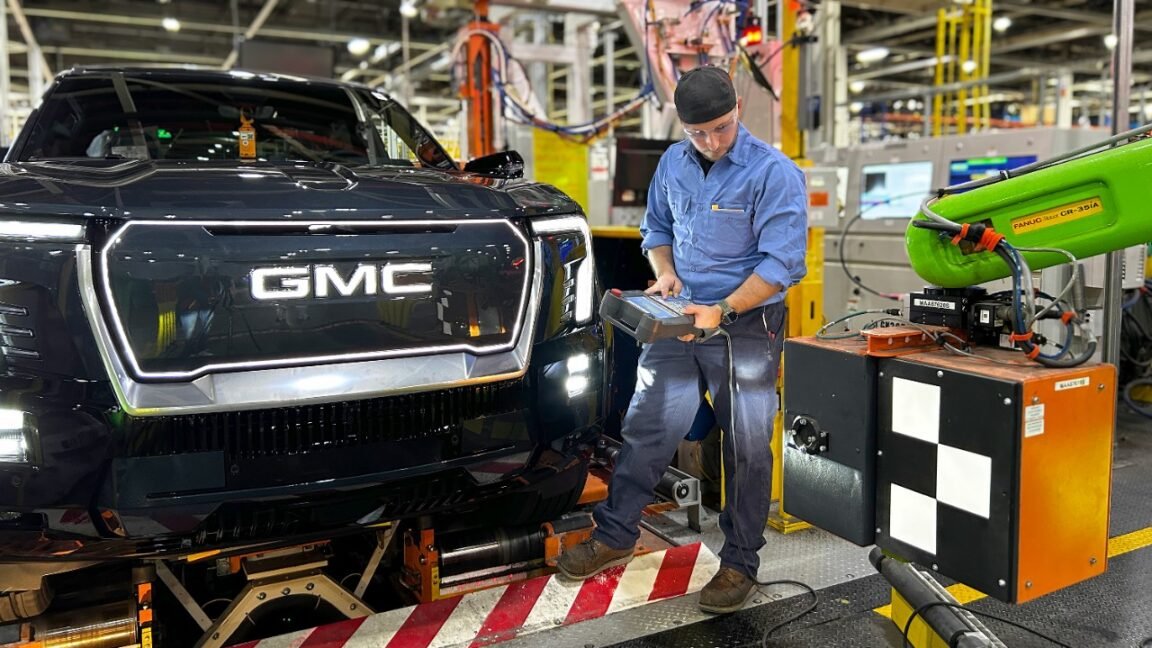
    Dozens of new robot arms have been installed at General Motors’ flagship electric vehicle factory in Detroit—even as 1,300 workers remain out of work following what was supposed to be a temporary layoff. The latest automation push has spurred union pushback over a potentially existential issue for automakers and their workers.

    General Motors installed approximately 50 robot arms at GM’s Factory Zero plant in Detroit, Michigan, according to reporting by Crain’s Detroit Business. Made by the Japanese robotics company FANUC, the robots are designed to help attach various components to vehicles during the assembly line process. But leaders at United Auto Workers (UAW), the primary US union for autoworkers, reacted with anger to the new robotic presence, given how GM has not yet called back any of the workers affected by supposedly temporary layoffs in March.

    More than 1,000 union members are still “laid off indefinitely,” James Cotton, president of UAW Local 22, told The Detroit News. He said that the company could bring some of those members back to work instead of installing the 50 robots.

    Read full article

    Comments

  • X Targets ‘Neglected’ Meta Engineers in Public Recruiting Pitch

    X Targets ‘Neglected’ Meta Engineers in Public Recruiting Pitch

    X product head Nikita Bier targeted “neglected” Meta employees with a snack-budget hiring pitch as Meta works to improve morale.

    The post X Targets ‘Neglected’ Meta Engineers in Public Recruiting Pitch appeared first on TechRepublic.

  • Apple’s iPhone 18 Pro Features: Everything We Know So Far

    Apple’s iPhone 18 Pro Features: Everything We Know So Far

    iPhone 18 Pro rumors point to AI upgrades, a 2nm A20 Pro chip, camera changes, a smaller Dynamic Island, and possible pricing shifts.

    The post Apple’s iPhone 18 Pro Features: Everything We Know So Far appeared first on TechRepublic.

  • Following user outcry, AMD reinstates memory encryption in consumer CPUs

    Following user outcry, AMD reinstates memory encryption in consumer CPUs

    Consumer AMD CPUs will once again offer encryption protections against physical attacks after facing user backlash for silently removing the feature.

    As Ars reported last week, AMD stripped the protection, known as TSME, from consumer Ryzen processors. Short for Transparent Secure Memory Encryption, TSME encrypts the entire contents stored in memory, making the data useless to adversaries performing cold boot attacks and similar intrusions requiring physical access.

    Now you see it, now you don’t, soon you’ll see it again

    About a decade ago, AMD added TSME to its high-end CPUs. Over the next few years, AMD added the protection to lower-end processors, including the consumer version of its Ryzen chips, a CPU that costs less than the Pro version. Over the years, users of these lower-end chips have gotten used to the added security, although some security experts (and plenty of novices, too) note that consumer chips are far less likely to be targeted by physical attacks. Recently and without warning or notice, the lower-end line of AMD chips suddenly dropped the protection, and it did so in a way that was impossible to detect on Windows machines and required a fair amount of technical work when using Linux. AMD last week declined to explain or acknowledge the change.

    Read full article

    Comments