Boston Dynamics refreshes Stretch, John Deere buys into orchard AI, and France lines up autonomous-driving partners. Here’s what mattered in physical AI over the past day.
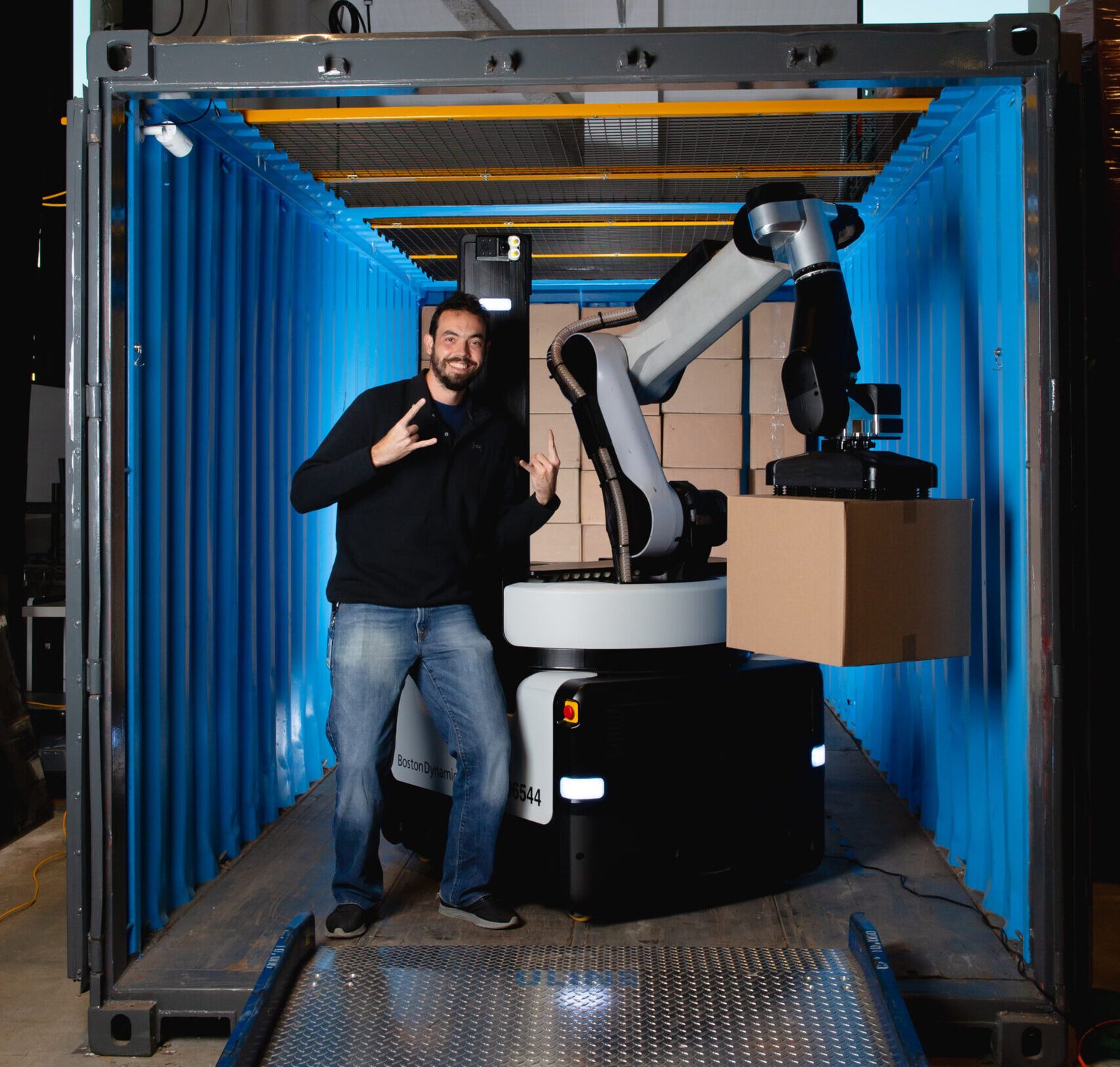
1. Boston Dynamics unveils Stretch Gen 2 trailer-unloading robot
Boston Dynamics introduced the second generation of Stretch, its autonomous mobile robot for unloading trailers. The company says the new version adds hardware and structural changes, drawn from first-generation deployments, aimed at more uptime and simpler maintenance in high-volume logistics sites.
Why it matters: Truck unloading is one of the heavier, more repetitive warehouse jobs, and reliability is usually the deciding factor for customers scaling a robot beyond a pilot.
2. John Deere acquires Orchard AI
John Deere is buying Orchard Robotics, a San Francisco company operating as Orchard AI that builds crop-intelligence tools for growers of high-value crops. Deere says the plant-level crop data will help growers make decisions across the season.
Why it matters: The deal brings plant-level perception and data into one of the largest farm-equipment makers, extending its precision-agriculture tools toward orchards and other high-value crops.
3. Wayve, Stellantis and Nvidia team up with France on autonomous driving
Wayve, Stellantis and Nvidia announced a collaboration with the French government to speed the development and rollout of autonomous vehicles in France, with an eye to wider EU adoption. The initiative pairs Wayve’s AI Driver software with Stellantis vehicles that the company describes as Level 4-ready.
Why it matters: Government backing alongside a major automaker could give France a clearer regulatory and commercial path for self-driving deployment. Track the field on our robotaxi tracker.
4. FCC adopts drone spectrum order 3-0
The FCC unanimously adopted its drone order covering the 450 MHz, 24 GHz and 800 MHz bands. Trusty said the final version clarifies that drones can use 800 MHz; the full text has not yet been released.
Why it matters: Dedicated spectrum is a building block for longer-range and beyond-visual-line-of-sight drone operations. Yesterday’s brief previewed this vote; the order’s final text will determine the practical details.
5. Serve Robotics offers its robot software stack to other companies
Serve Robotics launched physical AI Services, making the technology behind its delivery robots available to other robotics developers. The offering covers connecting robots to off-board intelligence, selecting useful training data at fleet scale, and real-world data for foundation models.
Why it matters: It marks a move by a robot operator to also sell infrastructure, betting that fleet data and tooling are valuable to companies that lack their own deployments.
6. Bolt and Stellantis plan autonomous service in Greater Paris from 2028
Bolt, Stellantis and Métropole du Grand Paris plan to start autonomous mobility services in 2028, with a pilot in up to five municipalities and possible expansion to more than 30 by 2030.
Why it matters: Combined with the Wayve announcement, it signals that Stellantis is positioning France as an early testbed for its autonomous vehicle plans.
7. VulcanForms places record order for 200 EOS metal 3D printers
VulcanForms, a digital manufacturer of precision metal parts that spun out of MIT, ordered 200 EOS M4 Onyx metal additive manufacturing systems. EOS says it is the largest single order in its history.
Why it matters: An order of this size points to a large expansion of automated US capacity for precision metal parts.
Quick hits
- inDrive, Pony.ai and Nvidia sign an MoU to explore robotaxi service in Kazakhstan, starting with Astana
- Realbotix introduces two Echo humanoid models for education, wellness and companionship, with deliveries planned for the second half of 2027 (see our humanoid robot tracker)
- London startup Saturn Dynamics is building Arc, a physics-based world model for robot training in simulation
- Knoxville police begin drone-as-first-responder flights from 12 docks, with face and plate recognition barred
- EASA’s annual safety review logs 39 drone accidents and serious incidents in 2025 and no deaths
Get the Daily and Weekly Brief by email — subscribe free. Every item links to our summary and the original reporting. Brief compiled by Physical AI News.
Newsletter
Get the Physical AI brief
The day’s most important robotics and embodied-AI stories, in your inbox.