An eon ago, in the year 2012, an editor at my first job at U.S. News and World Report had the idea that we should have a YouTube channel. It wasn’t a pivot to video, exactly, but it would be a bet on an emerging platform where some creators were beginning to go viral with news content. The idea was to put the journalists in front of the camera and have them talk about their articles and the news of the day. It did not go well.
I was nervous, unconfident, had a bad haircut, and, like everyone in Washington, D.C. then and now, was very unfashionable. I had no media training, had never been on TV or video of any sort. I did not have a smartphone. I was socially awkward and spoke in monotone. I blinked endlessly while I talked and fidgeted like crazy with my hands. I constantly said um, tripped over my words, and generally had no idea what I was doing. We made a series of videos with titles like “Head Injury Studies Continue to Cause Alarm in NFL,” “Are the Politics of Climate Change Shifting?,” and “Which Party Will Get the ‘Internet Vote’?” The videos were poorly edited, sounded weird, and got zero traction.
I did not want to make these videos but it was a newsroom-wide initiative and so I did it anyway. Thankfully and mercifully, almost no one watched any of these videos, because they were bad. Then and now, they are the opposite of what anyone watches on the internet. And yet, these videos were roughly about as good as a series of podcast videos being released by the Washington Post’s new and drastically worsened Opinion section, apparently at great expense to the outlet. They were also about as popular, with many of my videos garnering upwards of several dozen views.
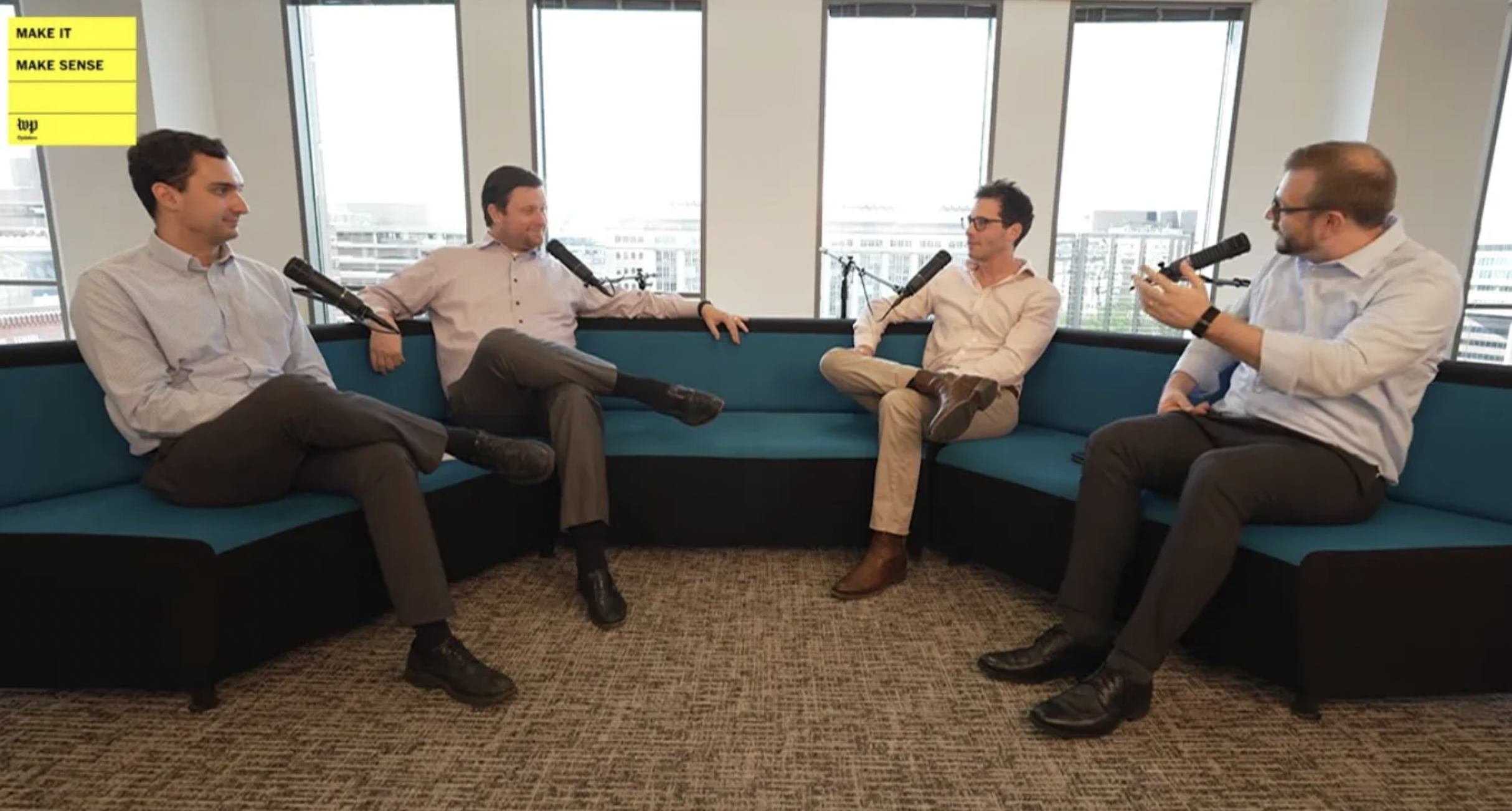
On Sunday, the very good media newsletter Status reported that the Washington Post recently invested $80,000 on new audio and video gear for its new Make It Make Sense podcast, which features the Washington Post Editorial Board. It has also remodeled a studio in its office, which seems apparent in a very bad trailer for the show titled “A News Show You Can Trust, Finally,” but not in any of its previously recorded videos (some of which were released this week). All of this has happened at the behest of opinion editor Adam O’Neal and Washington Post owner Jeff Bezos as part of the section’s shift rightward to focus on billionaire- and free market-friendly content.

The podcast is not going well. Watching a few minutes of several of the videos immediately gave me flashbacks to the videos I was in at U.S. News, and served as a stark reminder that the executives running these media companies have zero clue what they’re doing. The videos posted by the Washington Post so far feel extremely dated, as though they were made either with zero resources in 2012 or by someone who has never watched a YouTube video or listened to a podcast in their lives. Everyone is wearing the same business casual and looks like they have been suddenly airdropped from a Pret a Manger on K Street into a nondescript glass cube. The podcasts follow zero of the best practices of YouTube or podcasting; the only indication that anyone involved has been on YouTube ever in their life are the podcast’s thumbnails, which are bad and weird in a different way entirely but at least attempt YouTube’s signature clickbait style, albeit with a weird yellow wash and a serif font. Some of the videos start mid-sentence with no introduction or grabby hook whatsoever. One video begins: “The president of the United States is going to head to the Supreme Court to listen to some of the experts, uh, I think this might be the first time a sitting president is going to hear arguments at the Supreme Court…” the host trails off. Another host says “I think so. I think,” and stops speaking. “This is, uhh, we’ll confirm that. We’ll fact check that.” This is the first 19 seconds of the video.
Recent episodes of the podcast feature tired and milquetoast, recycled right-wing takes one could pull out of a hat, such as “What the Media Got Wrong During Covid,” “Weed Isn’t As Harmless As You Think,” and what-to-do-with-racist-statues. Other takes include college is too easy, billionaires actually do pay enough taxes, people who hate AI are unhinged, and—in a moment of actually trying to capture the zeitgeist—Hasan Piker is bad. None of the videos are popular. Some of them have fewer than 30 views, while others have ticked up into the triple digits primarily based on hate watches from people clowning on the podcast in recent days. The new studio has not helped, though it does at least look better. A video posted yesterday has 160 views at the time of this writing.
On audio-only platforms, the podcast is faring no better. Googling “Make It Make Sense podcast” brings up many other podcasts called Make It Make Sense, but not Jeff Bezos’s new flagship show. I was able to find the podcast in the Apple Podcast app, where it has four ratings and 2.3 stars out of 5, and the most glowing review is “This is bad and the people making it should feel bad.” On Spotify, it has a 2.8 out of 5 rating.
I do feel for the people who are in these videos. It is not easy to be on camera and it is not easy to make engaging YouTube content (growing our own YouTube channel has been a slog, and has been far more difficult than growing an audience on any other platform). Over time, with lots of practice and following many mean YouTube comments, I now feel slightly more comfortable being on camera than I did in the U.S. News days. And yet media executives keep trying to make people who are not good at presenting video do it anyway.
The best thing that can be said about this project is that at least we know Jeff Bezos is not buying views on YouTube, which is a common practice for vanity venture capitalist podcasts that no one wants to watch or listen to. So, why write about this at all?
Well, the show is the type of thing that we have seen time and time again from big media companies, and specifically, their airheaded executives who think that they have any idea how to make content that resonates with anyone at all. As Status pointed out, the Washington Post had a large and highly competent video team that made very good and successful video content. It laid the vast majority of them off, and this is what we’re left with. The Washington Post was known for having one of the most innovative, quirky, and successful TikTok channels, built in part by the journalist Dave Jorgenson.
Jorgenson left the Post in July of last year to start his own channel and company. “Dear Jeff Bezos, if you’re reading this, you already know. I’m leaving the Washington Post and starting my own company,” Jorgenson said in a video announcing the channel. “My boss, and my boss’s boss are coming with me, so viewers can continue to expect the same high quality, fact-checked videos.” Jorgenson now has 328,000 subscribers on YouTube and 317,000 TikTok followers. The Washington Post’s TikTok now exclusively posts repurposed stock footage from news wires. We have seen similar at VICE (which just “relaunched” VICE News as Adobe sponcon), Deadspin, etc.
Talented journalists—especially video journalists and podcasters—lose their jobs but the channels and feeds they created and built are zombified and repurposed for an executive’s passion project, staffed by people who have no idea what they’re doing. These projects inevitably also cost lots of money but with the added bonus that no one watches them. The project inevitably fails and is ignored into the oblivion. It’s fine to just ignore these stupid projects but maybe also we should mention sometimes that this is all part of the systematic hollowing out of news institutions that once did very good work that people cared about.
Turns out anyone can make a podcast. That doesn’t mean anyone is going to listen.