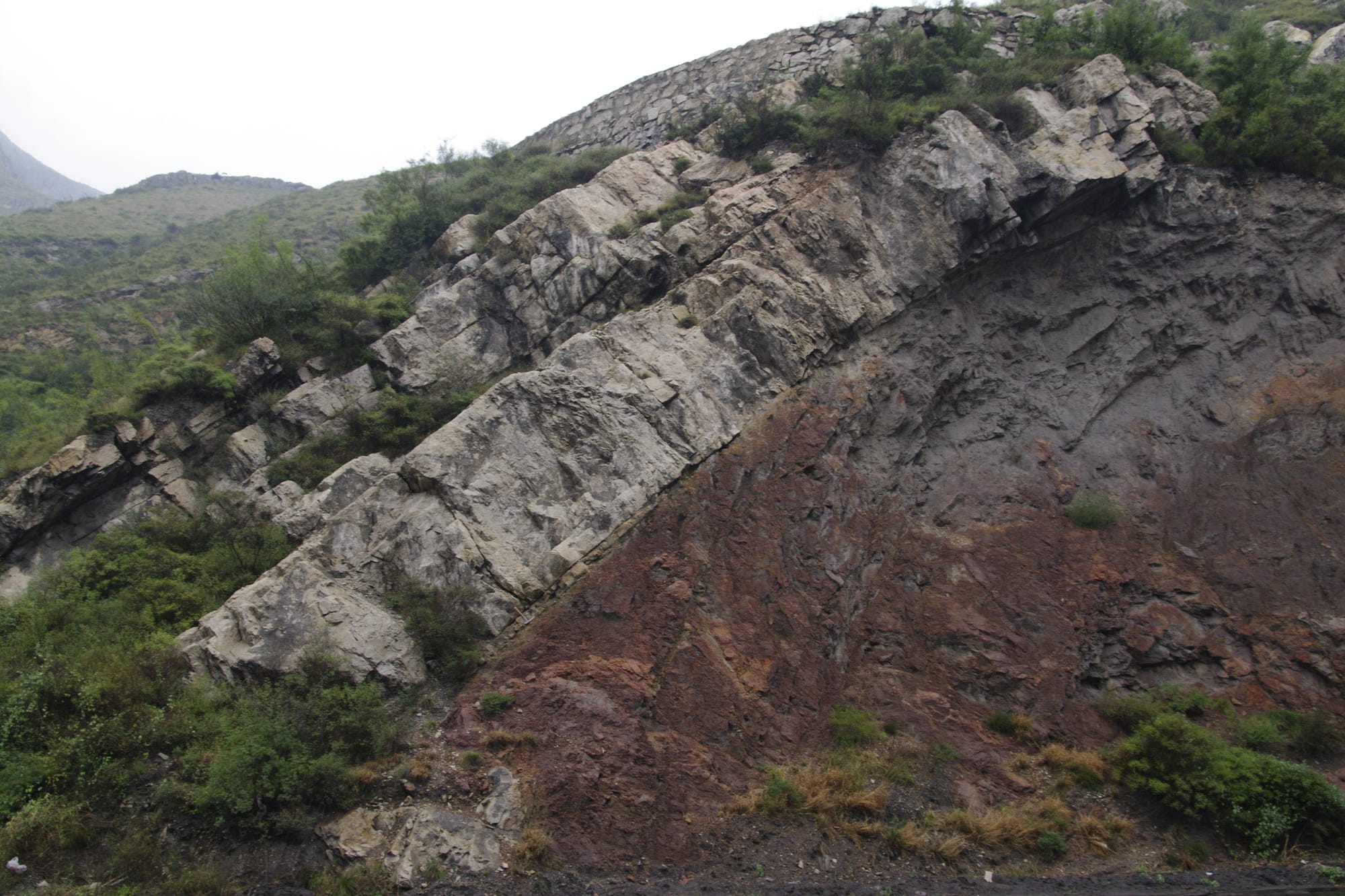
Scientists have resolved a longstanding mystery about the Great Unconformity, a huge gap in the geological record that shows up across the world and has inspired speculation for more than 150 years, reports a study published on Monday in Proceedings of the National Academy of Sciences.
The unconformity shows up around the world when sedimentary rock that is about 500 million years old lies directly on top of far more ancient “basement” rock that can be often over 1.7 billion years old. The missing layers can represent anywhere from several million to more than a billion years, making this feature “arguably the most iconic but enigmatic gap in Earth’s stratigraphic record,” according to the new study.
Now, scientists led by Rong-Ruo Zhan of Northwest University in China have presented new evidence that the gap was largely created by tectonic processes that occurred from 2.1 billion to 1.6 billion years ago, in the Neoproterozoic era, during the formation of an ancient supercontinent called Columbia.
Their results, based on geological sites in North China, cast doubt on an alternate explanation that suggests that the gap was formed by a “snowball Earth” phase of widespread glaciation that happened much later in time, around 700 to 600 million years ago.
This snowball phase closely preceded the Cambrian explosion, a sudden proliferation of complex life around 530 million years ago that established major animal families, leading to theories that the two events were linked. The new study, with its revised timeline of tectonic processes, challenges that connection.
“The contribution of this paper is to show that exhumation of mid-crustal metamorphic/igneous rocks in North China occurred mostly between 2.1 and 1.6 billion years ago, and that the timing of exhumation varies from one continent to another,” said study co-author Nicholas Christie-Blick, professor emeritus at Lamont-Doherty Earth Observatory of Columbia University, in an email to 404 Media.
“In other words, the surface may appear to be global, but its significance varies,” he added, noting that the unconformity in North America is shaped by specific regional factors, such as the break-up of the supercontinent Rodinia and sustained sea flooding.
“The conclusion therefore isn’t surprising,” Christie-Blick said. “It is just very nice to have shown in a previously less documented example (North China) that the timing has nothing much to do with late Proterozoic glaciation (720-635 million years ago) or the emergence of animals in the Cambrian.”
The Great Unconformity is perhaps most famous as a visible feature of the Grand Canyon, which preserves the core of a long-lost paleocontinent called Laurentia. But it is also present in the remnants of other paleocontinents, such as Baltica and Amazonia. It’s a wild case of stratigraphic amnesia, in which Earth seems to have memory-wiped epochs of geological time.
To further constrain the origins of the unconformity, Zhan’s team studied the thermal history of rocks at five locations in North China. The results revealed that in this region, crustal exhumation—the process by which buried rocks are pushed upward toward Earth’s surface—was mostly driven by tectonic processes in the ancient Neoproterozoic era.
Christie-Blick credited his colleagues in China with the bulk of the work, including the sampling and data acquisition, and said his role on the paper “was in thinking about the issues, and in helping to frame the paper.”
“The best way to think about unconformities is that they represent everything that may have happened over a span of time that in this particular case is more than one billion years” said Christie-Blick, adding that “it was never in the cards that we would discover one ’cause.’”
“It is merely the case that much of the erosion occurred early, and that formation of the unconformity could not have ‘triggered’ anything to use an expression from one of the early papers” that had speculated on a link to the Cambrian explosion, he noted.
While the new study has shed new light on the origin of the Great Unconformity—and its regional variability—there are still plenty of outstanding questions left to resolve about this geological gap. Christie-Blick is developing a new work about the late Proterozoic-Cambrian tectonic development of southwest Laurentia, and also pointed to the work of his colleague on the paper, Liang Duan, who has published several works on basin tectonics in China.
“Both of us like to challenge conventional thinking because that is where advances in understanding are commonly made,” Christie-Blick concluded.