Your daily rundown of what matters in physical AI — humanoids, autonomy, drones, industrial robots and the research behind them.
1. Agile Robots lands $500M at an $8.5B valuation
Munich-based Agile Robots closed a $500 million Series F led by SoftBank, with NVIDIA and Hitachi participating, bringing total capital raised to about $2 billion. The company builds humanoids, mobile robots, arms and hands, and says the money goes to production capacity and global expansion.
Why it matters: It is one of the largest physical-AI rounds of the quarter and a sign that Europe has a well-funded contender in industrial and humanoid robotics. Tracked in our funding tracker.
2. GXO plans up to 1,000 Apptronik humanoids
Contract-logistics giant GXO signed an agreement with Apptronik to expand deployment of its Apollo humanoid through a Robotics-as-a-Service model, with a rollout of up to 1,000 robots.
Why it matters: Most humanoid deployments are still counted in single or double digits. A logistics operator talking in the thousands — and paying per robot as a service — is a real test of whether humanoids can earn their keep in warehouses. See the humanoid tracker.
3. Google DeepMind ships Gemini Robotics 2.5
DeepMind introduced Gemini Robotics 2.5, an updated vision-language-action model aimed at more dexterous, more reliable work in industrial and everyday settings.
Why it matters: The robot “brain” is now the main bottleneck for general-purpose machines. DeepMind’s models power partners like Apptronik, so improvements here flow straight into hardware on factory floors.
4. DHL pilots AI orchestration for mixed robot fleets
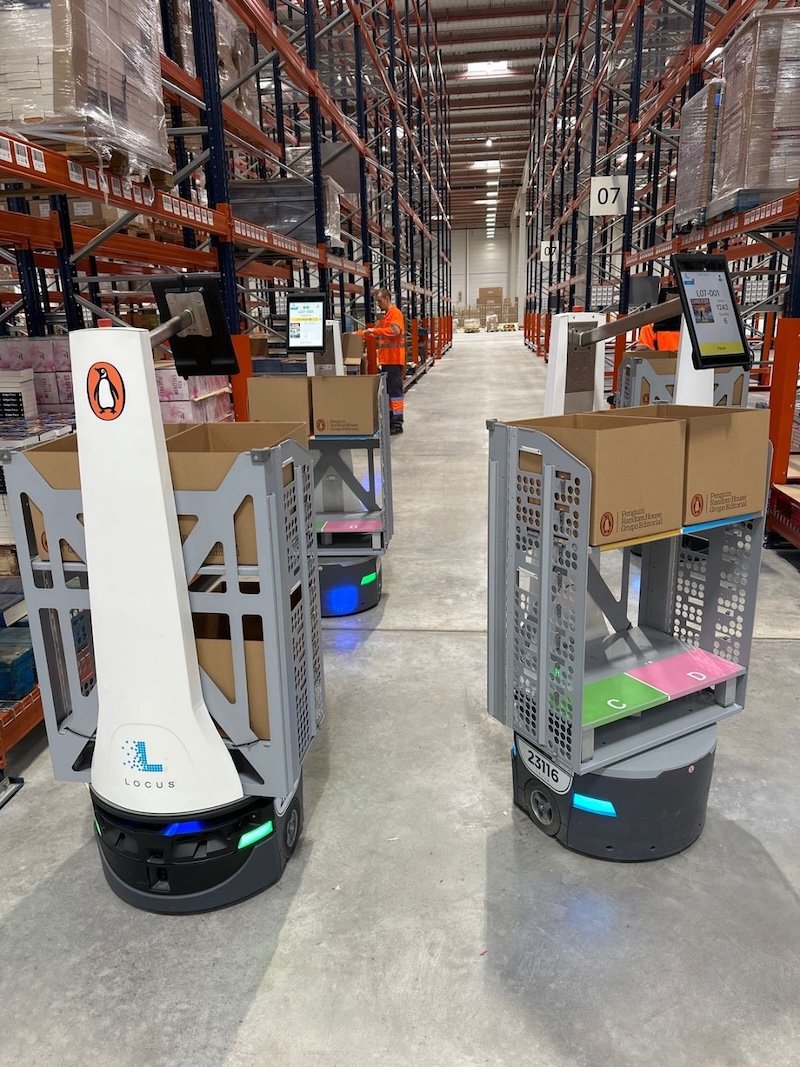
DHL Supply Chain is testing adaptive AI-powered robots and an AI orchestration layer in live warehouse operations to coordinate robots, software and people.
Why it matters: As warehouses add robots from many vendors, the software that coordinates them becomes as important as the robots themselves.
5. Autonomous weapons: the U.S. asks the UN for five more years
The U.S. is pushing for five more years and a voluntary text on autonomous weapons at the UN, while the Pentagon was given 90 days to rewrite its own rule. Separately, Estonia blamed Russia’s GRU for an arson attempt on drone maker Threod Systems.
Why it matters: Military drones are the fastest-scaling autonomous systems in the world right now, and the rules governing them are still being written.
6. Amazon’s Idaho drone hub permit sets no noise or flight limits
The city permit for Amazon’s Prime Air hub in Nampa, Idaho, lists five conditions — none of them a cap on noise, altitude, hours or number of flights.
Why it matters: Drone delivery is expanding to hundreds of U.S. towns. Local permits like this one are where communities will (or won’t) set limits.
Quick hits
- KAIST and Yonsei built a flexible display that shows color to people and near-infrared signals to robots at the same time.
- DGIST researchers made fibers that light up as soft robots move — sensing without batteries or circuits.
- IEEE Spectrum on remote robotic stroke surgery, steered by a doctor out of sight of the patient.
- Rhoda AI is training general robot models directly on video.
Get this brief by email — subscribe free. Every item links to our summary and the original reporting. Brief compiled by Physical AI News.
Newsletter
Get the Physical AI brief
The day’s most important robotics and embodied-AI stories, in your inbox.