Enterprise investment in generative and agentic AI continue to accelerate, but an increasingly important question is emerging amongst applied AI leaders:
Where is the measurable return?
At the individual level, the value is clear. With organizations launching copilots, AI assistants, coding tools, agents, automation programs & enterprise AI initiatives, employees can now carry out the same tasks at higher speed and quality. But have these investments materially improved productivity, operating economics, revenue, or margins at the enterprise-level?
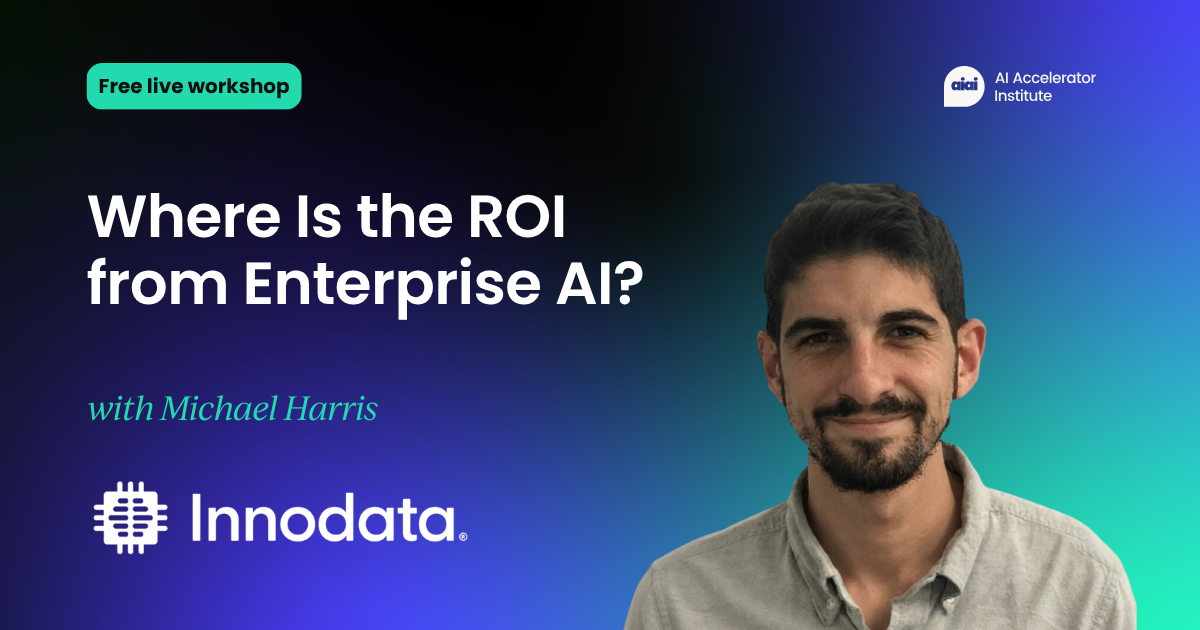
Our live session with Innodata to examines that gap by exploring how organizations distinguish theoretical AI potential from tangible AI business value.
What you’ll take away:
- The productivity paradox: Individual time savings from copilots will evaporate into organizational slack unless leadership deliberately reallocates that freed capacity toward measurable output or direct cost reduction.
- Workflow redesign matters more than basic tool adoption: Enterprise ROI requires moving past generic desktop assistants to redesign end-to-end workflows where agentic systems can measurably lower unit costs.
- The business case: Sustainable business value can only be proven when initial productivity gains visibly outpace the true total cost of ownership, including token consumption at scale, data curation, and human oversight.
Why you should attend:
- People work faster, but company expenses don’t drop. Staff finish slides, code, or emails in half the time, yet team sizes stay the same, projects don’t finish months earlier, and the bottom line doesn’t budge.
- Teams report high engagement, daily active users, and millions of prompts to prove success, even though none of that tells leadership if the company made or saved a single dollar.
- Spending millions on vanity projects instead of core operations: Budgets get drained buying thousands of copilot licenses for general office work, while the high-cost, high-volume parts of the business run on the exact same slow processes as before.