
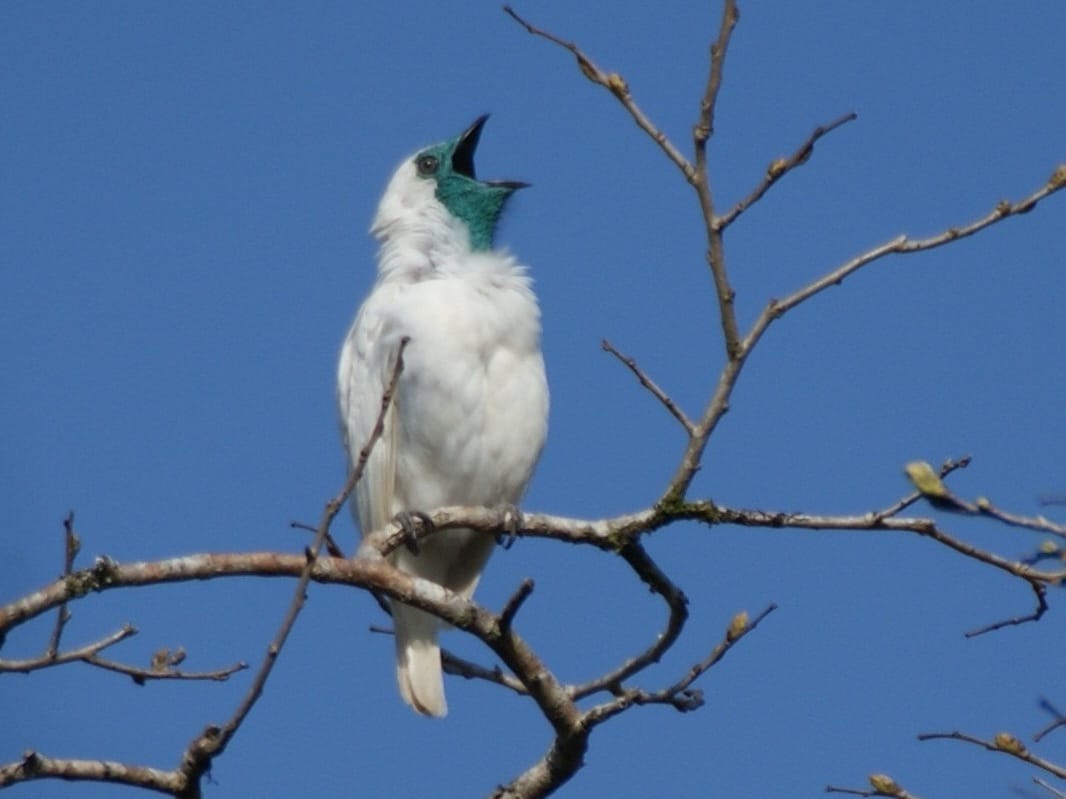
Scientists have identified two new contenders for the world’s loudest bird—the bare-throated bellbird and the red-legged seriema—both of which can exceed 120 decibels, which is louder than a jackhammer, according to a study published on Tuesday in Evolution.
These two bird species are now in the same league as the white bellbird, which shattered the record for loudest bird in 2019 after its bizarre call was first measured and reported by Jeff Podos, a professor in the department of biology at the University of Massachusetts Amherst. It’s worth taking a moment to listen to the bellbird’s otherworldly call, which the males unleash over their remote habitat in the northern Amazon rainforest.
In the new study, Podos and former UMass Amherst graduate student João C.T. Menezes report that the bare-throated bellbird and the red-legged seriema occupy the same decibel range as the white bellbird. It’s tough to declare a clear winner among the three birds due to differences in measurement techniques and individual variations within each species.
Regardless, this trio is a special class that is much louder than the fourth runner-up, the screaming piha, which tops out around 116 decibels. In addition to identifying the ear-splitting avians, the team captured unprecedented measurements of vocal amplitude in 123 bird species, an effort that represents “a step forward in uncovering what enables birds to produce the loudest acoustic signals of all terrestrial fauna,” according to the study.
“We were interested in a pretty basic question that’s still out there because we know so little about amplitude,” said Menezes in a call with 404 Media. “We were basically interested in finding out why some species sing louder than others. For that, the more diverse the sample, the better.”
“We wanted to know the softest species we could get, and the loudest species we could get, and everything in between,” he continued. “The more variation, the better for answering this type of question. Of course, along the way, we found the two new contenders for loudest species, and that’s super cool. But every species in the sample has their value for us to answer the actual question.”
Given the remarkable diversity of avian calls, it is no surprise that birdsong is one of the most well-researched topics in behavioral ecology. But unlike call features like tempo or frequency, vocal amplitude has been notoriously difficult to measure in the wild because it is dependent on distance to the animal, which can be tough to figure out in remote field environments, such as the Amazon rainforest.
Menezes and Podos were able to overcome this longstanding hurdle with the same laser rangefinders used by golfers to gauge the distance to holes.
“The laser rangefinders help us determine the distance between the recorder and the bird, which is important in our report as it allows us to correct our recordings of amplitude for distance,” Podos told 404 Media in an email. “But the actual recordings and thus readings of amplitude are made with another kind of device, a Sound Level Meter (normally used in industrial acoustics, but that can also serve in working with animals!).”
Using this new approach, the researchers were able to record the first clear amplitude measurements for dozens of species, from hummingbirds at the low end of the decibel range to the three loudest belters.
“I’ve been a bird watcher since childhood, so it was just adding another layer to bird-watching.” Menezes said. “And since amplitude is known for so few species, we could basically go anywhere and we could have like a new amplitude for a new species, even from my window here in São Paulo, or Jeff’s backyard” in Massachusetts.
When they began their field research, Menezes and Podos predicted that the loudest birds in their measurements would have bigger bodies and wider beak openings, which proved true in the most deafening birds. But they were surprised to discover that there was no clear link between extreme loudness and ecological factors, like habitat or sexual behavior.
The two bellbird species live in dense forest and are highly polygamous, so only the male bellbirds make loud calls to attract females. In contrast, the red-legged seriema lives in open habitats, including pastures, and forms long-term monogamous pair bonds.
“If you look at the top three birds, we can see perfect counterexamples for each of those factors,” Menezes said. “That was definitely a surprise—those parallel routes to extreme loudness.”
Menezes plans to keep delving into the particular ecological factors that lead to high vocal amplitudes in his future research. While he thinks that other birds may be capable of calls over 120 decibels, it would be unexpected to find even louder birds, as that volume seems to be an upper limit across terrestrial animals.
“There does seem to be a ceiling with terrestrial animals about the 120 to 125 [decibel] mark,” Menezes said. “Elephants can’t go beyond that. There are really loud bats that use vocalization for echolocation, and they also don’t go beyond that.”
“Based on that, my hunch is that we’re not going to find a much louder bird, but I do think we’ll find others that fall in that same category,” he concluded.

