
The onging summit between Donald Trump and Xi Jinping has been billed as a “high-stakes” meeting which the US president says will have a major focus on artificial intelligence (AI).
Trump told a gathering of world leaders at the US general assembly on Tuesday that, “whoever wins superintelligence wins … and we’re leading now over China by a lot”. Quite how this will help build rapport between the two leaders is anyone’s guess.
Leaving aside for now the US president’s decision to unilaterally rename (as is his wont) what everyone else calls artificial intelligence, there’s no doubt that what the world needs now is for Xi and Trump to do what they can to avoid an AI arms race.
Nicholas Wheeler and Marcus Holmes, whose research focus is on face-to-face diplomacy, believe the scale of this challenge recalls the summits between Ronald Reagan and Mikhail Gorbachev in the late 1980s. At that stage it was nuclear proliferation which was scaring people on both sides of the cold war. Fresh in Soviet minds were the Nato exercises which gamed out a scenario in which the Soviet Union invaded eastern Europe, to which the response was a nuclear retaliation.
Meeting in Geneva in November 1985, the two leaders – Reagan the dyed-in-the-wool anti-communist and Gorbachev, the passionate Marxist-Leninist – somehow developed a rapport which fostered an effective working relationship. As Wheeler and Holmes recount, the pair were able to appreciate that both of their countries shared a very real fear of nuclear proliferation.
This understanding enabled them to collaborate on a series of nuclear deals which pulled the world back from the precipice. The hope is that Trump and Xi, arguably the world’s two most powerful men, can reach the same sort of understanding.
Power play
The word “arguably” was used deliberately in the previous paragraph. As the UN secretary-general, António Guterres, noted in his final keynote address in the general assembly this week, the nature of power – and the way it is wielded – is becoming increasingly fluid in the 21st century.
Not only is it shifting in a geopolitical sense, but also from nation states to private corporations – and, worryingly, from humans to machines. And this shifting power will have an enormous influence on the key challenges facing the world, from war to inequality to the climate emergency and artificial intelligence.
Stefan Wolff and Martin Waelisch, experts in international security, caution that the US president’s speech suggested that an understanding of power that appears limited to achieving narrow victories is more likely to exacerbate, rather than mitigate, these problems.
A new form of governance
To another international governance group – and in advance of the UK taking the chair of the G20 in December, we ask the question: is this another glorified talking shop which rarely achieves anything? Gordon Brown, who was prime minister when the UK last chaired the group would point to its response to the global financial crisis. But the question mark remains.
A lot of this is to do with the need for the group to reach consensus, meaning its decisions, communiqués and leaders’ declarations require agreement from all participating member states to be officially adopted.
This is entirely the wrong approach, writes Henrietta Moore, the founder and director of the UCL Institute for Global Prosperity. She and her colleagues have developed a new framework for global cooperation called The New Alignment. This calls for issues such as climate change, sovereign debt and technology to be tackled in a way that engages the key players that can make a difference.
Or as she puts it here: “Begin with the problem, and ask what outcome is needed. Then consider which countries, institutions, businesses and communities have the capabilities to deliver that desired outcome”. That way, while consensus remains valuable, it’s no longer a precondition for progress.
Read more:
G20 needs a new approach to tackle the changing world order
Election special
Three election results to comment on, of which two could be accurately described as being shocks and one utterly predictable. Taking the latter first, it surprised nobody when in the elections for the Russian parliament, United Russia – the party of Vladimir Putin, won its usual landslide.
Business as usual then. But there was some features of the election campaign, which Putin billed as a referendum on the war in Ukraine, that bear further investigation, as Jennifer Mathers reports.
Read more:
No surprise as Putin’s party wins election billed as ‘referendum’ on war in Ukraine
Meanwhile two more German states held elections last weekend. In one, for the state of Berlin, the ruling Christian Democrats (CDU) were beaten into second place by the party on the left, Die Linke. In the other, for the rural eastern state of Mecklenburg-Western Pomerania, it failed to register sufficient support to merit winning a seat, attracting just 4.9% of the vote.
Here the big winner was the far-right Alternative für Deutschland (AfD), with 38.2% of the vote. This falls short of the outright majority it would need to form government writes Ed Turner of Aston University. But the results will pile yet more pressure on the already embattled German chancellor, Friedrich Merz, whose political survival now hangs in the balance.
Read more:
Two more election defeats pile pressure on German chancellor Friedrich Merz
The rise of the far-right has been a matter of some concern for anyone observing German politics in recent years. Since the end of the second world war, the fear of extremism in Germany has been such that the political system has operated a firewall, or Brandmauer, by which mainstream parties agree never to form a coalition which would help an extremist party – in recent years specifically the AfD – gain power.
Kai Schwerdt via Flickr, CC BY-NC-SA
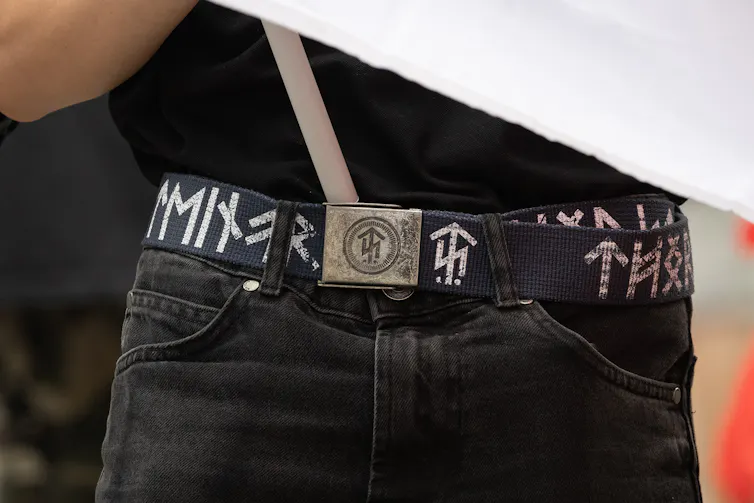
Another attempted safety valve has been a ban on neo-Nazi symbols, violation of which carries stiff penalties of up to three years in prison.
But there’s no denying the rise in popularity of right-wing politics in recent years and supporters of various extremist movement have developed their own ways to self-identify which aim to circumvent this ban.
These can include wearing certain brands of clothes, displaying various Nordic runes or using coded emojis in online communication, write Tom Birkett, Felix Lummer and Timothy Liam Waters of University College Cork, whose study makes for fascinating reading.


