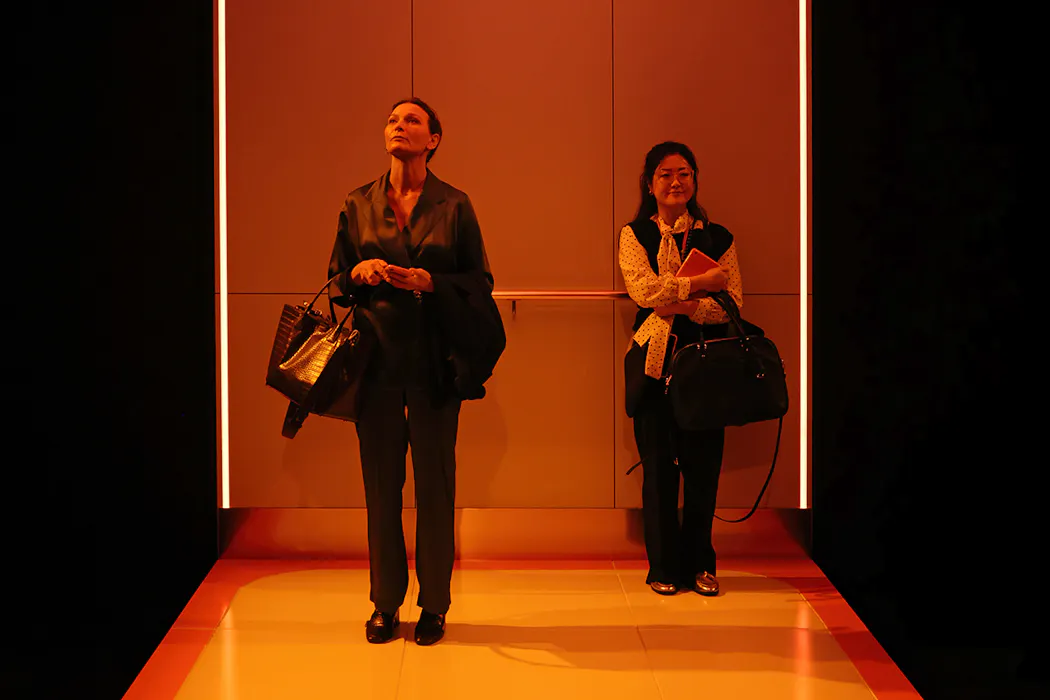
How would you feel about being stuck in an elevator with your boss?
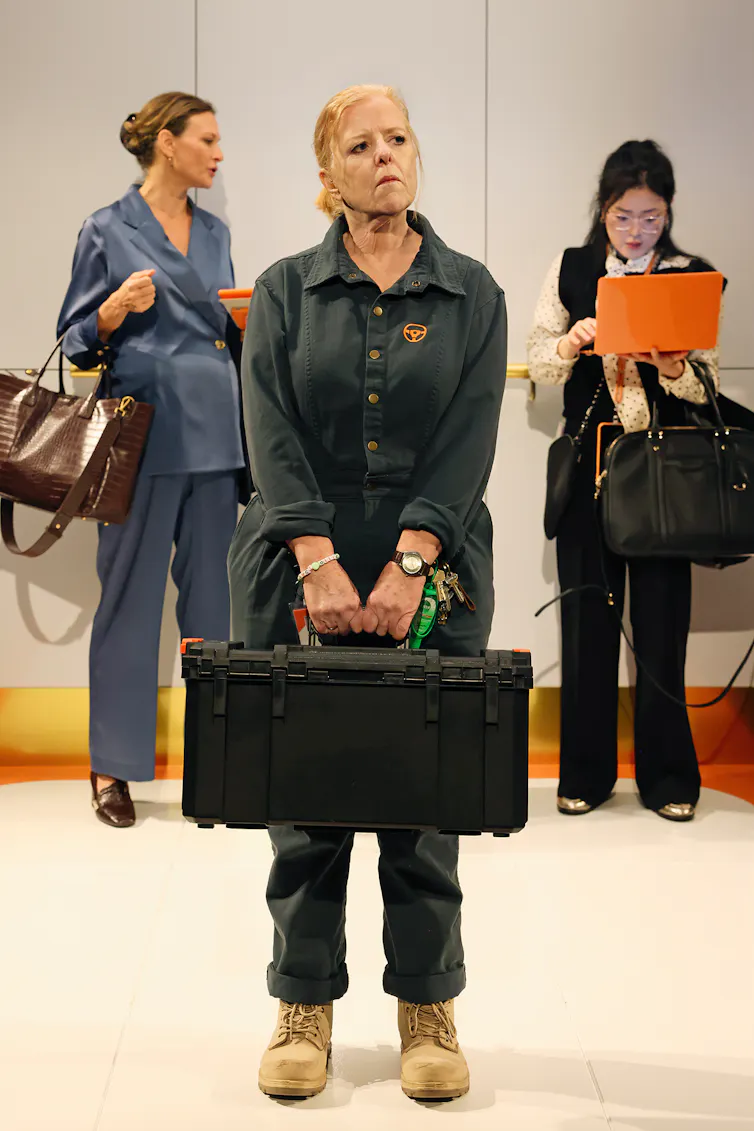
In Eloise Snape’s new play The Elevator, premiering at Sydney’s Ensemble theatre, the boss is Margot (Leanna Walsman), CEO of tech company Eco Engines. Margot has just returned to work, a day after giving birth. Then the AI-operated elevator of the company building malfunctions, trapping her inside with the public relations crisis manager, Alison (Shirong Wu), and the building janitor, Ollie (Di Adams).
The elevator breaking down is not the only thing that has gone wrong.
One of the AI-operated vehicles designed by Eco Engines has crashed into a man, leaving him in a critical condition. Margot has returned to work to clean up the mess, while her own body is quite literally leaking.
Prudence Upton/Ensemble
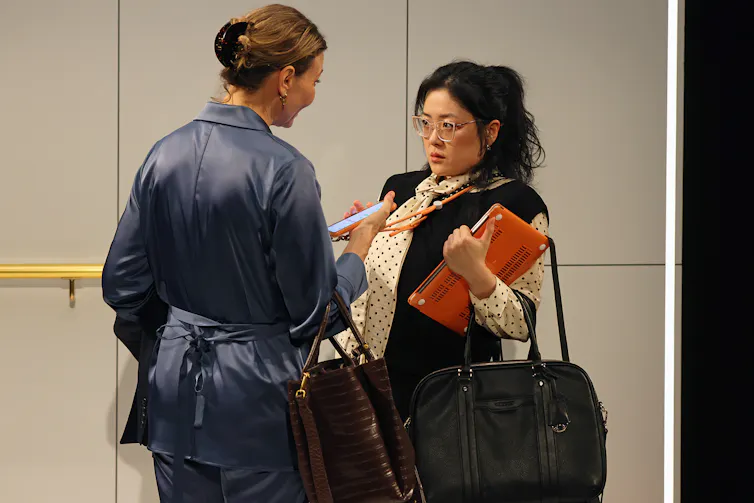
As they enter the elevator, Margot directs Alison on drafting the company’s press statement. She corrects Alison, applying lashings of spin: it was an “incident” not a “crash”; the person is a “pedestrian”, not a “victim”. Margot is accustomed to dehumanising people to get ahead in the ruthless, male-dominated corporate culture she operates in.
Margot also dehumanises herself, prolonging the need to pump breast milk and covering up her leaking body rather admitting she needs help.
Margot was six months pregnant when she was hired, and we learn her appointment was a result of the company’s feminist virtue-signalling after the previous, male CEO was stood down on sexual assault allegations. But his voice is still heard – literally, in the company’s AI model, Taurus. And his toxic, misogynistic legacy suffuses the company’s operations.
In many ways it is also embodied by Margot, who has adopted his ruthless approach to staff.

Prudence Upton/Ensemble
Big tech, corporate culture and the patriarchy
The Elevator offers a timely commentary on the impact of AI and big tech on our sense of humanity, wrapped in an engaging and high-tension premise. It also offers a feminist critique of corporate culture, exploring intergenerational and intersectional experiences of being a woman juggling care-taking responsibilities and a job.
Ironically, before the lights went down in the theatre, I was analysing an invoice I received for childcare fees today – fees that disincentivise women from working, exacerbated by the realities of the gender pay gap.
The set and lighting (designed by Kelsey Lee) are elegant, with a futuristic elevator where all of the action takes place. Within this restricted setting, director Anthea Williams manages to create a sense of easy dynamism in her blocking.
The emotional arcs of each character are carefully sculpted. Margot, Alison and Ollie all reach their breaking points, and these moments make for stunning performances by the respective actors.
Alison’s metamorphosis from her anxious, people-pleasing tendencies towards something more authentic is particularly satisfying, thanks in part to Wu’s ability to navigate between comedy and extraordinary emotional depth.
Alison’s experience of racism in the workplace – such as frequently being mistaken for the only other Asian female employee – is dismissed by Margot as something she should simply get used to. The toxicity of corporate life is strangling these women in different ways.
Prudence Upton/Ensemble
An invitation to question our values
The Elevator raises the question of how to be an ethical person while operating within an unethical system.
Margot urges Ollie to accept AI because it’s a losing battle, but Ollie’s politics are more resistant and critical, informed by environmental consciousness and the richness of a life lived on her own terms. She was a cab driver in London and can recite the directions of a route on cue. “I think we have different ideas of what success looks like,” she tells Margot.
The play makes us question what we value, reconsider what success looks like, and observe the often invisible labour and sacrifices of women.
Snape’s dialogue sometimes spells out the class differences between the women – such as when Margot tells Ollie she is “not a person of consequence” – rather than implying them more subtly. However, an astonishing twist at the end of the production serves as justification for some of this heavy-handedness.
In her writer’s note, Snape says she was struck after reading former Facebook executive Sarah Wynn-Williams’ account of typing a memo on her laptop between birth contractions. For women, negotiating their caretaking roles and their careers is an ongoing challenge.
Snape’s exploration of these tensions and how they dovetail with environmental crises and big tech make for a satisfying, socio-politically resonant play. In the expert hands of Williams, it’s also thrilling theatre.
The Elevator is at Ensemble, Sydney, until October 18.

Charlotte Farrell’s research is funded in part by the Australian Research Council Discovery Program (project number DP260102365) funded by the Australian Government.