
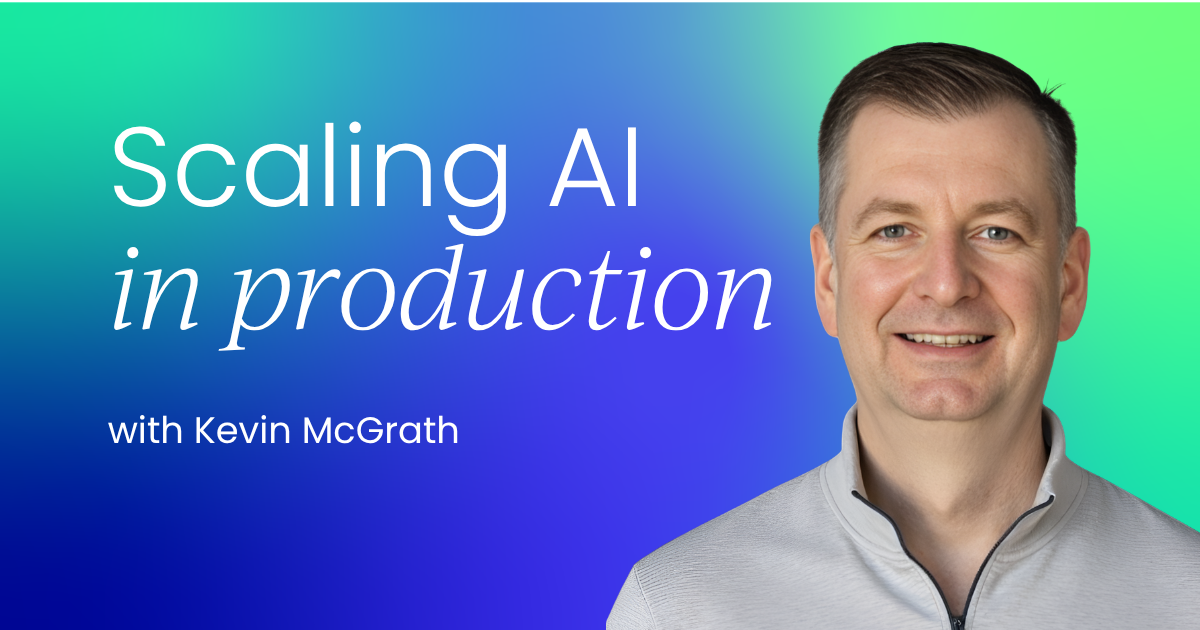
When I say scale here, I’m not talking about handling more traffic. I’m talking about getting AI to work for you without a human eyeball sitting on every single output.
Let’s get into it.
Start with the problem, not the technology
You have a throughput problem in some form. Maybe you’re in construction, and you need to process hundreds of requests for proposals every day. Maybe you’re a creator, and you need to ship more work for your clients. Maybe you’re a consultancy trying to productize what your senior people know.
Whatever it is, AI is the enabler for that work, not the work itself.
If you don’t have a problem to solve, sure, it’s fun to poke around with. You’re just not going to get to the point where you’re actually deploying AI in production unless there’s a real problem driving it.
The test for whether you’re ready is pretty simple. Does adding AI let your organization do more without burning out your team trying to make it work, and with a trust level similar to what you already have running your business?
- If you’re putting extra burden on your team just to get AI running, that’s a problem.
- If your team doesn’t know how to operate with it, that’s a problem.
- And if you don’t trust the output the way you trust other parts of your organization, that’s a bigger problem.
 Andrew Lovell
The adoption journey (and the trap waiting at the end)
You’ve got the throughput problem. You’ve decided your data needs to stay close. Now you’re on the AI adoption journey.
It usually starts with initial excitement because AI is genuinely powerful. What you can get with a few API calls to an LLM is amazing. Fast prototype, mostly right answers, directionally correct outputs. You look at it and think, ” This is so close.”
Then you start tweaking. The answer isn’t quite right. It’s adding stuff into responses you didn’t want. It’s missing things in particular documents. So you get into prompt engineering. You write a thousand different prompts.
So you need a more systematic approach. Now your engineering team is throwing new words at you. We need a vector database. What’s a vector? I thought we just threw everything at the LLM. Well, no, you have to vectorize stuff.
Now you need GraphRAG, or a citation graph, or a whole new set of tools to understand the semantic relationships in your documents.
And here’s where the trap closes.
You saw the potential. You wanted production-grade AI. And now your team is spending most of their time building AI infrastructure when your business isn’t about building AI infrastructure. Your business is about solving that original throughput problem.
The three things you actually need: context, control, and confidence
When you’re trying to get to production-grade AI, three things matter more than almost anything else:
- Context
- Control
- Confidence
Context
There’s a practice that goes alongside prompt engineering called context engineering, which is preparing your data so it’s ready for AI. You probably have a variety of documents in a variety of stores. Relational databases, unstructured documents, CSVs. They all need to be looked at differently.
It isn’t only about a vector database, or only about GraphRAG, or only about one approach.
You have to think about your data carefully because if you try to do all of this at runtime, you’re asking the technology to do a tremendous amount of work very, very quickly. It’s going to miss things. You need to guide it.
Control
You need an orchestration layer. In this current moment, everyone’s talking about agentic this, agent-to-agent that. I’ll tell you one thing from my experience. A lot of what’s being called fully agentic really isn’t. There are AI components doing very specific things along a pipeline.
Think about it in the old infrastructure way. I came up with racking and stacking servers, and we cared about uptime. Four nines, five nines, whatever. If I have a server with four nines of uptime and a network with four nines of uptime, do I have four nines overall? No. The probability compounds downward.
The same logic applies to agents. If you have an agent that’s 95% confident handing work off to another agent that’s 95% confident, you don’t end up with a 95% confident answer. You end up with something noticeably worse.
So when you hear people talk about chaining agents together, in real-world production, you probably have AI doing one specific task very well as part of a larger workflow. The rest of the workflow is fine, being conventional code. It doesn’t all need to be AI-ified yet.
You also need to define:
- How your data gets into the workflow
- How labeling controls what the AI sees on certain requests
- How rules and policies govern the flow
The simplest way to do this is data labeling. If you don’t want certain information showing up in an output, don’t present it to the LLM.
For expert advice like this straight to your inbox every other Friday, sign up for Pro+ membership.
You’ll also get access to 300+ hours of exclusive video content, a complimentary Summit ticket, and so much more.
So, what are you waiting for?
Confidence
Confidence means measuring accuracy rather than assuming it. Scoring outputs before you expand automation to everyone.
Confidence also means different things to different people. We talk about hallucinations as if they’re always bad. For Toffler, hallucinations aren’t bad. They’re red teaming. They want the AI to come up with wild, unexpected scenarios to stress-test ideas.

