
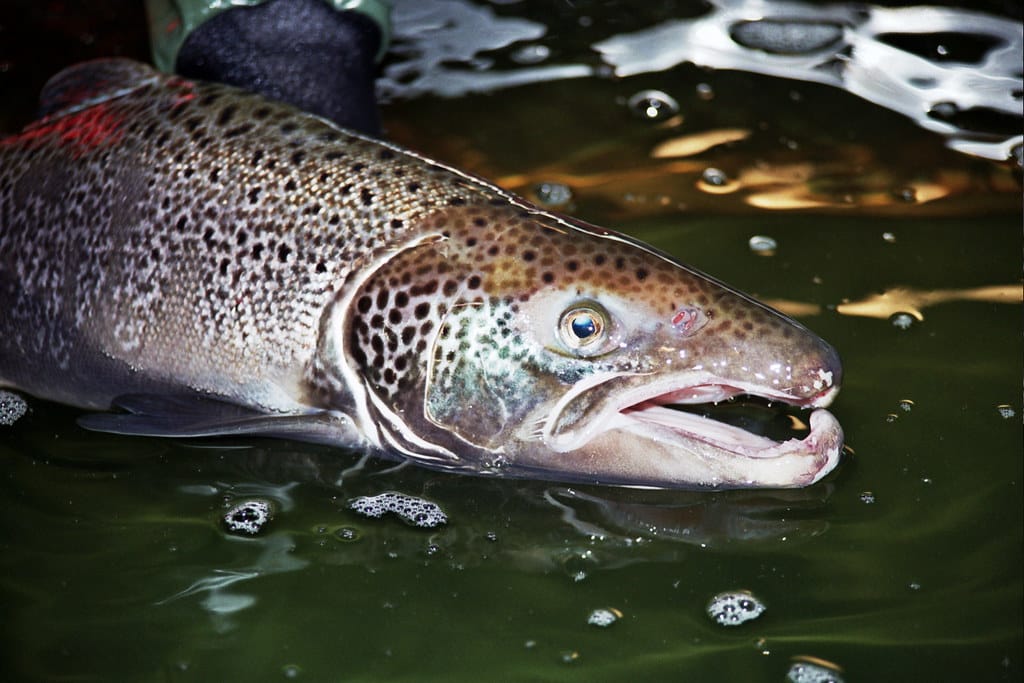
Salmon exposed to cocaine swim farther and behave differently than unexposed fish, according to the first study to observe the effects of cocaine on fish in the wild rather than a laboratory setting.
Many waterways around the world are contaminated with a host of legal and illegal substances that are consumed by humans and then excreted into sewage systems. As global demand for cocaine skyrockets, traces of the drug—including its main metabolite, benzoylecgonine—are flowing into lakes and rivers where they can be absorbed by wildlife, such as Atlantic salmon.
Previous research in laboratory conditions has already linked cocaine exposure to behavioral changes in aquatic species, but this connection has never been explored in fish in the wild. Now, scientists have demonstrated that cocaine and benzoylecgonine “can accumulate in the brains of exposed Atlantic salmon—an ecologically and economically important species of high conservation concern—and disrupt the movement and space use of these fish in the wild,” according to a study published on Monday in Current Biology.
“We were motivated by a major gap in the scientific literature: almost everything that was known about the impacts of cocaine pollution on animal behaviour relies on data that has been collected in laboratory settings,” said Michael Bertram, an author of the study and an associate professor in the department of wildlife, fish, and environmental studies at the Swedish University of Agricultural Sciences, in an email to 404 Media.
“We wanted to know whether environmentally realistic exposure to cocaine and its major metabolite, benzoylecgonine, actually changes how fish move in the wild under real ecological and environmental conditions,” he continued.
To fill this knowledge gap, Bertram and his colleagues obtained more than a hundred Atlantic salmon “smolts”—the term for young fish—that were raised in a hatchery until they were two years old. The team divided them into three groups of 35 fish each and equipped every fish with an implant and tracking tags. The “cocaine group” received a slow-release chemical implant of cocaine, the “metabolite group” received a slow-release benzoylecgonine implant, and a third “control group” carried a dummy implant with no chemicals.
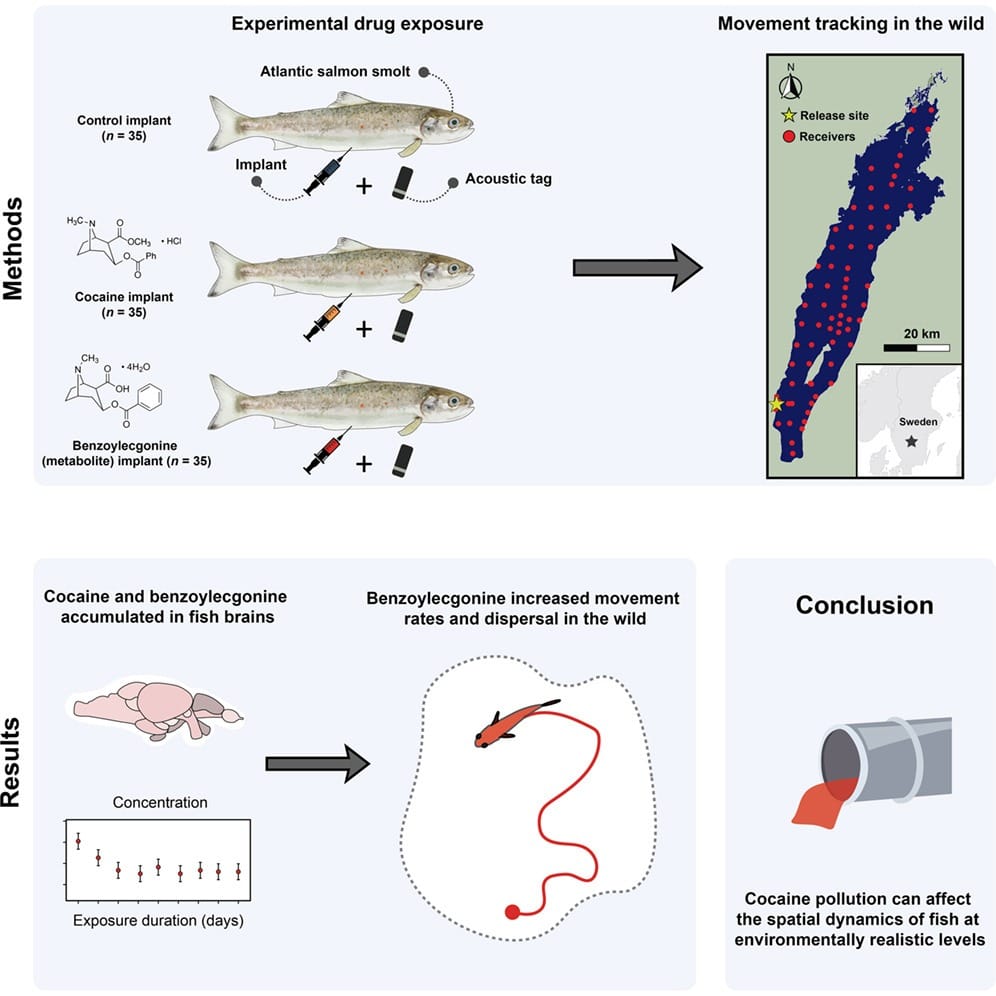
The three groups were released simultaneously on April 12, 2022 at the same site on the south-western side of Lake Vättern in Sweden, alongside 200 other smolts that were not involved in this experiment. Over the course of roughly two months, the exposed groups moved much more than the control group, especially the metabolite group; they traveled 1.9 times farther per week than the unexposed smolts.
“We expected an effect of contaminant exposure on the movement of salmon, but the scale of the changes seen still surprised us,” Bertram said. “The strongest response was close to a two-fold increase in movement, and the most unexpected result was that benzoylecgonine, the main metabolite of cocaine, produced the clearest effect rather than cocaine itself.”
Indeed, the study found that the metabolite group swam almost nine miles farther per week than the control week in the final two weeks of the 8-week experiment, whereas the control group was more settled down by that point.
“To the best of our knowledge, this is the first demonstration that environmental levels of a cocaine metabolite that is commonly found in aquatic ecosystems can alter the space use and swimming activity of fish in the wild,” the team said in the study.
It’s not clear why the metabolite group was so restless, given that benzoylecgonine is considered psychoactively inactive in humans. The compound is a long-lived byproduct of cocaine made by the liver and excreted in urine, which makes it the easiest biomarker to look for in a typical drug test. The possibility that this metabolite may have a greater impact on some species in the wild is disturbing, in part because it is frequently found in higher concentrations in natural environments than its parent compound (cocaine).
“The results suggest that benzoylecgonine may be more biologically important than it is often assumed to be,” Bertram said. “Our findings raise new questions about whether metabolites can sometimes be as disruptive as, or even more disruptive than, the parent compound in aquatic wildlife.”
The team emphasized that much more research is required to understand the pressures that cocaine and other substances might be introducing both to individual species and to whole ecosystems.
“The next steps are to work out the mechanisms by which cocaine and its metabolite disrupt behaviour and movement in fish in the wild, test how general this effect is across other species and systems, and use higher-resolution tracking to see whether these movement changes affect predation risk, migration, reproduction, or survival,” Bertram said. “That is really the key question now: not just whether behaviour changes, but what those changes mean ecologically.”
For example, this particular study focused on hatchery-raised smolts that were released into the wild, but future studies could test out the effects of these contaminants on fully wild populations as well, which have their own unique behavioral characteristics. Unraveling the effects of these human-sourced substances is even more urgent given that the global use of illicit drugs increased by roughly 20 percent over the last decade, suggesting that “the environmental impact of these substances is likely to grow,” according to the study.
“The behaviour and movement of wildlife underpin habitat use, feeding, predator exposure, and population connectivity, so altering these processes could have wider consequences for food webs and population dynamics,” Bertram concluded. “For species already under pressure, an added stressor like this could be highly detrimental, although the long-term effects on fisheries and ecosystems still need to be tested directly.”

