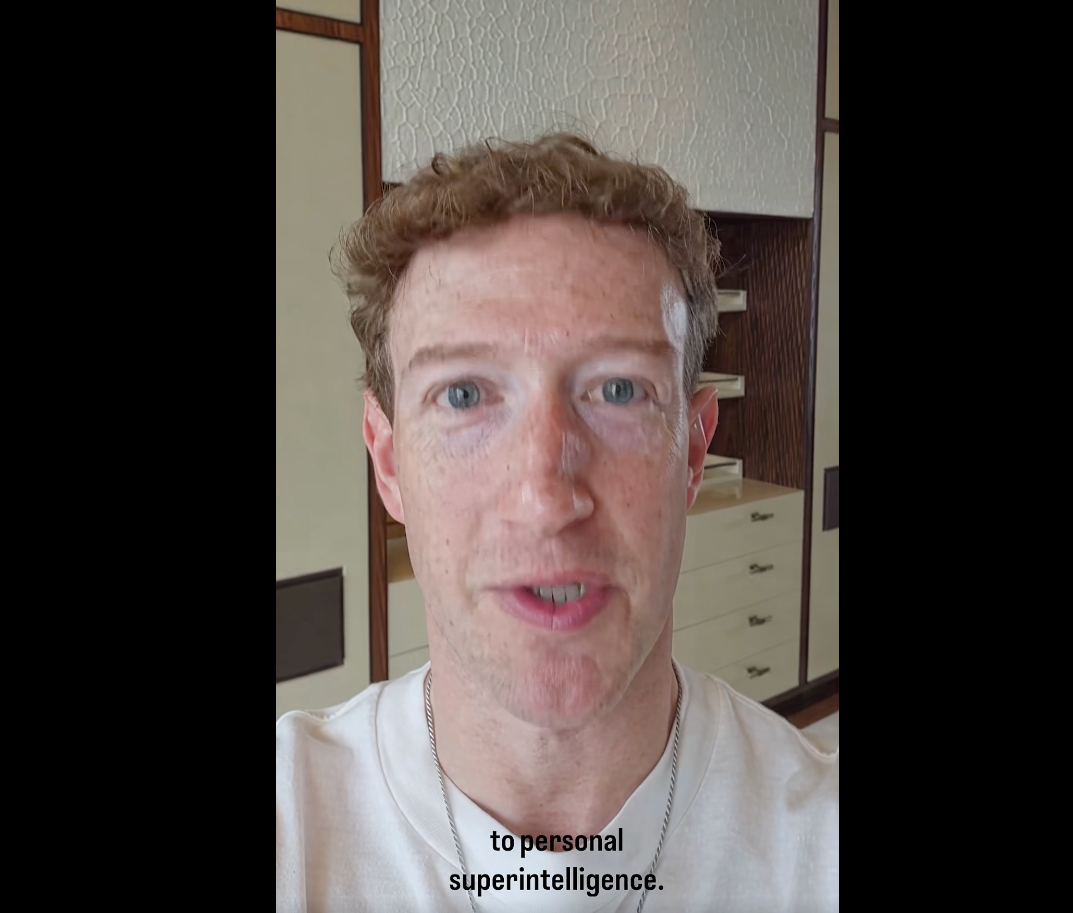
Mark Zuckerberg, whose superyacht apparently spent the weekend ignoring or missing the distress signal from a boat that ran out of fuel near Alaska, has posted a deranged, 6,500 word essay detailing his vision for AI superintelligence, a future that is “for everyone” but which sounds less social than ever.
Zuckerberg posts these types of essays every so often for purposes that serve his own company, and this one, called “The Future Is For Everyone,” is designed to defend against general backlash to AI but also to Meta’s own practices. Zuckerberg lays out the potential use case for Meta glasses (whose huge marketing campaign cannot get people to stop calling them “pervert glasses”), AI agents, open weights AI development, and why data centers are not bad for communities, actually. Like most Silicon Valley “utopian” essays, to believe that any of this is going to go how Zuckerberg suggests it will requires one to have been recently concussed or to willfully ignore how this technology is being used today and believe that thousands of years of human nature will suddenly shift.
For example, Zuckerberg writes “Everyone will have an exceptionally capable personal agent that understands you, your goals, and everything you care about. Your agent will work 24/7 on your behalf to improve your relationships, health, career, finances, home management, hobbies, and more. It will free up time for the things you enjoy, and help you accomplish more than you could otherwise. It will have strong privacy and security options so you can trust it to handle all of your personal content knowing that no one else can access your information, similar to how encryption works on WhatsApp. You’ll be able to interact with your agent through any device, including your glasses to keep you present in the moment with the people you care about.”
Zuckerberg does not grapple with, or even gesture at, the idea that some people may not want to have an AI agent working on their “hobbies.” He does not consider that, even if everyone were to have an AI agent, perhaps not everyone would use these AI agents for good. In the few months that AI agents have become popular among the early adopter set, we have seen “benevolent” AI agents endlessly spam humans and the internet with drivel. And those are just the kind-of-annoying ones. We have seen AI agents hack companies, and over the weekend an Australian man went viral because his AI agent that he asked to sign him up for gym classes did so by hacking the gym’s reservation system and canceling other people’s reservations.
Like many AI weirdos, Zuckerberg explains how AI has already changed his life by allowing him to automate many of the joyful tasks of parenting by outsourcing them to an agent: “My agent flags interesting information and helps me prototype ideas. It helps keep me healthy by monitoring my sleep and then watching as I train and giving feedback. My daughter loves to bake so my agent plans personalized recipes for us to make together each weekend, orders the ingredients, and then offers suggestions as we’re baking,” he writes. “My 8 year old daughter can already code her ideas and produce videos in an evening that would have either taken me months or been impossible previously. Now we’re designing a robot together.”
Zuckerberg’s essay goes on and on and on like this. He imagines a future where everyone can do everything and wants to do everything. In Zuckerberg’s future, everyone will have a business run by their AI agent. Everyone will be inventing things and doing basic research on the nature of the universe and physical elements, for some reason. Zuckerberg writes that Meta employees, with the help of AI, are “generating novel crystal structures that are ideal for augmented reality glasses,” then writes “everyone will soon have invention superpowers,” and that “everyone […] will be able to contribute to scientific progress.”
In this future that, again, is for “everyone,” Zuckerberg explains that AI tools will be free, but that, actually, using it will be a tiered system that is exactly the same as it is now: “For everyone to be part of the future, everyone must have the ability to use superintelligence to improve their lives and shape the world. We will offer free versions that will be accessible to billions of people. For those who want to pay to use more compute, there will be a dynamic auction mechanism that will guarantee that everyone gets the lowest price possible for the intelligence and compute they’re using while also ensuring the capacity is used for whatever people collectively find most valuable.”
Zuckerberg’s essay is full of platitudes and sentences that mean nothing, “thought experiments” that are not developed or explored in any way, discussions of “freedom,” etc. Here are some sentences:
- “Humanity is not a monoculture. People’s diverse values represent different tradeoffs they would make on important issues. There is no technological solution that can align with everyone’s opposing interests and values at once.”
- “As a thought experiment, imagine only one person had a superintelligent lawyer. They would have an unfair advantage in court — even if they were wrong on the merits. That would lead to a worse society. But now imagine everyone has a superintelligent lawyer. In this case, justice would be carried out much more fairly and efficiently than it is today when there is often an imbalance in skills and resources in litigation.”
- “People have an infinite demand for new experiences and have always found new problems to tackle.”
- “While the number of questions a person can ask in a day is limited, the number of valuable things superintelligence can invent to help achieve your goals is unlimited.”
- “If people can use AI to invent incredibly valuable new things, then it will make more sense to allocate it towards that rather than automating existing jobs. The more superintelligence serves as a tool of invention, the more likely that individual capability outpaces automation and the future is better for people.”
- “In a free society, people will have tools that can be used for good or harm, but law enforcement and military have more weapons and intelligence-gathering.”
There is an entire section on data centers. In Zuckerberg’s future they are powered by power infrastructure Meta owns (which is not the case currently) and create lots of high-paying, long-lasting jobs (not the case currently).
There is an entire section on “preventing government tyranny” by giving everyone superintelligence: “To maintain freedom, we must ensure that superintelligence primarily empowers individuals. The ideal in liberal democracy is that people naturally hold all rights and only agree to restrict some freedoms to protect the common good. Similarly, individuals should have access to personal superintelligence and should only be subject to restrictions when truly required.”
Zuckerberg does not address the backlash to his company, his data centers, his social media platforms, or his surveillance glasses. He does not discuss the slopification of the internet, gestures at job loss only through the lens that superintelligence will somehow fix it once AI agents start businesses for everyone or “invent incredibly valuable new things,” and describes a future in which bad actors essentially do not exist or are easily dispatched with.
It’s the future Zuckerberg wants. It’s not the future “everyone” wants.