India’s space sector is expanding through new policies, rising private activity and a growing set of deep-tech ambitions.
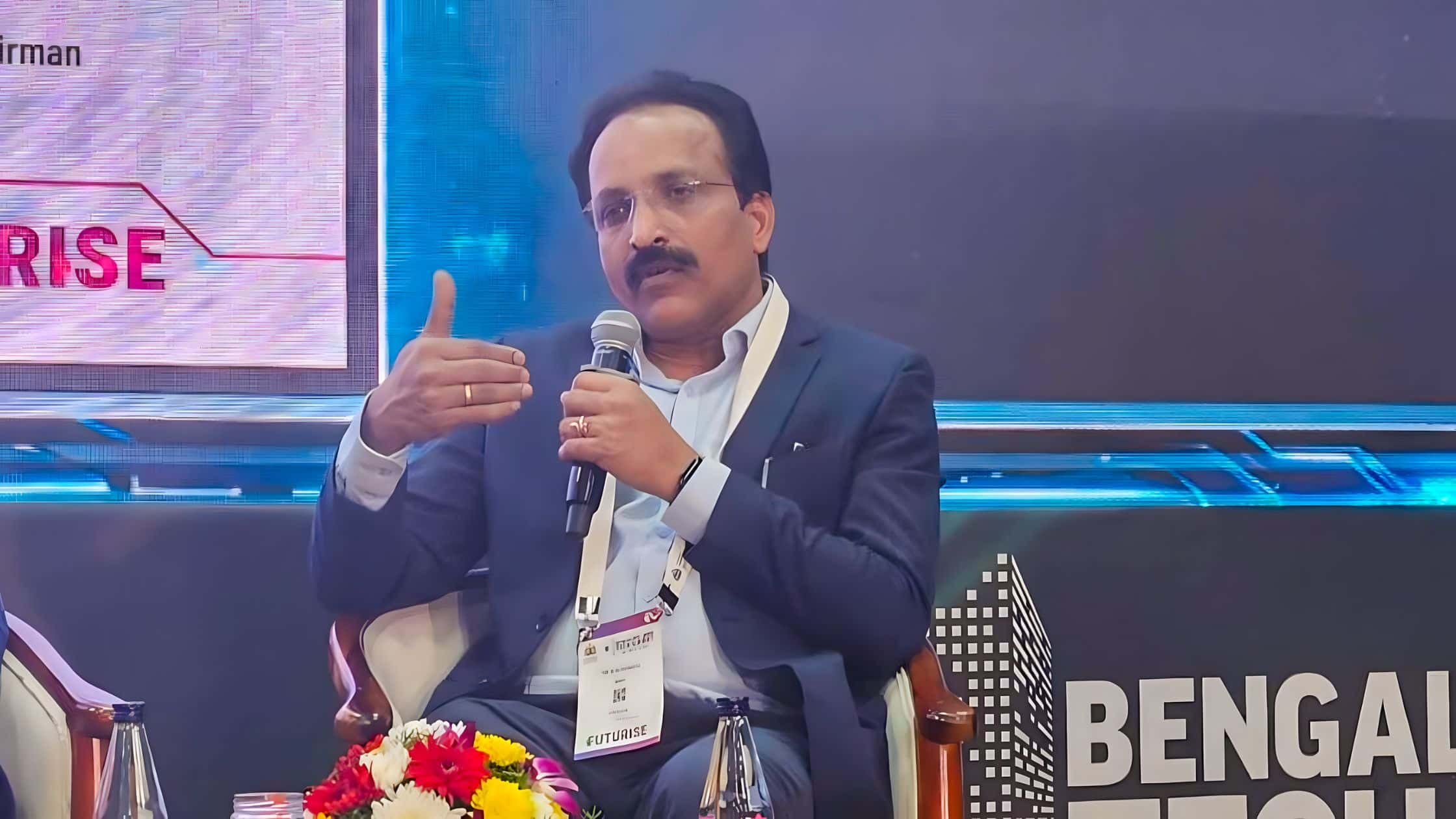
Yet, one question continues to surface in every discussion on long-term capability: does India have enough talent to support this shift, or is the country losing its best minds to opportunities abroad? On the first day of the Bengaluru Tech Summit 2025, this debate took an unexpected turn when former ISRO chairperson S Somanath said, in clear terms, that the idea of a space sector brain drain does not match reality.
The comment came in response to AIM’s question about whether he thinks brain drain plays a role in India’s space tech, and, if so, how the country can get that talent back. “I really don’t find any shortage of brains in India. I think we have enough. Actually, enough and more for other sectors. There is no brain drain,” Somanath said.
His view challenged a belief that has shaped several policy conversations in the last decade. According to him, India’s problem is not losing talent. The bigger gap is the lack of strong research environments that allow people to return and continue their work.
“What we need is to encourage them to come back and work with them at some point in time. The environment is the problem, not money. Outside India is an extreme environment where they have to do research,” he said. “If you are able to provide that type of facility, they will have to come back.”
His comments come at a time when Karnataka has announced the Space Technology Policy 2025-2030. The policy aims to capture 50% of India’s space market by 2033.
It also plans to expand testing facilities, satellite design clusters and manufacturing zones. These goals underscore the need for robust talent pipelines and long-term research environments. The policy places new focus on skills, deep-tech R&D and public partnerships, which align directly with Somanath’s view that India must create the right conditions to keep people in the country.
Where Talent Exists, Infrastructure Must Follow
The panel, moderated by Shashank Joshi, The Economist’s defence editor, brought together Somanath, Dhinesh Kanagaraj, founder and CEO at Fabheads Automation, and Prashanth Prakash, chairperson of the Karnataka Vision Group on Startups and a partner at Accel.
Somanath stressed that strong talent exists not only in top institutions but across several layers of the education system. “I have seen with my own experience that we find brilliant people at every level of these institutions,” he said. His point matched a broader trend in Karnataka.
The Bengaluru Innovation Report 2025 shows that the state now supports over 450 startups in regions outside the city. These include Mangaluru, Mysuru and Hubballi-Dharwad.
The report also shows that Bengaluru attracts 58% of India’s AI startup funding and has recorded the most deep tech patents in the country between 2020 and 2023.
Kanagaraj echoed this through his own experience of building a company that works with advanced composites. His team often struggled to access high-precision systems in India.
“There are not that many vendors out there available to cater to any of the new requirements,” he said. Their company had to build several critical components from scratch, which extended development timelines and raised costs. His account pointed to a larger issue: India needs more shared infrastructure to help early companies build faster.
The panellists also noted that this situation has improved in recent years. Accelerators, grants and deeper engagement between ISRO and start-ups have helped new players enter the field at a pace that wasn’t possible earlier.
Yet, current progress still depends heavily on government support. Somanath said that “real fundamental work” continues to rely on public funding and that early deep-tech companies in any country receive their first support from the state.
This brought the conversation back to the question of scale.
Patient Capital is the Need of the Hour
India has several space startups, but still lacks large companies that can supply global markets. “We need to create large-sized space companies in India; this is what is missing now,” Somanath directly said. He argued that without long-term patient capital, industrial facilities and strong demand from public agencies, scaling will remain difficult.
Prakash explained that deep-tech investing has moved forward in the last decade, but still needs more patience. “Returns may be some way off,” he said, adding that investors now understand that long gestation cycles are normal in such fields.
He noted that many funds have begun allocating space, manufacturing and advanced materials, though consumer and financial technology still receive the largest share. Over time, he expects deep tech to become a much larger part of India’s investment market.
Programmes that once offered ₹2 crore now offer up to ₹50 crore. This allows start-ups to tackle harder problems, build prototypes and take on larger projects.
Prakash suggested that government direction could influence how these funds allocate capital in strategic sectors. This, he argued, would help close some of the gaps in manufacturing, supply chains and R&D.
Next Wave is Cross-Domain Skills
While most of the panel focused on space and hardware, Somanath pointed to a broader trend. He said future disruptions will come from “the interaction between engineering and the human body” and that many engineers abroad now work in biomedical and biophysical systems. He listed drug delivery, health sensors, medical equipment and related research as areas that will grow in importance.
His point was clear: India must prepare for technologies that blend biology, AI and engineering. This shift will need new labs, new training pathways and new forms of collaboration between institutions. It will also demand stronger talent retention and a new set of return-opportunity programmes for researchers abroad.
For now, Somanath said that India is only at the beginning of this shift. He mentioned China’s 10-year effort to bring back top researchers and said India had only “just started the process.”
The post ISRO Ex-Chairman Believes There’s No Brain Drain in India’s Space Tech appeared first on Analytics India Magazine.