Following a relatively lacklustre stretch, the Indian stock market is set to launch its largest initial public offering (IPO) to date.
Reliance Industries’ digital and telecom arm, Jio Platforms, will debut on the stock market on October 28 as a separately listed company. Investors have oversubscribed its ₹30,213-crore offering by 22.19 times. As per IPO Watch, the grey market premium stands at Rs 245.
As investors look to Jio’s listing to revive sentiment in a sluggish market, here are some lesser-known details about its business, finances, partnerships, and ambitions beyond telecom.
The Two-Shareholder Structure
Reliance Industries Limited, the promoter (RIL), holds 66.43% of Jio Platforms before the issue.
Meta affiliate Jaadhu Holdings holds 9.98%, while Google International holds 7.73%.
In April 2020, Meta invested $5.7 billion for a stake, making it one of Jio Platforms’ largest external investors.
The investment came with a commercial partnership between Jio Platforms, Reliance Retail, and Meta to bring more of Reliance’s retail business onto the messaging platform WhatsApp.
Launched in August 2022, JioMart on WhatsApp let users browse, add to cart, and purchase products natively. By September 2023, monthly orders increased sevenfold year-on-year, and new-customer conversions grew sixfold month-on-month.
Group B investors, including KKR, Silver Lake, the Saudi Public Investment Fund, Mubadala, Intel Capital and Qualcomm, hold the remaining 15.86%.
The company proposes a fresh issue of up to 27 crore shares, equivalent to approximately 2.93% of its post-issue equity.
Although the fresh issue will dilute RIL’s stake from 66.43% to around 64.4%, it will retain a clear majority in Jio Platforms and continue to exercise significant influence over the company’s business and key decisions
IP, Patents, and Homegrown Tech
Jio Platforms develops core technologies in-house, including its 5G core, network management systems, and customer apps. Specialised subsidiaries support telecom software, wireless broadband, and digital services.
As of June, Jio Platforms and its subsidiaries had filed 7,220 patent applications across India and overseas, covering 4G, 5G, 6G cloud-native core network architecture, AI-driven network automation and other digital technologies.
Of these, 1,043 had been granted, leaving about 85.5% without a granted patent. The company cautions that it cannot assure approvals of the pending applications.
Its technology portfolio was built partly through acquisitions by its parent, RIL, and later brought under the Jio Platforms umbrella. RIL acquired US-based Radisys Corporation in 2018, adding open-architecture telecom software, hardware and services.
In 2023, Jio Platforms acquired wireless broadband equipment maker Mimosa Networks for $60 million through Radisys, strengthening its fixed wireless access and wireless backhaul capabilities.
RIL also expanded the group through investments and acquisitions of various digital assets, brought together under Jio Platforms. These include Jio Haptik Technologies, which develops conversational AI platforms; Reverie Language Technologies, which specialises in language-localisation technology; and Sankhyasutra Labs, which develops simulation software and services.
Jio also lists JioBrain as its proprietary AI platform, embedded in network operations for tasks such as capacity allocation, fault prediction, anomaly detection and network optimisation.
In its draft red herring prospectus, the company noted that it employs nearly 28,000 full-time staff alongside more than 63,000 contract workers, and this public listing marks a massive payday for its core tech workforce.
Jio had 12,477 employees in digital products and technology development, representing approximately 45% of its full-time workforce, as of June. Of these, 8,156 worked on digital products and services, while the rest were engaged in network technology engineering.
What About Data Centres?
RIL owns Jio’s main data centre facilities in Mumbai, Jamnagar, and Nagpur.
Jio rents the space, electricity, and cooling setups from RIL on a cost-plus-margin basis under contracts approved through FY2032. As it’s a material transaction between related entities, shareholders have set a fixed ceiling on what Jio can pay RIL for these services.
For FY2027, the ceiling for data-centre services is ₹4,600 crore. From FY2028 to FY2032, the annual ceiling rises to ₹5,300 crore, covering data-centre services as well as business support and infrastructure services.
Jio also operates a distributed computing footprint, including more than 100 edge nodes deployed within its 4G and 5G networks. Its infrastructure includes fibre connectivity at more than 1,200 facilities across India, alongside partnerships with global cloud providers such as Microsoft and Google Cloud.
It has investments and consortium interests in several subsea cable systems that connect India to major data hubs in Singapore, Europe, the Middle East, and the United States.
In 2025, Jio completed the India Asia Xpress cable system in collaboration with other telecom operators, including hyperscalers.
The company is also developing cable landing stations at Digha in West Bengal and Machilipatnam in Andhra Pradesh, supplementing existing facilities in Mumbai and Chennai.
The Loss-Making Subsidiaries
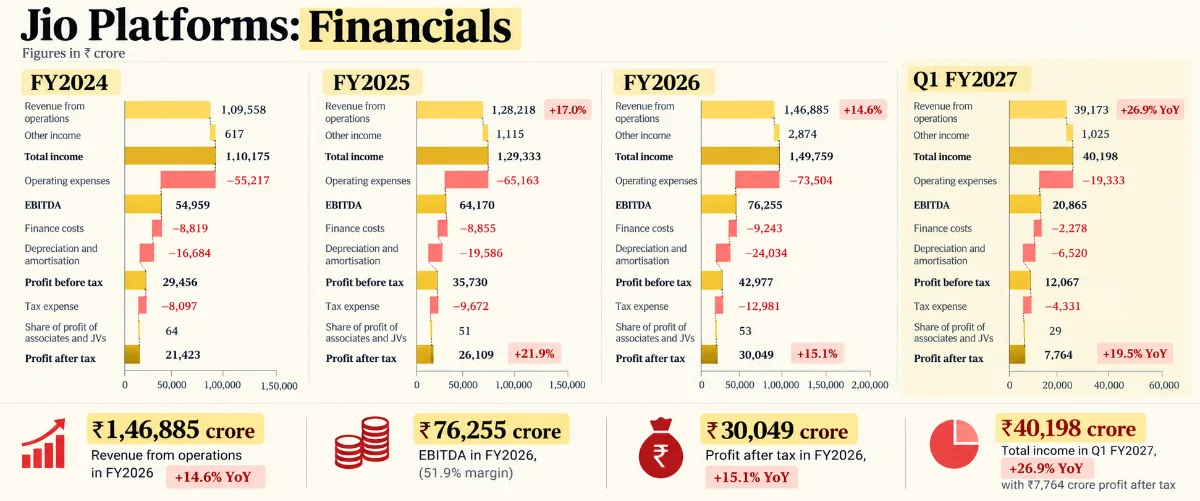
Reliance Jio Infocomm Limited (RJIL), Jio Platforms’ main telecom subsidiary, generated ₹28,173 crore in profit after tax in FY26, accounting for 93.76% of Jio Platforms’ consolidated profit after tax.
However, several of its smaller digital and technology businesses continue to report losses. Eleven of Jio Platforms’ 33 subsidiaries reported losses in FY26, and that number rose to 15 in Q1 FY27.
Their combined after-tax loss was ₹20.5 crore in the quarter, compared with ₹100.6 crore in FY26.
Struggling to compete with Spotify and YouTube Music, Jio’s music and audio streaming business, Saavn, posted a loss of ₹53.7 crore in FY2026 and carried accumulated losses of ₹1,131.8 crore as of Q1 FY27.
The company’s AI-powered ed-tech platform Embibe carried accumulated losses of ₹88.2 crore as of mid-2026.
Reverie, which offers AI-powered language translation and voice technology solutions, logged a ₹7.1 crore loss in Fiscal 2026, with accumulated losses standing at ₹77.4 crore.
Several global entities under the Radisys umbrella have also weighed on the books. Radisys Canada, for instance, carried accumulated losses of ₹395.6 crore as of Q1 FY27, alongside ongoing operational deficits in entities like Radisys Technologies Shenzhen and Radisys UK.
The Environmental Footprint
Operating over 360,000 network towers and high-capacity data centres consumes substantial electricity. In FY 2026, Jio spent ₹10,933 crore on power and fuel.
Jio plans to transition to 100% renewable energy to curb fuel emissions, but it is starting from a relatively modest base.
As of March 31, its renewable capacity powering the network was 236.7 MWp, including a 25 MW solar farm in Bidar, Karnataka, along with small rooftop solar setups.
In FY 2025, the Maharashtra Pollution Control Board issued a show-cause notice refusing the company consent to operate under the Water Act, Air Act, and Hazardous Waste Rules due to delays in submitting renewal paperwork. However, Jio settled the issue and paid the required penalties to secure operating permits.
The Risk Factors
Jio Platforms discloses notable structural and financial vulnerabilities.
Chief among them is that over 56% of its physical and developmental network assets remain completely uninsured against material damage, with spectrum entirely excluded from coverage.
On its balance sheet, Jio carries over ₹1.04 lakh crore in sovereign deferred spectrum debt to the Department of Telecommunications, alongside an unacknowledged ₹6,795 crore tax dispute over tower equipment input tax credits that it keeps off its contingent liabilities.
On top of these debt pressures, JioAirFiber faces a major policy risk. Its low-cost model relies on ‘free,’ unlicensed radio airwaves to deliver home broadband.
If the government charges fees or auctions off these frequencies, Jio’s deployment costs could rise sharply.
While it doesn’t name Starlink, it does identify satellite broadband as an emerging threat to its empire.
With lower spectrum entry costs, low-latency satellite constellations can beam high-speed internet straight into remote homes, government offices, and enterprise sites without laying a single meter of underground fibre or erecting local towers.
While Jio is mounting its own satellite counter-play through a joint venture with Luxembourg-based SES, the company cautions that rolling out a cost-competitive satellite alternative in time is far from guaranteed.
Moreover, India’s strict net neutrality rules bar telecom operators from creating fast lanes, throttling traffic, or offering preferential data rates to favoured platforms.
For Jio Platforms, which operates both the telecom pipe and the apps running on it, this creates a persistent regulatory ceiling.
It limits how aggressively the company can commercialise 5G “network slicing”, charging premiums for dedicated, low-latency enterprise or gaming lanes, while barring it from giving its own digital apps (like JioCinema and JioSaavn) or RIL’s media giant, JioStar/Hotstar, preferential access.
These restrictions help prevent unfair distribution or a bandwidth advantage over third-party rivals.