
Welcome back to the Abstract! Here are the studies this week that moved the heavens, coveted crystals, dined on lunar legumes, and got a four-star review.
First, humanity has permanently signed its name into the orbital dynamics of the solar system. Take the win! Then, we’ve got the origins of our obsession with sparkly rocks, a stint of extraterrestrial gardening, and a story of stellar significance.
As always, for more of my work, check out my book First Contact: The Story of Our Obsession with Aliens or subscribe to my personal newsletter the BeX Files.
DART delivers an orbital bullseye
Well folks, pack it up: Humanity has shifted the path of a celestial object around the Sun.
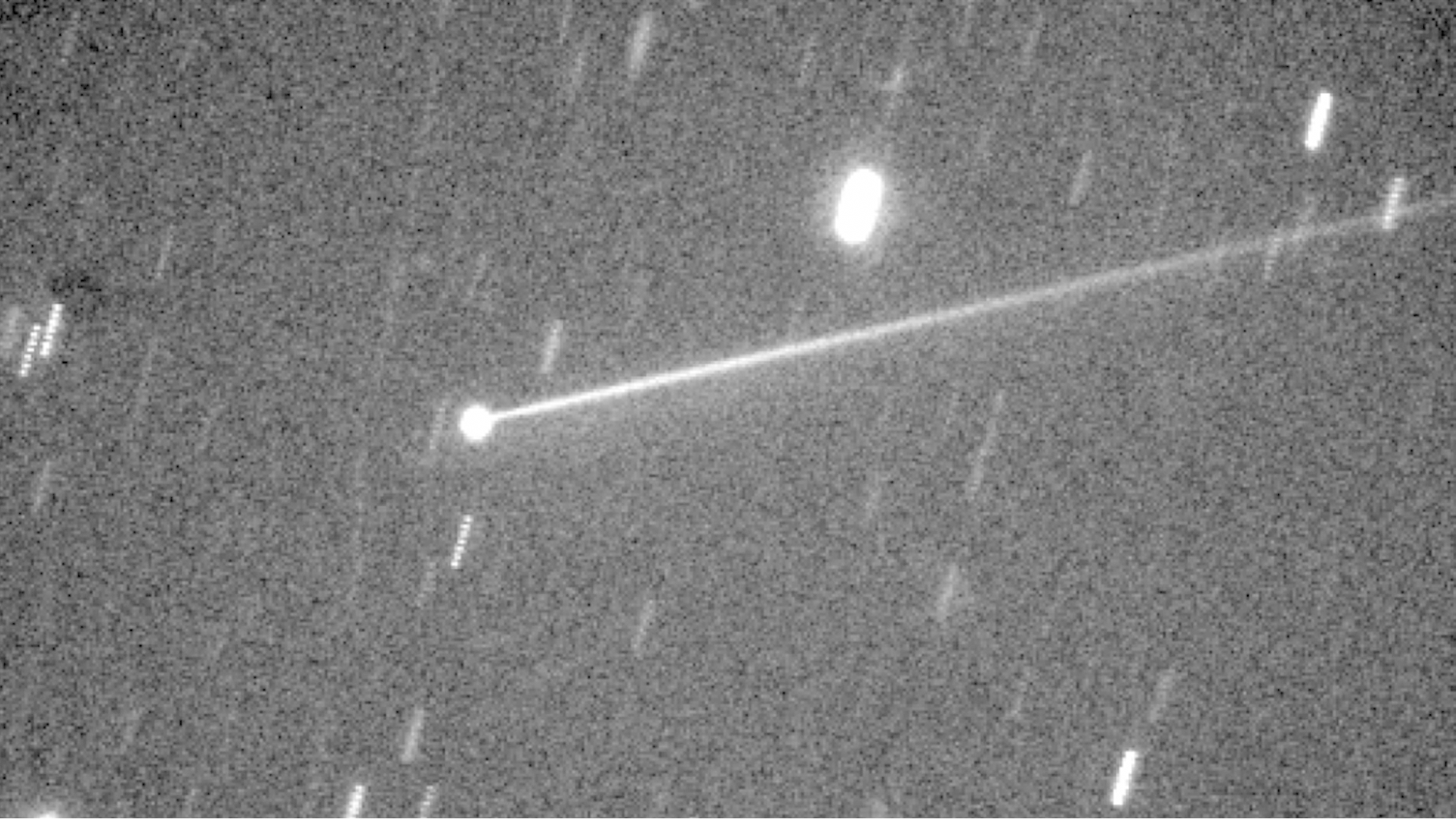
You may remember NASA’s Double Asteroid Redirection Test (DART) spacecraft, which slammed into an asteroid named Dimorphos in September 2022. Dimorphos, which is about the size of the Great Pyramid of Giza, orbits an asteroid named Didymos, roughly five times bigger. In the aftermath of the crash, scientists determined that DART had successfully shifted Dimorphos’ path around Didymos, shortening its roughly 11-hour orbit by 33 minutes.
Now, scientists have confirmed that the mission also changed the entire binary system’s “heliocentric” orbit around the Sun. While scientists had expected the spacecraft to push this pair of asteroids off-kilter, a new study has now quantified the impact by presenting “the first-ever measurement of human-caused change in the heliocentric orbit of a celestial body.”
The team determined that the system’s pace around the Sun was slowed by about 10 micrometers per second as a result of the mighty spaceship wallop. It took years to refine that measurement, which the researchers calculated with radar and stellar occultations, which are observations of the system against background stars.
But it’s worth the wait to know that we shifted a celestial object’s circuit around the Sun, even by a tiny bit—an achievement that may come in handy if we ever need to deflect an asteroid or comet on a collision course with Earth.
“By demonstrating that asteroid deflection missions such as DART can effect change in the heliocentric orbit of a celestial body, this study marks a notable step forward in our ability to prevent future asteroid impacts on Earth,” said researchers co-led by Rahil Makadia of the University of Illinois Urbana-Champaign and Steven R. Chesley of NASA Jet Propulsion Laboratory.
So, forget moving mountains—we’ve graduated to moving space rocks.
For anyone interested in learning more about DART, I highly recommend How to Kill an Asteroid by Robin George Andrews, which provides a fascinating inside account of the mission.
In other news…
Chimps glimpse a “big beyond”
It’s crystal clear: We clearly love crystals. Humans and our early hominin relatives have collected crystals for nearly 800,000 years, making them “among the first natural objects collected by hominins without any apparent utilitarian purpose,” according to a new study.
To explore the origins of this fascination, scientists gave chimpanzees, our closest living relatives, a bunch of sparkly crystals at an ape preserve in Spain. The chimps were intrigued by the offerings; indeed, one female named Sandy immediately absconded with a large crystal dubbed the “Monolith” and took it back to her group’s indoor dormitory for two days.
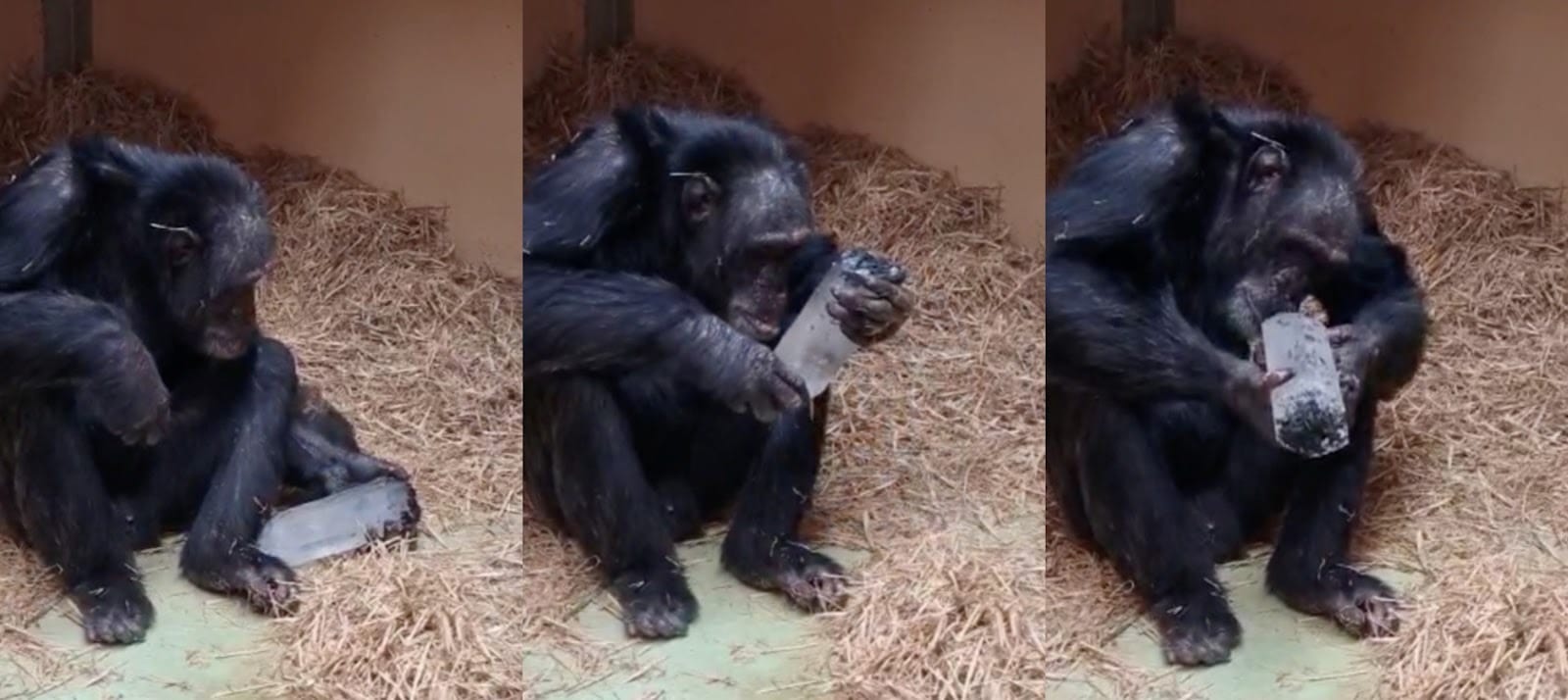
“When the team of caretakers tried to retrieve the crystal, it took hours to exchange it for valuable ‘gifts’ (i.e., favored food items—bananas and yogurt—which are known from daily observations to be highly appreciated by the chimpanzees), which suggests that the crystal was highly valued,” said researchers led by Juan Manuel García-Ruiz of Donostia International Physics Center.
“Crystals may have contributed to the development of metaphysical and symbolic thinking, acting as catalysts for the conceptualization of a ‘big beyond,’” the team concluded.
Shining moonbeams on moon beans
Scientists are finally addressing my dream of enjoying locally-grown falafel on the Moon. In a new study, a team experimented with planting chickpeas in lunar regolith simulant (LRS), a human-made substance that mimics lunar soil.
The results revealed that chickpeas could flower and produce seeds in the simulant, provided that it was treated with arbuscular mycorrhizal fungi (AMF) which are fungal microbes known to protect plant health. Small additions of vermicompost also helped the Moon beans flourish.
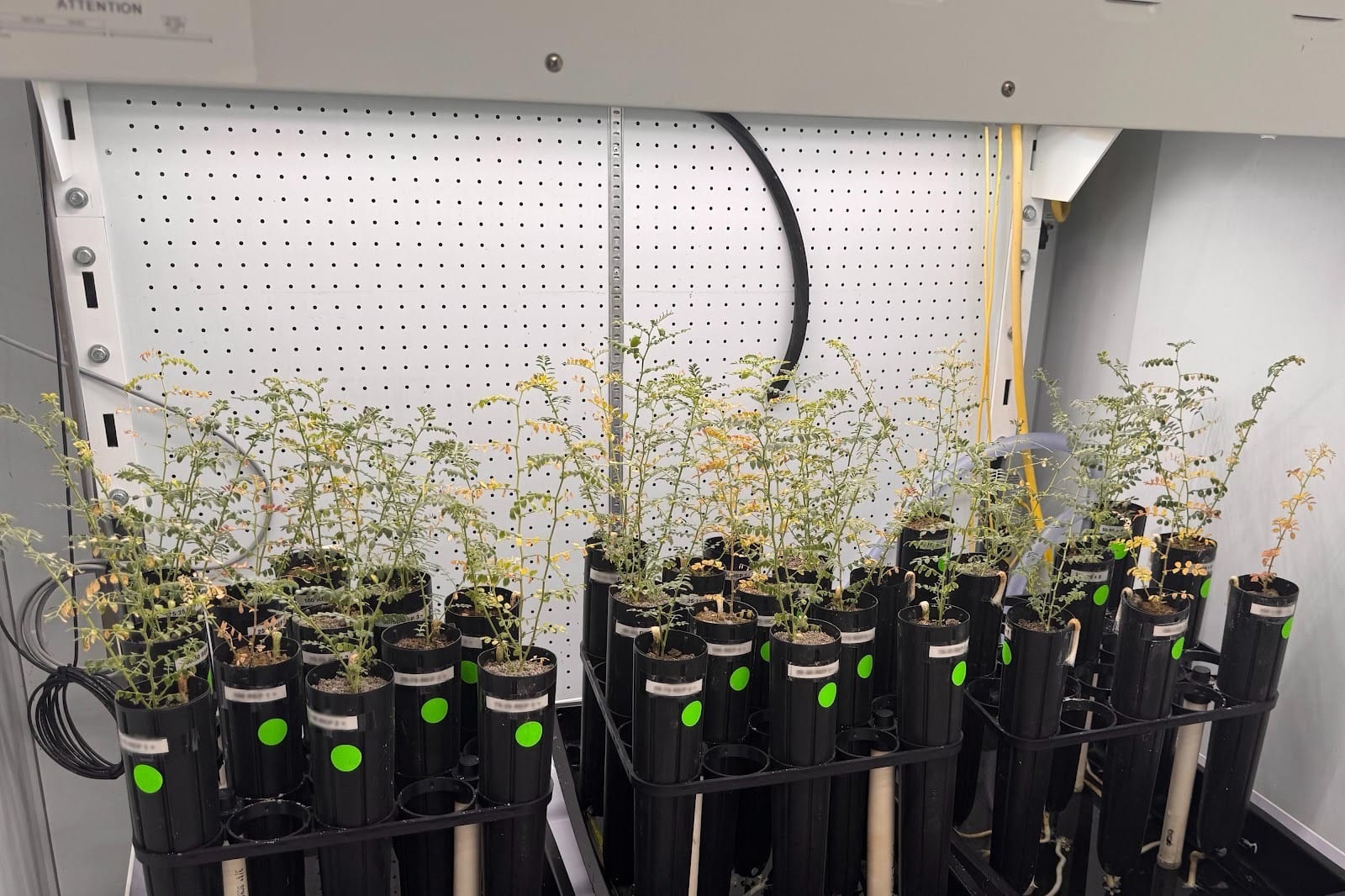
“Plants seeded successfully in mixtures containing up to 75 percent LRS when inoculated with AMF,” said researchers led by Jessica Atkin of Texas A&M University. “Higher LRS concentrations induced stress; however, plants grown in 100 percent LRS inoculated with AMF demonstrated an average extension of two weeks in survival compared to non-inoculated plants.”
“We present a step toward sustainable agriculture on the Moon, addressing the fundamental challenges of using Lunar regolith as a plant growth medium,” the team concluded.
Who knows if we’ll ever live off the lunar land, but as a garbanzo fanzo, I’m hoping for heavenly hummus.
TIC 120362137 is the real quad god
Three-body problems are so last season; the era of the quadruple star system is upon us. In a new study, scientists unveil the most compact quartet of stars ever discovered, known as TIC 120362137, which is about 2,000 light years from Earth.
“This inner subsystem, which contains three stars that are more massive and hotter than the Sun, is more spatially compact than Mercury’s orbit around our Sun, and is orbited by a fourth Sun-like star with a period of 1,046 days,” said researchers co-led by Tamás Borkovits and Saul A. Rappaport of the University of Szeged, Hai-Liang Chen of the Chinese Academy of Sciences, and Guillermo Torres of the Center for Astrophysics, Harvard & Smithsonian.
“To our knowledge, there are no other known, similarly compact and tight, planetary-system-like 3 + 1 quadruple stellar systems,” the team added.
The researchers predicted that this fantastic foursome will eventually merge together into a pair of dead stars known as white dwarfs in about nine billion years. No planets have been found in this system, and it may be that it is too dynamically eccentric to host them. Still, it’s fun to imagine the view from such a hypothetical world, with four Suns in its sky. Eat your heart out, Tatooine.
Thanks for reading! See you next week.

