
Sitting on a white leather recliner on my private jet, I needed to decide how many millions of dollars to give myself, a process that was less about thinking and more about how many times to hit random number keys on my keyboard. I watched 404 Media’s revenue graph go up and to the right.
I clicked record on my camera, wanting to show my followers how hard I work, even when I’m getting shuttled off to exotic locations. “We’re here on the PJ, off to Ibiza. Got the passport, got the prosecco. We’re hustling. 404media.co,” I say. “You want to get rich? Publish journalism on the internet. I just published something.”
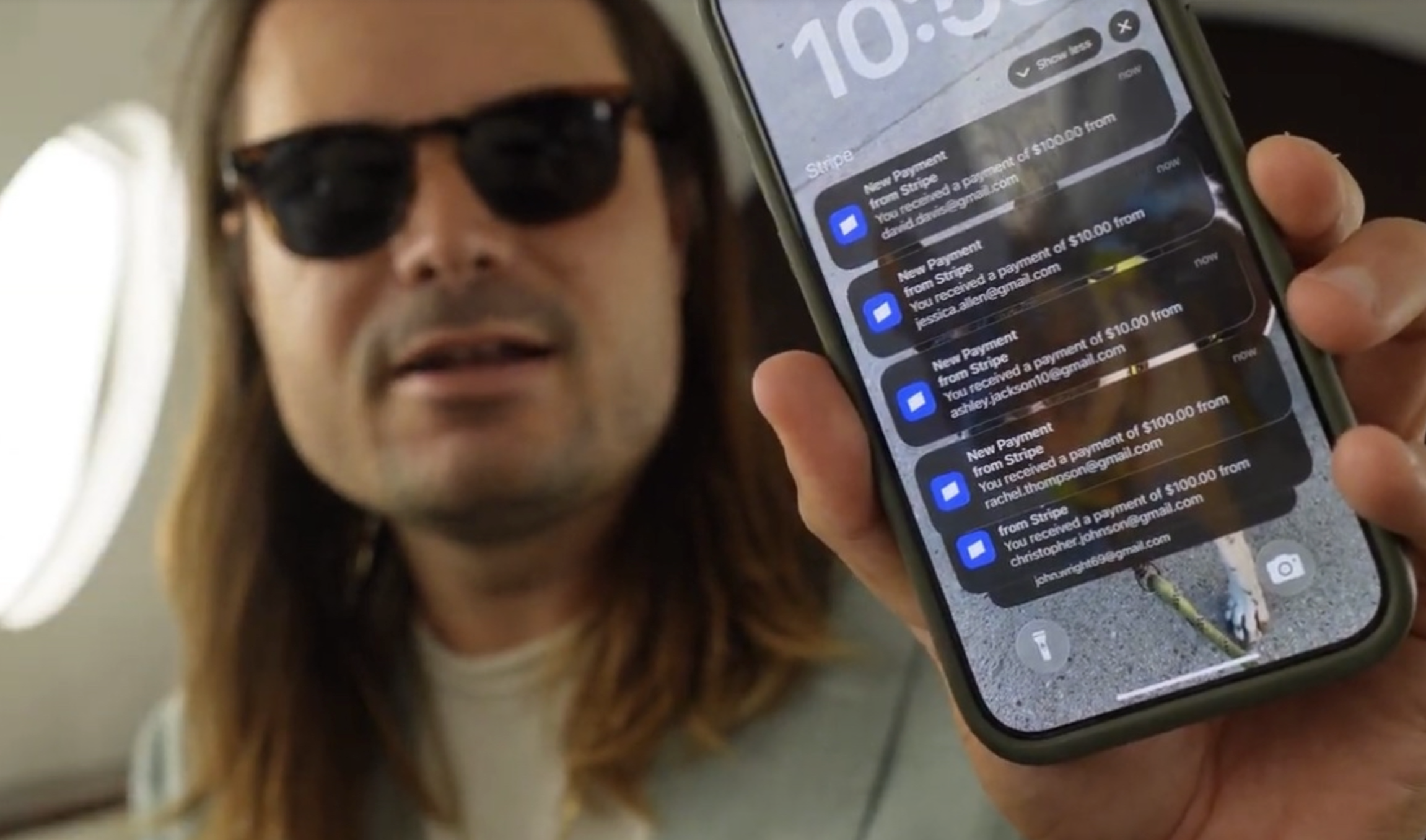
Because I’d sold tens of thousands of dollars worth of subscriptions today alone, I wanted to show my followers just how quickly I’d been making money. I opened the Stripe app on my phone and decided how many subscriptions I wanted to sell. I used a slider bar—again, somewhat at random—to select 164 new subscribers, spaced out every .5 seconds. I clicked a button that said “Start Burst.” Notifications begin streaming across my phone’s Lock Screen. I hold it up to the camera.
“Let me show you how easy it is. Just published,” I say, holding my phone up to the camera. “New Payment from Stripe,” the notifications read. “You received a payment of $100 from rachel.thompson@gmail.com,” one says. Then John Wright subscribes. Then Megan Johnson. Then Daniel Thomas. Honestly, I can’t keep up. “Ten dollars, ten dollars, a hundred dollars a hundred dollars,” I say, pointing at the phone. “Take my easy course online, learn how to become rich like us.”
“Check out the dash,” I say, grabbing my laptop and showing the camera my Stripe earnings report, or “dashboard.” “This is from today only. $51,000 gross, $2.7 million so far this year. It’s easy. Take my online course, join the community, I’ll show you how to be rich.”
I stop recording. In reality, I was sitting alone in photo studio Olympic 4, inside a warehouse jammed between the 5 freeway, a railway for cargo trains, and the largely dry, concrete Los Angeles River. Moments earlier I called a receptionist because the code for my one-hour rental ($65) wasn’t working. I didn’t even have the keys to my fake, indoor private jet. I had to stop recording because my voice inside the private jet was overpowered first by a power saw outside, then by an ambulance siren. My subscribers, my Stripe dashboard, my notifications were all fake of course. My prosecco was real; I bought it at Ralph’s for a party a few months ago on sale for $6. It didn’t matter. I was LARPing. It was going well. Buy my course.
Over the last few years, I have become mildly obsessed with hustle bros: The Instagram, TikTok, and YouTube influencers who claim to have become wildly wealthy by doing some sort of hustle. Some of them make AI babes they monetize via OnlyFans competitors. Some are into crypto. Others do real estate. Some do clipping. Some do AI slop. Some do drop shipping. The thing they all have in common is that they all have an online course to sell you, telling you exactly how they got rich and how you can too. Subscribe for $30 a month and you’ll gain access to their Whop course (a Patreon-like platform popular for hosting hustlebro courses), their Discord community, and, critically, all their secrets. Because I’ve reported endlessly on various hustlebro schemes, I have bought many of these courses, and they’re almost universally the same: They feature shitty, usually AI-generated (or poorly written) PDF guides, a community that has just a handful of people in it, various webinars, video content, and, sometimes, access to various vibe coded software.
Using these simple strategies, they make monthly recurring revenue, allowing them to hustle from anywhere. Why are you, a loser, sitting at home scrolling Instagram Reels on your phone when you could be making and selling AI porn subscriptions while poolside in Ibiza, at a stoplight in your Maybach, while poppin’ champagne on the PJ, or while getting bottle service at the club?
Critical to the hustlebro fantasy is the “dashboard,” which are screenshots and videos of the analytics page for whatever platform you’re using. This is the number of subscribers and revenue you get from hustling, and posting these in your videos or in a slideshow is both a flex and is nominally proof that you are indeed rich and that your course is therefore worth buying.
The extremely obvious truth (which is barely even veiled) is that at least most of these hustlebros are faking it. They hope to make money selling their courses. The scheme is not the AI babe or the drop shipping, it’s the course, the community, the fantasy. They’re LARPing, or LARPmaxxing, if you will. In recent months, LARPing has become a whole subculture on TikTok and Instagram; pretending you’re rich, just for the hell of it.
And so a new economy has popped up to service this fantasy. The LARP influencer sells tools, software, videos, and guides to LARPing; subscribe to my course and I’ll help you make content to market your subscription course about making content to sell subscriptions to poor fools on the internet.
The first LARP influencer I found was someone who goes by “Jordan” on TikTok. I’m not sure which video or slideshow I saw first, but most of his content is the same. His “HOW TO LARP LIKE A PRO” playlist features tips like:
- “Buy a Chinese Rimowa rep (Just walk around with it)”
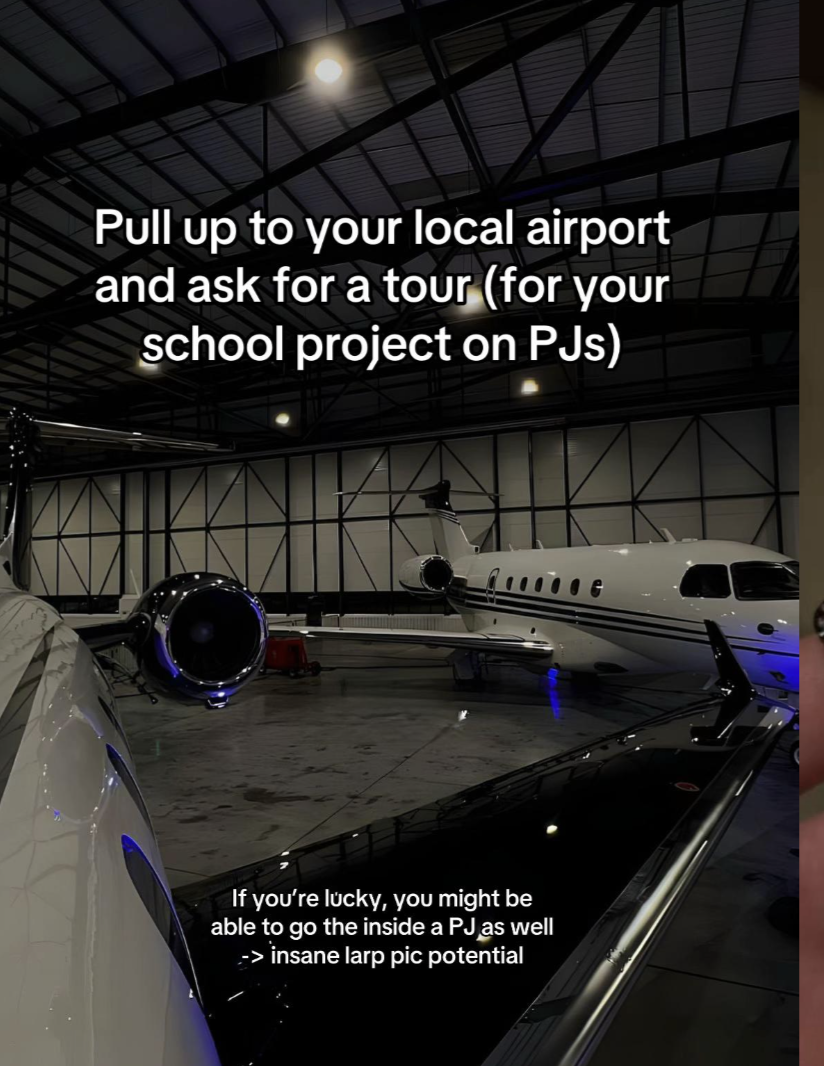
- “Pull up to your local airport and ask for a tour (for your school project on PJs)”
- “Take pics outside Erewhon”
- “Pull up to a boat rental spot, ask for a tour, and then bounce (Take as many pics as you can)”
- “Rent a Maybach for 20min and have your friend drive you around”
- “Open your laptop and act like you’re hustling”
- “Put your old shoe boxes into paper bags (You just went shopping)”
- “Fake dashboards: Very good for more targeted warping (e.g. if you’re trying to sell a course on a specific business method) or to justify your “lifestyle.” Can be done by photoshopping screenshots or by using dedicated dashboard replicas for added realism (link in bio)”
I think all of these tips are very funny, but this last one really intrigued me. Jordan was advertising a Telegram account called the “Fakify” “Larp marketplace.” Fakify has 9,000 members on Telegram and sells just two products: Software that makes fake YouTube, Shopify, Coinbase, and Fanvue dashboards and a web app that sends your phone fake notifications for Shopify, Stripe, and Whop. This software is not cheap. A fake Shopify dashboard costs $750, a YouTube dashboard costs $550. The notification app costs $100.
A demonstration of DashMock
I found various fake dashboard software companies. Some (most?) are vibe coded, and a lot of them look very bad. I found a company called Dashmock, which advertises both to would-be salespeople and to hustlebros as “the secret weapon for agencies and founders. Visual dashboards that close deals.”
“FAKE IT UNTIL YOU MAKE IT,” they advertise. “DashMock lets users create realistic, professional dashboards for major business and creator platforms like OnlyFans, Shopify, Stripe, Fanvue, and Infloww. No coding, no analytics, no real account connections.” Critically, DashMock offers “pixel-perfect” fake dashboards, meaning that the company monitors what a real dashboard looks like and updates their software constantly: “We push updates every single week,” they say. Each dashboard is sold individually, and as a subscription. An OnlyFans dashboard costs $119 a month, a Shopify dashboard costs $149 a month, a Stripe dashboard costs $189 per month.
I thought I would try this software.
I realized that, in many ways, 404 Media has the business that many of these hustlebros say they want to build. We have subscribers, we have monthly recurring revenue. We are not rich, but we do have a functioning business that uses Stripe and Shopify; I could compare the real Stripe dashboard to the fake Stripe dashboard, and the real Shopify notifications to the notifications we get when we sell merch. Rather than reinvent the wheel for my LARP, my fake course would be about journalism, and my general spiel would be that it is incredibly lucrative to publish factual, deeply researched articles and blogs to the internet (a thing that is famously not true). Want to become rich? I will teach you to be a blogger.
Honestly, I have no beef with either the Dashmock Stripe dashboard I bought or the Fakify notifications app I bought. Both do what they say they do. The Dashmock Stripe dashboard lets you edit your revenue graphs by clicking and dragging the lines on the line graph; you can edit your overall revenue and company name hidden in a plus button that is usually used to sell a new product in Stripe (if only real business were this easy). You can also change your logo using a variety of preset options; an upload logo feature did not work for me, which was really the only thing that didn’t work. The URL for the dashboard was also fake (stripè.com, with a backwards accent over the e), and I got a warning when I opened it in Chrome. But otherwise, it would be great for LARPing.
The notifications app was even better. At a website called notification-generator.com, I selected between Stripe, Shopify, and Whop. It is essentially a mobile website that you add as a bookmark to the home screen of your phone. I tested both Stripe and Shopify. You input whatever dollar amounts you want the “sold” product to be, and then can either input a list of fake email addresses or have it randomly generate email addresses from fake “customers” “using common names and weighted domains (~75% gmail.com, ~25% outlook.com). You can customize the notification to say whatever you want; I kept it as “You received a payment of $X from [email address].” You can click a button to send one notification or you can use a slide bar to send a burst of as many as 200 notifications spaced as far apart as you want. This, too, worked very well. While I was setting this up, I got a real Shopify notification for a real t-shirt we sold; it looked the exact same as the fake notifications.
With my fake software set up, I realized I would need to actually LARP to have footage to go along with my fake dashboards.
To LARP, I set some general ground rules for myself. I would work on this for only one day. I would not actually make a course. I felt I could easily take this very far, renting Maybachs, booking trips, etc. I would hop around Los Angeles and emulate things I had seen before in one very chaotic day, and I would be obnoxious in my videos but I would try not to actively bother people.
I started by booking a private jet photoshoot in a warehouse for $65 for an hour. I hopped in my (leased, non luxury) car with my camera, phone, laptop, and a bunch of changes of clothes (to make it look like I was shooting content on different days, a tip I learned from a LARPer). In a stroke of inspiration, I grabbed my passport and a bottle of prosecco. I got to the photo studio and couldn’t get inside, which felt distinctly non-luxurious. Eventually, I managed to amble my way, arms overloaded with gear and clothes, into the studio. The studio felt cheap and old but actually looked good on camera. I shot my footage, which you can see spaced throughout this article. I periodically had to stop for ambulances and power saws, as the studio was working on building out some of its other experiences. The furniture in the “private jet” felt very cheap, like it was probably purchased either secondhand or was the cheapest they could find on Wayfair. While sitting in my jet, I found myself thinking about a Hollywood studio tour I had recently been on, where the guide explained that nearly everything on most sets is built out of styrofoam or other very cheap and light materials; it just needs to look good on camera.



When my hour was up, I thought I should swing by the jewelry district, which is very Uncut Gems. I had bought a necklace there a few years ago and thought maybe the guy who sold it to me would let me hold a Rolex or a stack of gold chains. I circled the jewelry district over and over, looking for parking. I eventually found a lot that charged a mere $25 (lol) for one hour of parking. I got out and looked for my guy, but he wasn’t there. I was not shameless enough to ask any of the vendors to let me hold their very expensive wares for my stunt blog. So I walked to a taco truck (luxurious), and had a stroke of inspiration. I was standing outside of a jewelry box wholesaler, as in, a store that sells jewelry boxes and bags to actual jewelry vendors. I walked in and bought a few jewelry bags and 20 earring boxes for $12. As I ate my tacos, I stuffed the boxes into the bags. I walked back into the jewelry mall and filmed myself walking out “Just walked out of the St. Vincent Jewelry Center,” I said, holding up my bags of empty boxes. “Bought out a few places. This is how much money you can make when you blog. When you’re selling your blogs. You want as much jewelry as me? Buy my course.” I fumbled my bags, which fell all over the street.
I walked back to my car, sat in traffic for 1.5 hours, and got back to my apartment. I live close to Marina del Ray, a huge marina where celebrities and billionaires keep their megayachts. I decided to bike over there and film some content outside of a yacht club: “Gonna go take the yacht out for a spin, head over to the yacht club for some food and drink. If you want a yacht, publish blogs on the internet. The key to getting rich, you can learn in my online course, is to write factual and good journalistic articles that have high impact. You can make millions of dollars a year doing this,” I said. Then I went to Hi-Ho Cheeseburger, bought a burger, and filmed myself (and my laptop) overlooking the yachts.
Some larpers say that you can buy clip packs of exotic locations, which you can use to cut into social media clips. Pools in exotic locations like Bali and Greece, footage from inside nightclubs and concerts, private jets, beautiful nature. This type of fake LARPing, where you buy clips, is seen as lame even by LARP standards, because you can easily be caught faking. To have good footage, you need first-person footage of yourself, and footage with you actually in it, for authenticity’s sake.
The goal for all of this was to film content that I could then use to make it seem like I was really rich. As I was running around Los Angeles alone, portraying a life that I didn’t have, I started thinking about what other footage might exist on my camera roll that could be used for my LARP. To complete my LARP experience, I did what many LARPers do, and hired someone on Fiverr to turn my raw footage into slickly edited reels; I paid a total of $60 for three short edits.
While looking through my camera roll, I began thinking that I have had a very privileged and beautiful life, and that blogging has actually afforded me many opportunities that most people never have. I went on safari to Kenya as part of a conference I was asked to speak at; I’ve been to Norway and Athens, for free, to speak on panels or give trainings, which I have footage of. I have been on lots of boats; last year I rented a yacht with a bunch of friends, which sounds extremely luxurious and was very fun, but ultimately cost us only $50 each.
I thought about a bachelor party I went on where the groom got bottle service as I watched footage of myself dancing on tables with a sparkler in my mouth. I thought of the vacations and backpacking trips I’d taken, the nature I’ve seen, the hikes I’ve been on. As I scrolled through my camera roll I saw all of this stuff, and I started to feel happy, an emotion I did not expect when I was filming myself alone in a sad warehouse. I have had a good life as a blogger.
Surprisingly, by LARPing, I had unexpectedly tricked myself into appreciating my life and the experiences I’ve had. To help me keep it up, please buy my course, or, alternatively, subscribe to 404 Media.

