
This article was produced in collaboration with Court Watch, an independent outlet that unearths overlooked court records. Subscribe to them here.
Newly filed court records show exactly what happens when messaging app Telegram provides data to U.S. authorities.
A letter written by Telegram, and providing a specific user’s phone number, user ID, and IP address, reads:
Dear Sir or Madam,
For this particular case, the following information was available:
User #7149269705 : +201155664529 [Mahmoud Almohtadi]
IP 184.186.72.239, 8 Oct 2025 2:08:12
We hope this information will be helpful in your investigation.
Kind regards,
The Telegram Team
The letter says Telegram provided the data “voluntarily” and that by providing it, Telegram is “not conceding that we are subject to U.S. jurisdiction for this or any other request or any purpose.” A related court filing written by the government the data came in response to a court order issued pursuant to the Stored Communications Act.
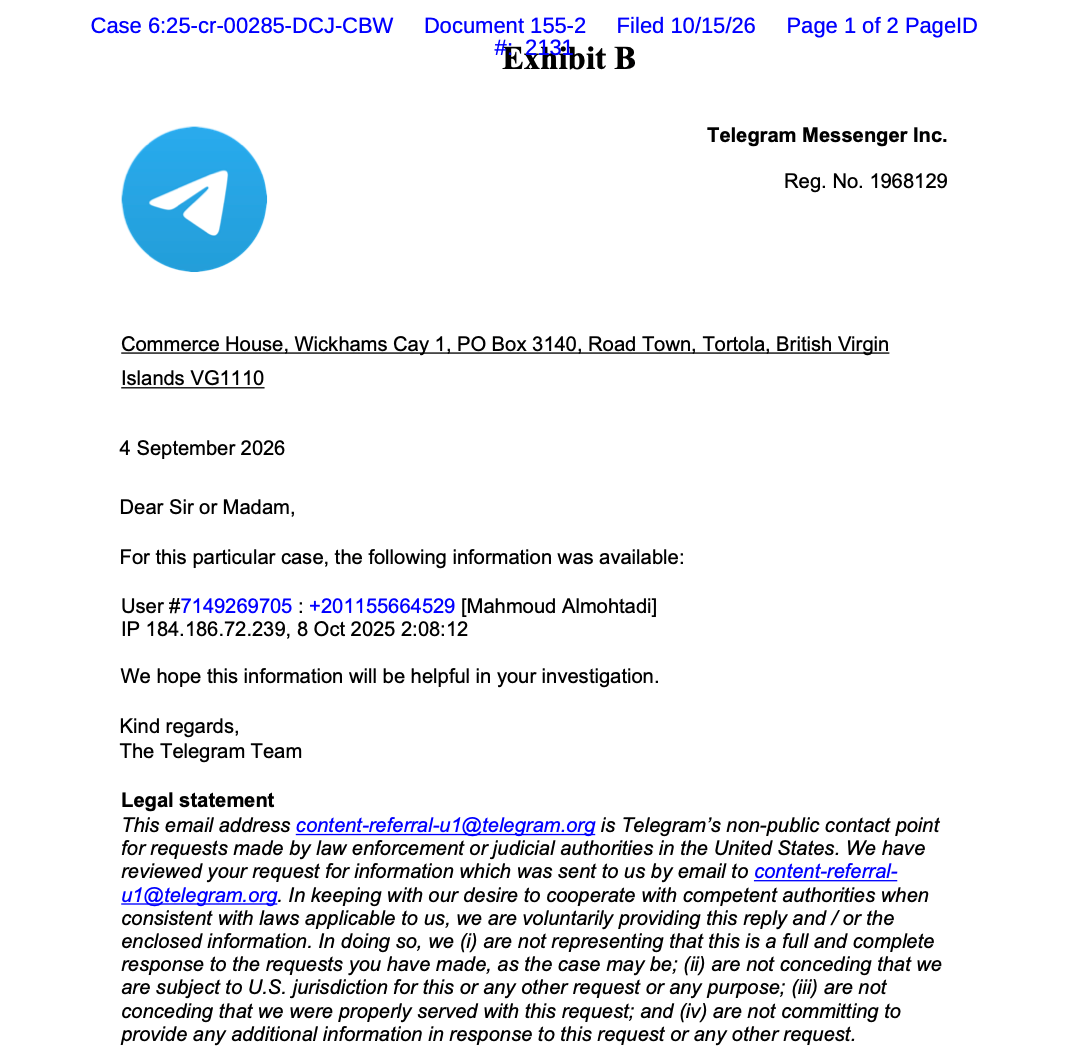
The letter also includes what Telegram calls its “non-public contact point” for requests made by U.S. law enforcement. This email address — content-referral-u1@telegram.org — is now in public court records. Hackers often contact tech companies impersonating law enforcement, often using compromised government email accounts, to trick them into handing over someone’s user data.
The case this document surfaced in centers around Mahmoud Amin Ya’qub Al-Muhtadi, who allegedly participated in the October 7 attacks against Israel.
As of last January, Telegram had given U.S. authorities data on 2,253 users, 404 Media previously reported.
Telegram only got serious about responding to lawful requests for data after French authorities arrested Telegram CEO Pavel Durov in August 2024, in part because the company refused to assist law enforcement in a child abuse investigation. Since then, Telegram has dramatically changed from a company that very rarely, if ever, provided data to the authorities, to one that does it as a matter of course, in line with other tech platforms and messaging apps.