
Use of generative artificial intelligence technology is already widespread in K-12 schools and higher education. Now, AI technologies such as conversational agents and tablet-based assessments are starting to make their way toward early childhood education.
One concern with AI in a prekindergarten setting is that the technology will replace or disrupt the rich interactions and deep relational bonds between children and their caregivers. Another worry is that AI systems will reproduce discrimination related to race, gender and socioeconomic status, which could reinforce stereotypes and biases.
What if, instead, this technology was used to uplift marginalized voices rather than silence them?
We are part of a team of developmental psychologists, learning scientists, early childhood educators and community leaders creating AI-based tools designed to enrich caregiver-child interactions. Instead of replacing parents, we use technology to involve them in the creation of educational material, allowing them to bring their lived experience to their child’s learning.
Early childhood education research shows that children engage more deeply and learn more effectively when learning environments build on their experiences and connect to their families’ cultural practices. Our work with generative AI builds on a larger set of research projects where we codesign early learning spaces with children and families.
Culture in early learning
Many technologies marginalize low-income, immigrant and racially minoritized families in their children’s education. Our work is designed to do the opposite: amplify the voices of families and empower them to be the drivers of their children’s learning.
It is grounded in a long-term partnership between the University of California Irvine School of Education and the Santa Ana Early Learning Initiative, or SAELI, a grassroots community organization focused on early education led by over 300 families in Santa Ana, California, a predominately Latino community.
In a recent project, we partnered with researchers from UC Irvine, Harvard and University of Michigan to design e-books with families from SAELI and En Nuestra Lengua, a nonprofit that runs early education programs for Spanish speakers in Michigan. We convened families in Santa Ana and Michigan and supported them in using generative AI to produce content that serves as a “first draft” of an educational e-book.
For example, families in our sessions talked about how their children use technology to stay connected to grandparents who still live in their home countries. That theme inspired a group of parents to write a story – by writing a series of prompts into ChatGPT using a laptop – about a young boy who video-chats with his grandfather in Mexico to learn how to grow corn. Parents also used an AI image generator to produce concept art for the stories.
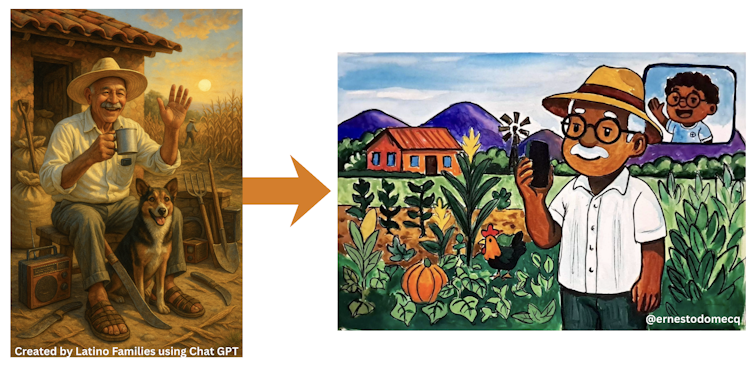
Andres S. Bustamente, CC BY-ND
After families reviewed the images, they highlighted the reasons they liked certain parts and disliked others and revised the prompts to make images that represented their ideas. Our team revised the stories, connected them with pre-K science learning standards and then collaborated with a visual artist, Ernesto Domecq Menéndez, who used the AI-generated images as inspiration for the books’ illustrations.
As part of another story, families noted that AI-generated content can reflect a common assumption in the U.S. – that “Latino” means “Mexican.” In response, families emphasized the diversity of Latin America by using generative AI to create a story about children from different countries who explore the science of cooking as they share family recipes for gorditas, arepas and pupusas. To an untrained eye the dishes look similar, but the families highlighted the distinct ingredients, preparation techniques and meanings behind each one. We worked with the families to tweak the AI prompt until they were happy with the story draft output.
Taken together, these examples show how pairing community collaboration with AI tools can create early educational content that reflects families’ experiences – and represent them the way they want to be seen. When children and families see themselves and their communities represented in STEM learning experiences, it can foster positive identity and self-efficacy in STEM domains.
AI as a conversational partner in learning
This project builds on previous work that integrated AI conversational agents, such as Siri or Alexa, into children’s media so the main character of the story can ask children questions to reinforce learning.
We are embedding the same technology in these e-books so the characters in the story can ask children questions at key learning moments and engage in back-and-forth conversation to reinforce the big science learning goals.
This approach builds on a long history of developmental research that shows strategically placed questions during book reading lead to increased learning and improve children’s language skills.
Learning and connection in the community
We have also applied this approach in a community health clinic. In an ongoing project, we are partnering with SAELI families and researchers from UC Irvine, Boston College and University of Illinois Chicago to incorporate playful learning activities into the waiting rooms at the Children’s Hospital of Orange County.
In codesign sessions with families and providers, one of the main themes that emerged was the desire to build a strong sense of community at the clinic. One family suggested we design a “chismografo,” or a shared “gossip notebook,” that was popular in Latin America in the 1990s and early 2000s. In those sessions, providers also shared tensions of wanting to be able to connect with families and build a relationship but also needing to minimize wait times.
In response, we plan to use a simple AI platform to prompt families waiting to see their pediatrician to dictate into a tablet the ways they cook, play and relax before bedtime. The AI will summarize the information families share and create artifacts like badges that can be displayed on a clinic “chismografo” so families can learn about each other.
The AI will also provide a summary to the pediatrician so they can learn something about the family and engage in conversation around nutrition, physical activity and sleep routines that build from families’ everyday practices. In this way, AI is used as a tool to enhance communication and connection between families and providers.
Customizing and scaling up
While the examples provided here are unique to the communities that designed them, and might not resonate in the same way in other places, AI offers a platform for educators and families to create their own resources and experiences.
This approach addresses a major tension in education research – cocreating educational resources with the people they are intended for enhances usability, meaningfulness and effectiveness. However, when you customize or adapt a resource for a specific community or population, it can become less usable in other places. Generative AI can be used to continuously design and adapt early learning resources, customizing them for different communities.
Critically, this work is best done in partnerships between families, educators, early learning researchers, artists and technology designers whose collective expertise leads to products that none of them could have made on their own.

The research referenced in this article was supported by the National Science Foundation’s Advancing Informal STEM Learning (AISL) Program Award #2415882 and the Heising-Simons Foundation Award #2024-5105.
Aria Gastón-Panthaki does not work for, consult, own shares in or receive funding from any company or organization that would benefit from this article, and has disclosed no relevant affiliations beyond their academic appointment.

