
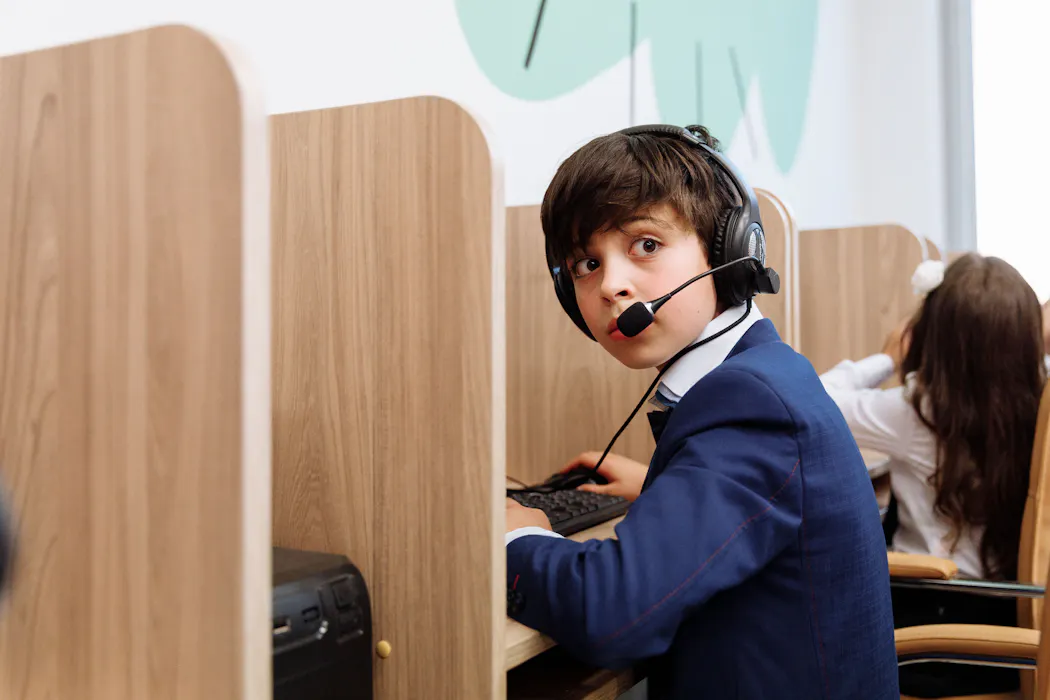
Australia’s education ministers are increasingly asking if there is too much screen time in schools.
Phones are already banned or restricted in every public school around the country. And Victoria has announced that from 2027 primary schools will cap classroom device use at 90 minutes a day in Years 3 to 6.
Last week’s NAPLAN results provided another opening for concern. Federal Education Minister Jason Clare wondered whether shortform writing on phones was hampering literacy results. He said state and federal ministers were thinking about moving back to some pen-and-paper NAPLAN exams, instead of doing them online.
He added state and federal ministers were also worried about protecting students’ privacy and how “we make sure that students are learning rather than just relying on an AI prompt”.
These comments flag a reversal of the direction set in 2008, when the Rudd government began providing laptops to high school students. States have added digital devices, platforms and programs ever since.
But the evidence around increased technology use in schools has not been clear-cut. A 2025 OECD review found access to technology on its own does not guarantee any educational gain.
Read more:
Victoria wants daily ‘device-free’ time in high schools. What works best for learning?
How much technology is used?
There is no comprehensive national data on how much time Australian children spend on devices at school.
The rules are just as patchy. Phone bans are set at state level. Almost everything else is decided school by school, including whether students bring a laptop and which AI tools they can use.
There is a national framework for generative AI in schools. It sets out principles covering privacy, safety and fair use. What it does not do is say how much technology a child should use, or at what age. Nor does it require tech providers to show a product works before it reaches a classroom.
There are also hints of a growing new divide, with some wealthier schools pulling back on technology and promoting this as an advantage.
Australia’s clearest example is Sydney Grammar, where laptops are not used in class and classwork is done using pens and paper.
What is best?
The evidence around how much tech is optimal for learning is also mixed.
In 2022 a major international survey found 30% of 15-year-old students get distracted by devices in most maths lessons. But the same research found it also depends on how devices are used. Students who spent up to one hour per day on digital devices for learning activities in school scored 14 points higher on average in maths than students who spent no time.
For primary-school children, there is even less evidence to go on.
Watch out for ‘cognitive stunting’
Unsurprisingly, we know the quality of the technology being used matters.
Think tank The Brookings Institute, estimates only one in five education technology products in US classrooms has any evidence it improves learning. These products include technology platforms, programs and applications that run on devices. A similar pattern is likely in Australia.
Just as poor nutrition stunts physical growth, there are concerns about “cognitive stunting” when children routinely offload the work of learning to a machine and so never fully develop the capacity to do it themselves. Based on the results of a randomised control trial of learners writing with ChatGPT, researchers have also referred to this tendency as “metacognitive laziness”.
But nobody yet has a systematic way to tell which tools carry the risk of metacognitive laziness, under what circumstances, or to what degree.
We can’t just forget tech
We also know students will need to use technology as they grow up – both in their lives and workplaces. And will need to learn how to use it well.
This does not just happen naturally or because young people are using a lot of tech. Only 50% of Year 6 and 37% of Year 10 students met the national standards for digital skills in 2025. This was the lowest results since the assessment began in 2005.
Australia has no dedicated mechanism for figuring out what the right approach should be, and no plan to build one. This has already been prioritised in many other parts of the world, such as Hong Kong.
3 important questions
In the meantime, we know raw time in front of a screen is not an adequate measure when we are thinking about children’s interaction with technology. These three questions are more useful:
1. What is the device for in this lesson?
Devices should be used intentionally rather than by default. This means screens are not “just open”. They are turned on for a specific, defined purpose.
2. What is it replacing?
Some research suggests technology can be used to replicate what a teacher already does rather than change or improve it. So, do we need more technology or more support for teachers?
We know teachers are under a lot of pressure. Australian teachers report working 46.5 hours a week, with high levels of burnout and stress.
3. How would we know if tech use is not working?
Between 2008 and 2013, the federal government spent A$2.4 billion putting a computer in the hands of every student in Years 9 to 12. It was evaluated for rollout, engagement and teacher confidence. There was no official examination of whether it saw children learn more effectively.
As colleagues and I have noted, without a national, coordinated and evidence-informed approach, Australia is on course to repeat this mistake with AI.
What now?
Clare says there is “a lot of work to do” around technology use in schools. He is right.
We still have no sense of how much time Australian children spend on devices at school, and no requirement products actually work before they are used for education.
As a researcher, I stay optimistic about what technologies can do to support learning. As a parent of two primary school children, I also want to see governments and schools make decisions based on robust evidence about how students best develop and learn.

Jason M. Lodge receives funding from the Medical Research Future Fund and Studiosity. He has received funding from the Tertiary Education Quality and Standards Agency, the Australian Department of Education, Queensland Department of Education, the Office for Learning and Teaching, the Higher Education Research and Development Society of Australasia, Australasian Society for Computers in Learning in Tertiary Education, and Echo360. He is one of the convenors of the Castlereagh Statement: A cross-sector call to action on Australian education and training in the age of AI.

