
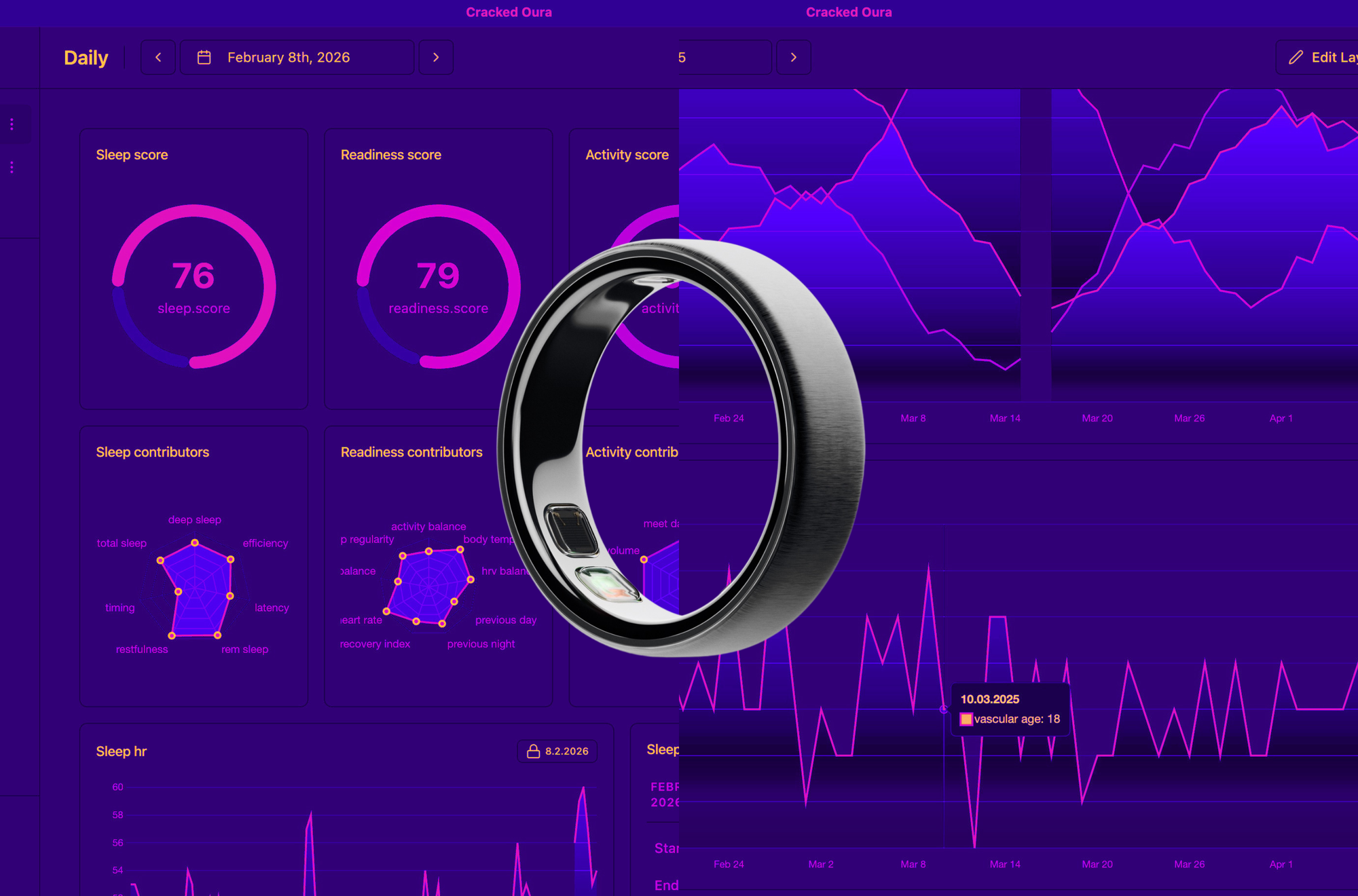
Rather than pay a monthly subscription for an app that plenty of people think kinda sucks, a developer has created Cracked Oura, an open source app that lets Oura ring wearers query and analyze their health data without the monthly fee.
On Thursday, Oura announced the new Ring 5, a lighter and smaller wearable with an allegedly better battery life. That ring will cost at least $399, and some models cost as much as $499. An Oura subscription, which is required to actually get usable insights on your sleep, stress, and exercise, costs nearly $70 a year or $6 a month.
Or, users could try Cracked Oura, which developer Elmo Ahorinta published on GitHub earlier this year. “Pay for the ring, not for the app that is not even that good,” its GitHub page reads.
The page says Cracked Oura keeps the health data local to a user’s device, provides some deeper insights than the official app, and, most importantly, doesn’t require a subscription. The app works by using Oura’s data export function on its website. “Anyone can request the data from their website and it comes with a bunch of CSVs that contain the data. My application just takes the CSVs and populates a database,” Ahorinta told me in an email. Rather than having to log in to Oura’s website and manually download their data each time, Cracked Oura does it automatically, Ahorinta said.
It’s not complete, though. “At the moment, my application misses some features that Oura has. For example, women’s health, symptom radar, and the front page’s short texts about sleep and readiness are features that would need reverse engineering,” Ahorinta said. “Also, features like recording your workout heart rate and adding tags requires the subscription. But other than that, my application can be used to visualize the same data points that Oura does.”
The GitHub page lists Claude as a contributor, indicating Ahorinta used AI to make the app.
Even if not that many people end up using Cracked Oura, its existence highlights that people don’t necessarily want to be locked into a single platform, or a monthly subscription fee, when they’ve already spent a bunch of money to generate data about their own health. “I hope that other people would also contribute to this project and fix my bugs and bad design choices that I have made. I believe that this type of workaround applications could be made for any other wearable devices that have a subscription that gatekeep some parts of the data,” Ahorinta said.
Oura did not respond to a request for comment.
The company recently told cybersecurity journalist Zack Whittaker that it does “receive infrequent requests from the government” for user data. Oura wouldn’t say how many requests it receives, how often it turns over that requested data, or what kinds of data is requested, Whittaker wrote.

