
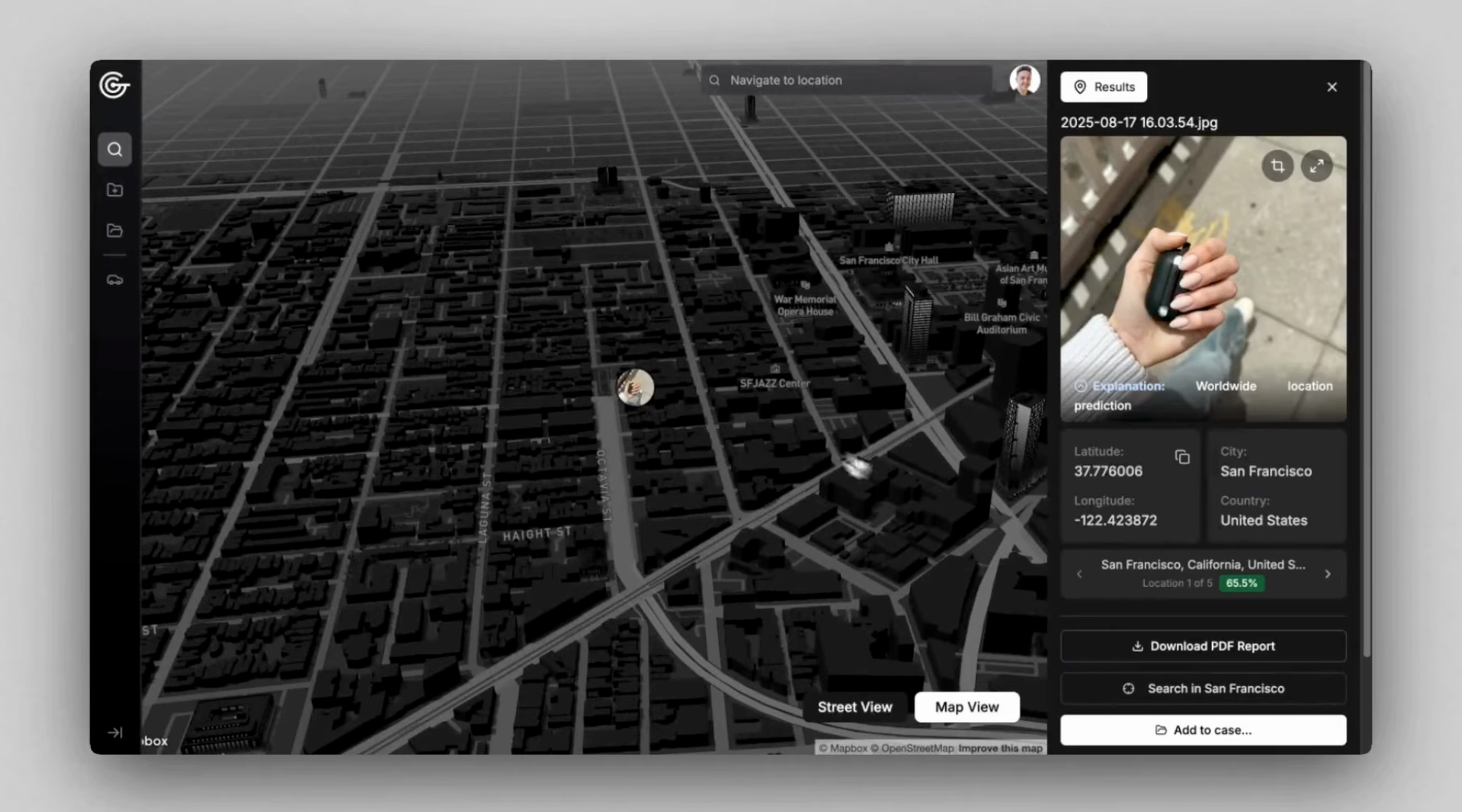
The Miami-Dade County Sheriff’s Office (MDSO) and the Los Angeles Police Department (LAPD) have bought access to GeoSpy, an AI tool that can near instantly geolocate a photo using clues in the image such as architecture and vegetation, with plans to use it in criminal investigations, according to a cache of internal police emails obtained by 404 Media.
The emails provide the first confirmed purchases of GeoSpy’s technology by law enforcement agencies. On its website GeoSpy has previously published details of investigations it says used the technology, but did not name any agencies who bought the tool.
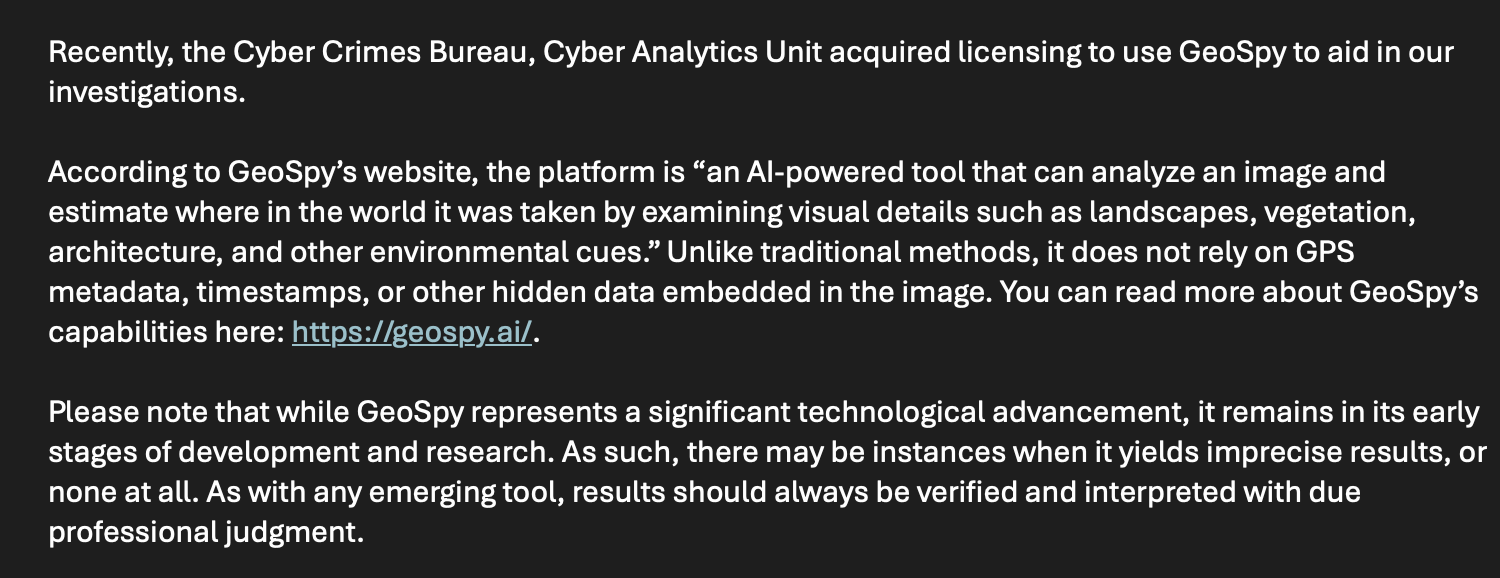
“The Cyber Crimes Bureau is piloting a new analytical tool called GeoSpy. Early testing shows promise for developing investigative leads by identifying geospatial and temporal patterns,” an MDSO email reads.
The emails show MDSO has access to the “global” GeoSpy model, which lets it geolocate photos from around the world, and a custom model specifically trained for Miami-Dade County. GeoSpy claims that its custom models provide results to an accuracy of one meter, according to the emails. 404 Media has not independently verified those claims, and on its site GeoSpy changes that claim to “Our AI can pinpoint locations in supported cities within 1-5 meters accuracy.”
“The one-time fee covers data collection, compute resources, research and development, and engineering hours,” a June 2025 email from GeoSpy to the agency reads. That fee changes “based on region size and density,” according to the email.
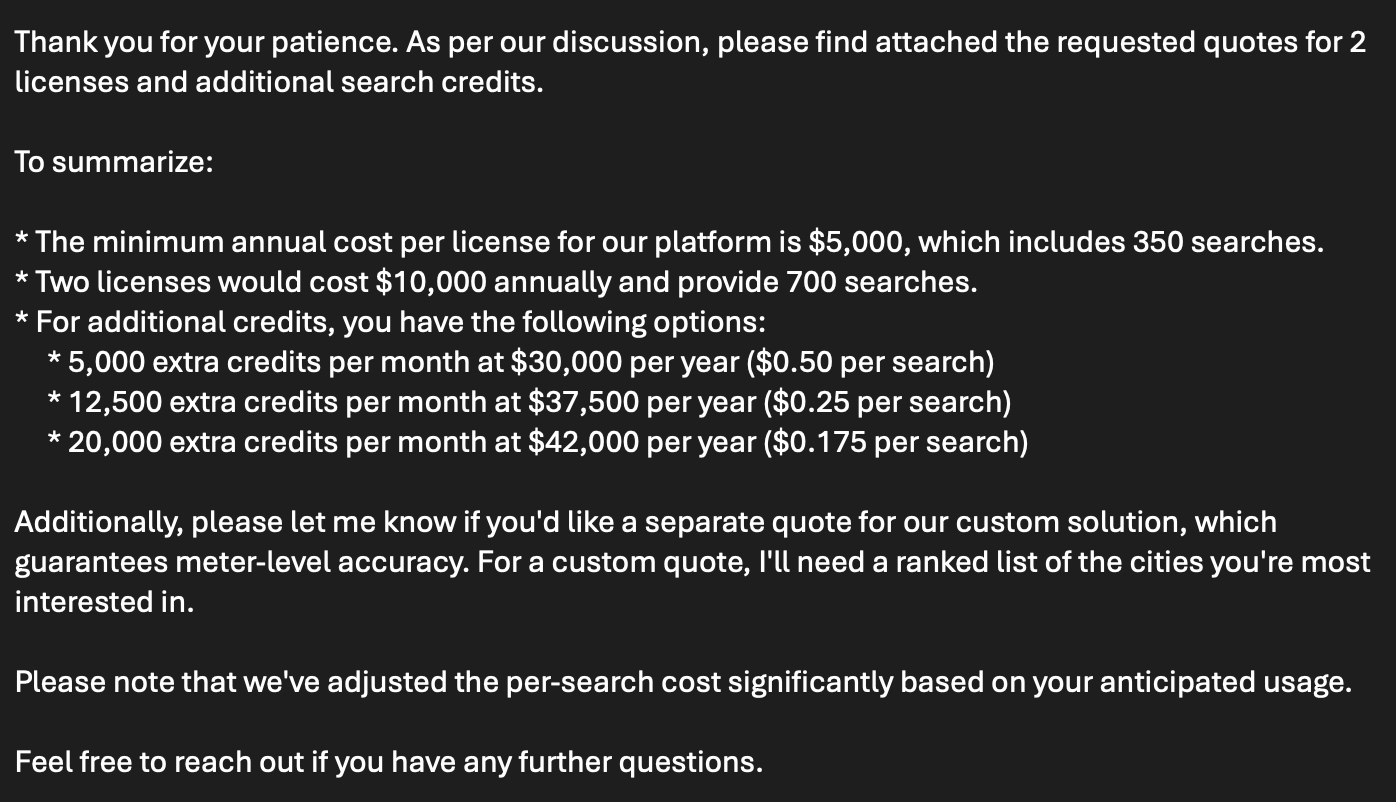
In all, MDSO’s access cost $85,500, according to documents attached to the emails. That includes the custom Miami-Dade County model for $38,000, two annual GeoSpy licenses each costing $5,000 with 350 searches, and an additional 150,000 searches for another $37,500.
A presentation included in the emails says the only other law enforcement agency using GeoSpy is “LAPD’s Robbery and Homicide Bureau.” 404 Media previously reported on LAPD’s interest in the technology, but the new emails say LAPD did acquire a license for the tool.
404 Media first covered GeoSpy last year. Made by Graylark Technologies from Boston, the tool is trained on “millions” of images worldwide “enabling it to recognize distinct geographical markers such as architectural styles, soil characteristics, and their spatial relationships,” according to marketing material available online. In essence, it does the same sort of tasks an open source intelligence (OSINT) researcher or GeoGuessr player might do but automatically, allowing someone with much less or no geolocation experience to potentially figure out where a photo was taken. Because it is a relatively new technology, it is unclear how well exactly Geospy performs, though.
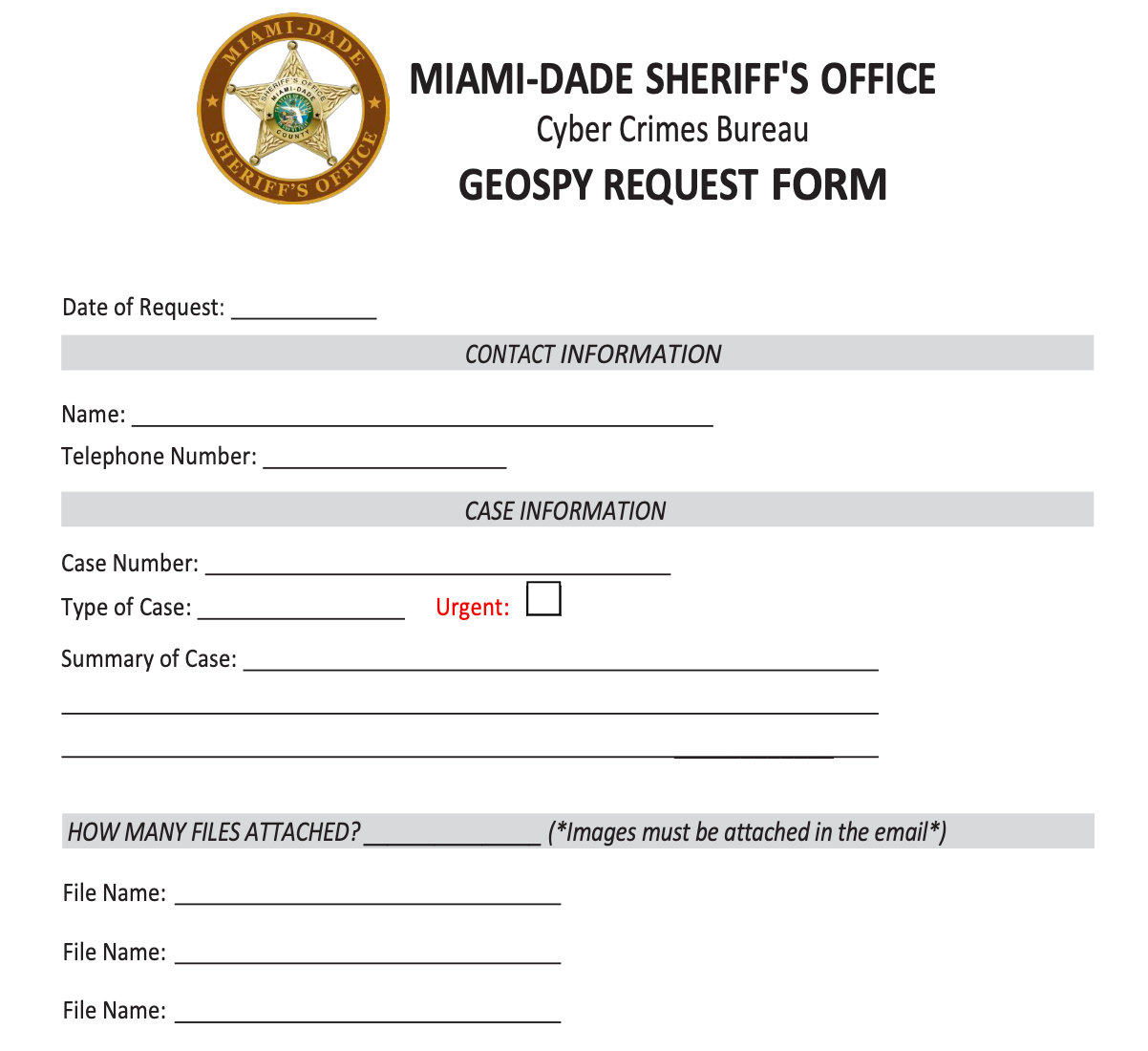
The MDSO’s Cyber Crimes Bureau is the part of the agency with access to GeoSpy, according to the emails. But the bureau has offered to perform lookups for other parts of the Sheriff’s Office. In one MDSO form attached to an email, law enforcement officials can put in a request for a set of images to be run through the software.
“That said, the tool is not foolproof and remains in a testing/validation phase. During this pilot, we’d like to make our analysts available to run GeoSpy queries in support of your active cases,” the email, sent by a lieutenant in the Cyber Crimes Bureau, reads. “Our intent is to provide timely, analyst-assisted leads that may help you advance major cases. GeoSpy outputs should be treated as lead information only and corroborated through standard investigative methods.”
The email acknowledges that results may include false positives, and asks officials to limit sharing personally identifiable information (PII) to what is necessary and authorized for the request.
In one response, an official wrote, “It sounds like it could be useful to us in Robbery.” The Cyber Crimes Bureau official said “Yess. Would be cool to help you guys out.” Officials from the Special Victims Bureau and Homeland Security Bureau also expressed interest.
Another email from an intelligence analyst says if the tool has enough success, “other bureaus can explore purchasing it.”
Joseph R. Peguero Rivera, from MDSO’s Public Affairs Office, told 404 Media in an email the agency “purchased a limited number of GeoSpy licenses to evaluate its potential use in investigations involving online child sexual abuse material (CSAM). The Cyber Crimes Bureau was involved because these cases frequently involve digital evidence obtained from online platforms, where any additional contextual information can assist investigators in narrowing leads.”
He said that the use of GeoSpy has not led to any arrests. “To date, use of GeoSpy has been limited and largely exploratory. While it has been reviewed in a small number of cases, it has not resulted in any significant investigative breakthroughs or arrests. No case outcomes were driven solely or primarily by information generated by the tool,” he wrote.
The 2GB cache of emails includes MDSO officials discussing 404 Media’s previous GeoSpy coverage. When we reported the LAPD had expressed interest in the technology, 404 Media found Daniel Heinen, the CEO of Graylark Technologies, had uploaded a photo from inside the Secret Service’s Miami field office. 404 Media determined that with clues in the picture and by then contacting the Secret Service. At the time, local Miami law enforcement agencies, including MDSO, did not respond to requests for comment.
“Please that is [sic] we bring folks here for training or demos that they do not take selfies or photos for posting later. Thanks,” George Perera, the commander of the Cyber Crimes Bureau, wrote in an internal email responding to 404 Media’s article.
The LAPD did not respond to a request for comment.
When 404 Media first covered the technology, GeoSpy offered a public version of the tool that anyone could use. A day after 404 Media contacted Heinen, GeoSpy closed off public access.
But GeoSpy may soon be available to other, non-law enforcement markets. Under an “Industries” section, GeoSpy lists “Insurance.” GeoSpy did not respond to a request for comment for when the tool might be available to the insurance sector.

