
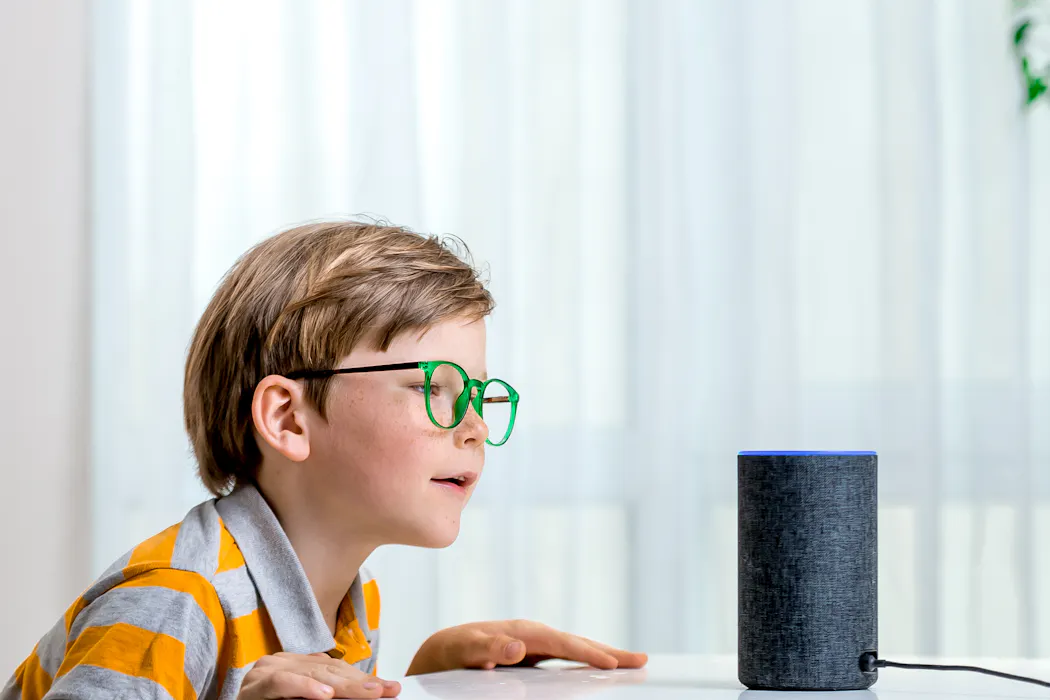
Children are innately curious, and throughout any given day they come up with all manner of questions: Why don’t fish have hair? Why do flowers wilt so quickly? Their need to understand the world – and develop their language skills and ideas – makes them tireless conversationalists.
While their inquiries would usually be directed at parents or teachers, in modern homes even the youngest kids might now talk to a digital interface like Siri or Alexa. These AI systems are fast becoming part of many children’s everyday lives, as kids ask them to play music, help with their homework, answer questions, or just chat to them.
These kinds of interactions are no longer strange, but we need to ask what happens when they become completely routine. Do they change the way children learn to communicate? Do they change the words they use? And are they a threat to kids’ cognitive abilities?
Language learning
Learning to speak has never been a question of just learning words. Children acquire language through human relationships, and by building emotional ties to other people. They learn to take turns, how to interpret silence and context, and how to tell when someone is tired, annoyed or distracted. They also discover that conversations do not need to be perfect – there will always be interruptions, misunderstandings, and off-the-cuff explanations.
But AI does not think like a human. Think about your interactions with ChatGPT or Gemini. We rarely lose our patience while talking to these virtual assistants, partly because these interactions are, by their very nature, governed by a very different logic to human conversation. These tools are built for quick responses and infinite patience, and this changes the experience of communication.
AI and politeness
In many homes, something very curious is becoming increasingly common: some children (and even adults) are adapting their speech so that virtual assistants will understand them better. They speak in simple sentences, and give direct instructions: “play cartoons, open YouTube, tell me a joke”. This kind of speech – known as instrumental language – aims to get immediate results.
This shift does not necessarily mean children are becoming ruder or less empathetic, but it may influence their expectations of conversation in general. Human interactions are usually slow and ambiguous, and require patience, attention and negotiation. Chatbots, on the other hand, are designed to give quick, fluid responses, or even create a sense of virtual empathy with the user.
Leer más:
ChatGPT’s artificial empathy is a language trick. Here’s how it works
This all leads us to a question that may seem minor, but reveals a lot: should we teach children to say “please” and “thank you” to Alexa? Beyond the surface-level question of whether we should be polite to machines, this debate forces us to think about the communicative habits that children develop through daily interactions with technology that always obeys them. The wider question for families and educators alike is: what idea of “conversing” will children construct in this context?
Alongside these doubts, we should not lose sight of the opportunities that these systems present. Many children feel freer to ask questions when they do not fear judgement, and a chatbot will repeat an explanation as many times as is necessary, adjust the level of complexity, or support them as they learn new languages or concepts.
These tools provide a safe space for trial and error, free from the social pressures that often accompany human conversation. This is not just the case for children. Many of us now resort to AI to ask ordinary questions, from “Alexa, how do I recover my password?” to more embarrassing queries that we would rather not voice out loud.
Leer más:
Chatbot teddies for three-year-olds? Why AI toys are risky for kids
Responding is not understanding
Current AI systems produce extremely convincing answers, but they do not understand the world the way a person does. They do not have experiences, emotions, or intentions – even if they talk like they do. Just like many adults, young children tend to attribute human qualities to the things they interact with. If something can converse, it is easy to presume that it also has understanding or knowledge.
However, a lot of the information in human conversation is unspoken. An adult can tell when a child’s question is the product of curiosity, fear, or a simple need for attention. This pragmatic dimension – consisting of gestures, tone, looks, feelings – is crucial for children’s development. It is difficult to replicate in a machine, which can only offer an answer without capturing any of this nuance.
Leer más:
Seven tips for talking to children and young people about generative AI
Humans are not machines
When children grow up surrounded by a particular kind of linguistic exchange – one that consists of quick responses and having every single request obeyed – it ends up shaping habits, expectations and ways of interacting. This can lead children to always expect clear, quick, effortless answers, as though any conversation were something to be resolved on the spot.
The adults who live with young children therefore have a vital role to play. They are the ones who mediate daily use of these tools both at home and at school, who understand their limitations, and who are able to integrate these conversations into general learning.
A child asking Alexa to answer their questions or tell them a joke is not, in and of itself, detrimental to their language development. But we should guide these conversations so that they understand they are dealing with a machine that responds to them, not a person.
We need to show children what separates us from machines, how we should interact with them, and in what situations it is alright to use them. We should accompany them in these everyday interactions, commenting on them and helping them to understand AI’s limitations.
AI can be useful as a support, but under no circumstances should it take the place of replace conversation between people. Despite rapid developments in technology, human interaction remains at the heart of the way we exist in the world.

A weekly e-mail in English featuring expertise from scholars and researchers. It provides an introduction to the diversity of research coming out of the continent and considers some of the key issues facing European countries. Get the newsletter!

Clara Macarena Ponce Romero is part of the Koiné group at the University of Santiago de Compostela. She currently participates in the project entitled “Agencia Estatal de Investigación, Corpus y densidad de datos. Versión robusta del ‘corpus Koiné’ de habla infantil” (PID2024-158897NB-100), financed by the European Regional Development Fund and the Spanish Ministry of Science, Innovation and Universities.

