
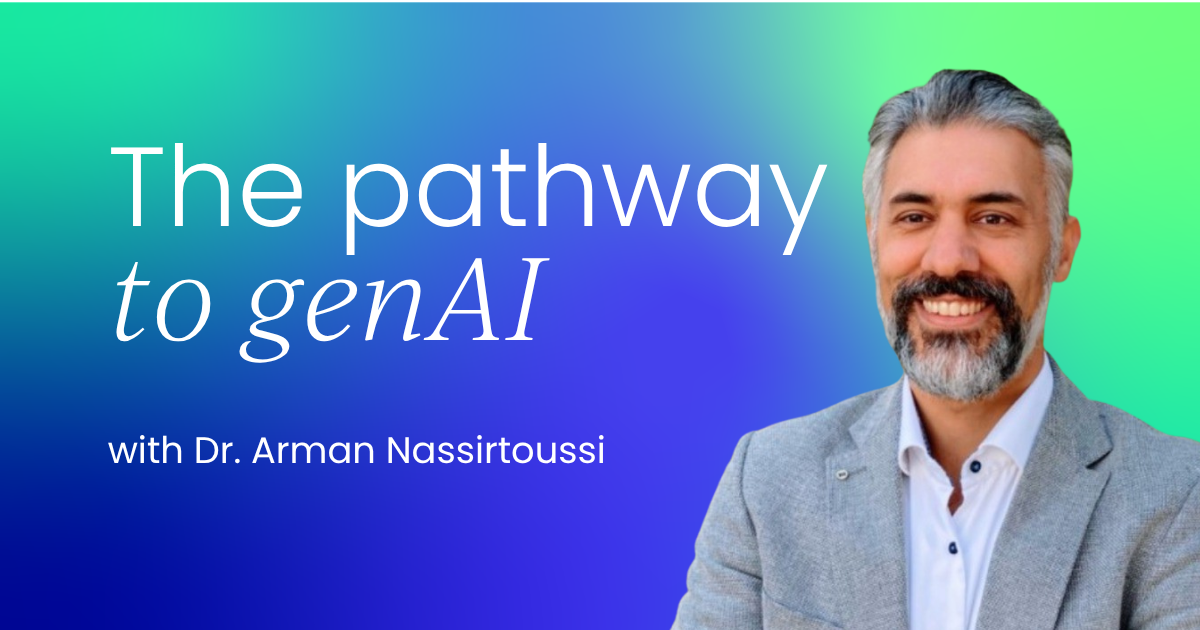
I’ve spent twenty years moving between corporate work and startups, and what keeps drawing me back is a timeless question: how do we use knowledge, and how do we build tools that help us think better?
That’s what I want to explore here – agentic AI, where it came from, what it actually is, and why it matters for how you’ll work with information going forward.
Starting with a name you might not know
Let me begin with a name that should be more famous than it is: Vannevar Bush. If you haven’t read his 1945 paper As We May Think, put it on your list. Across eight or nine pages, it offers probably the clearest summary of the entire vision of computer science, AI, and arguably human destiny.
Bush makes a simple but profound argument: extending man’s physical power has been the job of most tools developed so far. Now, he says, we need to extend our minds. For context, he wrote this right after World War II, where he had been running R&D for the United States military.
As the war ended, he was trying to redirect that enormous scientific community toward a larger mission – and it worked remarkably well.
He explains how this would help people navigate human knowledge, observing that even in 1945, scientific knowledge was being produced faster than anyone could consume it.
That imbalance between production and consumption of knowledge is a mental frame worth holding onto.
Bush goes further: he focuses on associative learning, the way memory connects ideas by association. He imagines voice-controlled systems, personalized learning, and interactive knowledge navigation. All of this in 1945, when the first computers were just being built.
 Andrew Lovell
For expert advice like this straight to your inbox every other Friday, sign up for Pro+ membership.
You’ll also get access to 300+ hours of exclusive video content, a complimentary Summit ticket, and so much more.
So, what are you waiting for?
From Bush to Engelbart to Jobs
Bush’s vision was picked up by Douglas Engelbart in 1963, who created A Conceptual Framework for the Augmentation of Man’s Intellect and spent his life building toward it.
In 1968, he delivered what’s now called the “mother of all demos” – over an hour and a half of live demonstration that introduced the personal computer, Windows, hypertext, graphics, the computer mouse, word processing, video conferencing, and collaborative real-time editing.

