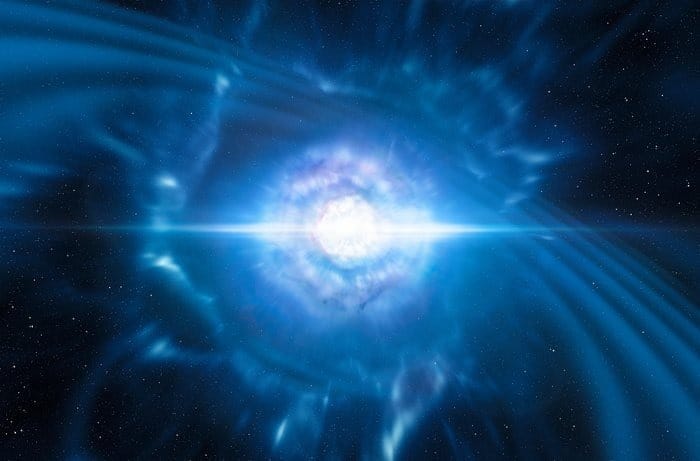
Scientists have discovered a bizarre “invisible” object in space that challenges our understanding of stellar evolution and could help resolve longstanding astronomical mysteries, according to a study published on Wednesday in Science Advances. Its orbit and mass are so strange, in fact, that researchers ran thousands of simulations and couldn’t reproduce them.
The hidden object is likely an ultra-rare supermassive neutron star, which is the collapsed core that is left over after a massive star goes supernova. Located in a system called J0008+0128,, the object was detected through its gravitational effects on its companion, a red giant star.
Massive stars that go supernova either collapse into neutron stars or black holes, both of which belong to a wider family of dead stars known as “stellar remnants.” But for decades, astronomers have puzzled over the so-called “mass gap” between neutron stars and black holes, which is the observed scarcity of remnants between 2.5 and five times as massive as the Sun.
The object lurking in J0008+0128 could be up to 2.8 times as massive as the Sun, which “potentially places the unseen companion within the mass gap between neutron stars and black holes,” according to the new study. The colossal mass, combined with its unusually wide orbit of 1,218 days, challenge our understanding of how these objects form.
“We search for compact objects (mainly neutron stars and black holes) using large spectroscopic surveys,” said Song Wang, an associate researcher at the National Astronomical Observatories, Chinese Academy of Sciences, who co-authored the study, in an email to 404 Media. “We have found more than 10 neutron stars, and J0008+0128 is the most massive one among them.”
Generally speaking, stars that are over 25 times as massive as the Sun will form black holes, while stars that are about 10-to-25 times as massive will become neutron stars. Stars with masses similar to the Sun, meanwhile, are destined to spend their afterlives as white dwarfs, which are much larger and less dense than neutron stars. For instance, neutron stars are mere miles in diameter, whereas white dwarfs are about the size of Earth.
Because they are dense pressure cookers, neutron stars are filled with disassembled components of atoms, especially neutrons—hence the name—but also protons and electrons. Supermassive neutron stars like the one in J0008+0128 can shed light on the poorly understood “equation of state” in these objects, which is the relationship between their immense pressures and densities.
“The equation of state of neutron stars is a long-standing unsolved problem in astrophysics, and neutron star masses can provide crucial observational tests,” said Wang. “This is particularly true for massive neutron stars: how massive a neutron star can become depends on how ‘stiff’ its internal matter is in resisting gravitational collapse.”
“The discovery and measurement of supermassive neutron stars (i.e., those above two solar masses) can place important constraints on the equation of state of matter at extreme densities, helping to identify the theories that truly describe the behavior of matter under such extreme conditions,” he added.
In other words, J0008+0128 could open a window into the churning atomic stew within these exotic objects. But the system is weird for reasons beyond the supermassive object lurking in the dark. Indeed, the team ran thousands of simulations but none of them “reproduced physical and orbital properties similar to J0008+0128,” according to the study.
The wide orbit between the neutron star and the red giant star is particularly difficult to explain. Neutron stars could become supermassive by gravitationally tugging material off of their stellar companions, but this object is too far away from the red giant for this mechanism to make sense.
“In fact, many compact objects discovered in recent years cannot be explained by standard binary evolution models and supernova mechanisms,” Wang noted, citing two other examples, known as Gaia BH2 and G3425.
Wang and his colleagues proposed a few alternate scenarios to account for these outliers. It may simply be that supernovas can form supermassive neutron stars within the mass gap in rare cases. The researchers also speculated that this system once contained three objects, and that two of them merged together to form the supermassive neutron star.
“There may be two massive stars forming an inner binary,” Wang explained. “They can merge at different stages. For example, a neutron star merges with a normal star, or two neutron stars merge. Either case could produce the supermassive neutron star that we observe today.”
“In addition, if J0008+0128 formed through single-star evolution, its discovery would suggest that supernovae can produce massive neutron stars,” he added.
Studying systems like J0008+0128 could illuminate the murky limits that determine the afterlives of massive stars. They are also helpful for understanding the dynamics of neutron star mergers, which scientists can detect through gravitational waves, which are ripples in spacetime.
Wang and his colleagues were able to make this new discovery with the help of sophisticated sky surveys, including astrometric data from Europe’s Gaia space telescope. The team hopes that the forthcoming data release from Gaia, due out next month, will help to narrow down the possible mass of the unseen object in J0008+0128.
“The discovery of J0008+0128, together with other systems discovered in these years (e.g., Gaia BH2 and G3425), suggests that much work remains to be done on binary evolution and supernova explosion theory,” Wang concluded.