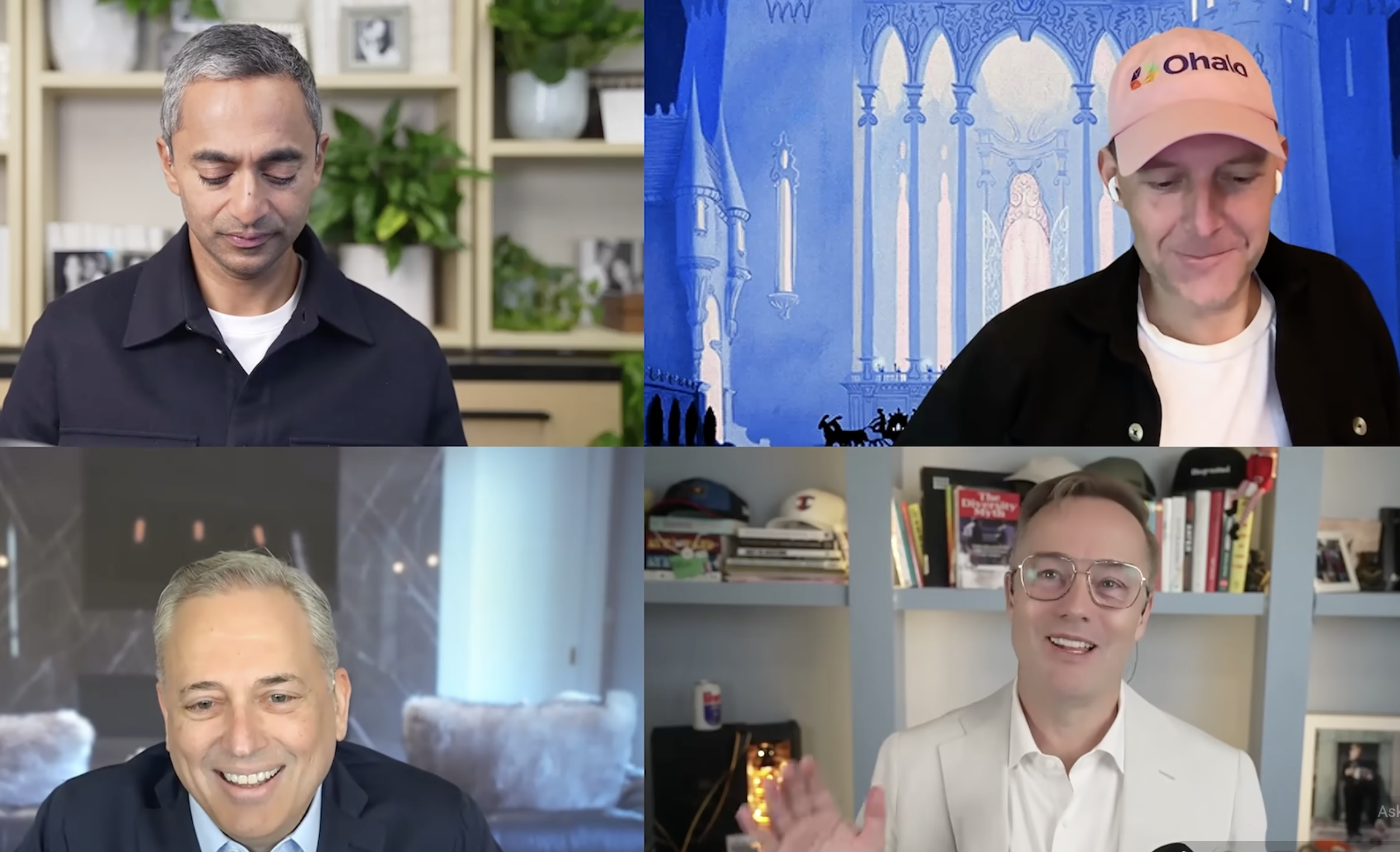
If you want to watch four billionaire/billionaire wannabes cope with the election results, you could watch the absolutely dreadful hosts of All-In talk across a livestream and a follow-up podcast for four hours, or you could just watch the Lucille Bluth “What could a banana cost, Michael,” clip on repeat until your eyes and ears bleed.
Throughout their post-election breakdown podcast episode released over the weekend, the All-In bros seem to be on the verge of grasping why Americans are so mad and who they’re mad at, but are still trying to find the guy who did this. They appear to finally grasp that Americans are mad at something called “oligarchs” but largely do not seem to know who they are (it’s them). Populist anger at the oligarchs is a “perception” or “narrative” problem. The four hosts — David Sacks, Chamath Palihapitiya, Jason Calacanis, and David Friedberg— spend much of the episode considering whether they are out of touch, or whether the children are wrong. Let’s see how they did.
“We lost all the podcast bros,” David Sacks, a Trump sycophant billionaire most famous for leading anti-DEI witch hunts against college administrators and writing interminable, book-length tweets, said on the most recent episode. “We lost a huge part of our base. The Republicans in particular are dependent on the podcast circuit. Let’s call it alternative media. Why? Because the mainstream media hates us. Legacy media hates us.”
“And they’re 90 percent left, so it is what it is,” Jason Calacanis, a man who seems singularly focused on discussing how he moved away from California three years ago to move to now-Blue Texas, responds.
“Without them, we don’t have any media that supports us,” Sacks says, seemingly unaware of the existence of Fox News, CBS News and 60 Minutes under Bari Weiss, the Paramount-Skydance (and CNN) merger, Jeff Bezos’s Washington Post, the concept of Elon Musk’s X, to say nothing of Democratic pseudo-scandals being ginned up by the New York Times.
The podcast, like their election night coverage last week (which features, among other guests, Ted Cruz and the CEO of Polymarket explaining at length how little he knows about elections), goes on and on like this.
In the aftermath of last week’s election, the schadenfreude of watching right-wing figures crash out as they realize just how unpopular Trump’s policies have become has been particularly satisfying. But there’s something special about watching smarmy Silicon Valley weirdos who sound like they haven’t spoken to anyone who hasn’t founded a startup in several decades advance their theory of the case about what just happened, and what Trump could do next to “save his legacy.” Calacanis, for example, suggested a policy of “no taxes on people under a certain revenue, uhh, income threshold.” He catches himself, perhaps realizing that most people don’t think of their paychecks as their “revenue” because they are not businesses. Palihapitiya says something must be done to “allow the wage earning class to feel more ownership of the United States economy.” Calacanis has come to the realization that “the bottom half of non-equity holders” are mad about the state of the country. Sacks says the wave happened because of “this narrative around affordability plus the perception of the lack of affordability” that has put the public “in a very ornery mood.” “It doesn’t matter how good the economy actually is,” he says. “It matters how good people perceive it to be,” adding that “the economy is not that bad. I mean, in fact it’s quite good.” In fact, data shows this is deeply out of touch with what people across the country are experiencing: More than half of Americans can’t afford to have an emergency fund or save for the future, and most Americans report having to cut back on their lifestyles to afford to live. Housing affordability is at crisis levels.
Friedberg says “there’s this idea of this oligarchy,” and that AI “made it really easy to attack with this oligarch narrative,” which have led not to people “choosing socialism as an ideology or as a set of principles, [but] socialist outcomes arise from the policies that people think are going to solve their cost issues.” Aside from pretending the tech oligarchy isn’t real—even as we watched an unelected Elon Musk ransack the government as his companies collect billions in contracts, for just one example—people are mad at AI because it threatens their livelihoods, superpowers surveillance, has made the price of gadgets and computers skyrocket, is built on stolen content, has rotted people’s brains, the list goes on.
Palihapitiya appears shocked that trickle-down economics, a widely disproven economic theory, yet again did not work (but did serve to make everyone on the podcast far richer): “I thought top down economics can still work. I thought that when you had asset owners building assets and investing in the economy, these things can get to everybody else. It’s clearly not happening.”
He, too, believes that at least some of this is a perception problem rather than a real problem. He brings up a viral video of SpaceX employees pitching a data center to Cochise County, Arizona, where the employees explain the potential benefits of a data center. “They [the SpaceX employees] should be proud of how they conducted themselves. But they were getting run over,” he says. “This is an emotional issue that is not tethered to the facts. It represents a totem around the oligarchy and the economic fissure that exists in the U.S. economy.” Calacanis suggests the “data center stuff is performative” and suggested that Trump could work with Democrats to raise the minimum wage to $15 because “it would counter this narrative that we don’t care about the bottom half of society. In fact, there’s only 10-15 million people who are under $15 an hour, so it’s an easy thing to do.” The “emotional issue” is, in fact, a well-documented and factual one: data centers don’t deliver on the job growth they promise communities, are credibly accused of manipulating air pollution permitting processes, temporarily and permanently damage and disrupt the places where they’re put up, and are driving a new fossil fuel boom.
Friedberg appears obsessed with the idea of “socialism” and government spending, and says that the end result of people being mad about oligarchy is “voting in more of these kinds of socialist principles, socialist policies, socialist politicians.”
Sacks has convinced himself that we must not give the people what they have voted for, which is accountability, but sees the Democrats as a huge danger. “I believe that Democrats want to create a surveillance and censorship state that’s turbocharged by super intelligence. I mean, that’s ultimately the end state.” Flock CEO Garrett Langley, who is actively building the “super intelligence” powered surveillance state, was a recent All-In guest, where he got to talk at length about how vital his company is to the hundreds of communities across the country that do not want it, with little pushback from the hosts.
There is not so much to analyze here, exactly, other than to point out how wildly out of touch the oligarchs are, how extremely weirdly they look at the world, and how little they think about or interact with the average person. They are not to be taken seriously, save for the fact that they have lots of money and have a close relationship with this current administration.
It is hard to hand out gold stars to this lot, but Palihapitiya does, at one point, come close to actually getting it.
“They are shouting a broad-based belief that the economy has completely decoupled from reality and is broken. The economic reality in America is broken. There is a small percentage of people—the four of us on this podcast and our friends—who are the asset owners of America,” he says. “We have benefitted in every weather condition. When rates were zero, we benefitted because we were able to build our businesses with very cheap capital. When rates were high, we benefitted because we had pricing power.”