

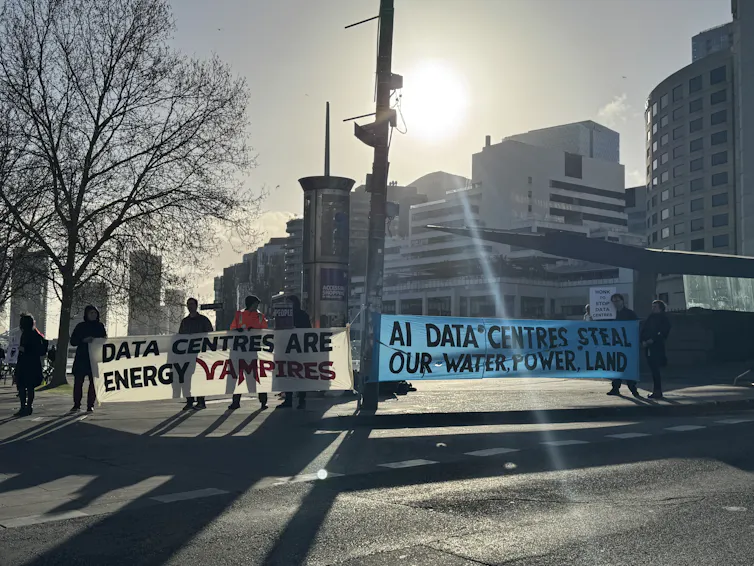
Community opposition to large-scale data centres is growing. Critics are calling for a pause on data centre development, in line with other jurisdictions such as New York, but Prime Minister Anthony Albanese has ruled this out.
We put a call-out to our audience: what questions do you have about data centres? We were quickly overwhelmed with responses and had to close the survey.
This avid response cemented our decision to take a deeper dive into data centres. From almost 350 questions, here were the most common ones.
Click a question to jump to the answer.
1. What data is stored in them, and who owns it?
3. Do communities get a say in where they go?
4. Why do they need to be located near where people live?
5. What’s in it for us? Why does the government want them?
8. What happens to them when the AI bubble pops?
9. Are they/will they become military targets?
Data centres have existed for decades. But something has changed, and this essential infrastructure is now at the centre of a major policy debate.
This article is part of The Conversation’s series on data centres – what they are, why we need them, and why they’re suddenly so controversial.
1. What data is stored in data centres, and who owns it?
A data centre is a bit like a modern library. It holds data in a range of formats and organises it so the data is easily searchable and accessible. Like libraries, data centres have archives and backups, and can hold items until you need them. Like librarians, computer servers inside data centres process requests and send the right data to your device.
To do all this, data centres work with huge amounts of onshore and offshore data. The largest and most complex workloads are handled by “hyperscale” data centres – these facilities are optimised for AI and equipped with specialised chips that can perform millions of computer calculations in parallel.
It’s useful to distinguish between data centre operators and tenants. The operator runs the facility, while the tenant rents space or server racks inside.
Sometimes the operator and tenant are the same company, such as Google. More often though, an operator has multiple tenants and bills each one for the amount of data centre capacity they use. NextDC, CDC and Airtrunk are among the biggest operators in Australia, but they don’t tend to publicly disclose their tenant agreements.
Generally speaking, a data centre is the custodian of the data it hosts. The data remains the property of the individual, or of the service provider that creates or controls the data.
However, data ownership is often complicated by overlapping laws and jurisdictions, as well as the commercial contracts or terms of service between data centre operators, tenants and end users.
Importantly, having data onshore doesn’t guarantee the data can’t be accessed or controlled offshore. This is especially true in cloud computing and AI, where different parts of the workflow can be spread across different servers and locations. A prompt to ChatGPT submitted from Sydney is likely to touch servers well beyond Sydney before returning a response.
Data centres physically located in one jurisdiction must operate under its rules. This means a data centre in Australia abides by Australian privacy laws, environmental regulations, critical infrastructure rules and so on.
Certain types of sensitive data may be subject to strict local requirements. For example, Australians’ My Health records are not allowed to be held, processed or stored overseas.
In other circumstances, data may be subject to overseas access. The US Cloud Act allows US authorities to request American companies to hand over data within their “possession, custody, or control”, even if that data is stored outside the United States.
As data becomes vital currency in an AI-driven economy, questions of data sovereignty – who has genuine control over what – are likely to become even more contested.
2. Are data centres regulated? How?
In short, they’re not.
Despite increasing community concern about large date centres both here and overseas, there is no consistent national framework for regulating them or their increasing demand on power and water. The only laws that currently apply are the standard planning processes that apply to most infrastructure projects.
Instead, states and territories have varying and largely unenforceable requirements at local levels. None is legally binding.
Of the seven jurisdictions, four have set some policy. Victoria has a data centre action plan and New South Wales has guidelines incentivising developers who meet them with fast-tracked approval.
Tasmania and South Australia both have data centre strategies and inquiries underway to update them.
These strategies all attempt to regulate data centres and to attract them under the right conditions. The strategies all note the pipeline of billions of dollars of investment data centres represent. Most of this investment is occurring in Victoria and New South Wales.
Queensland, Western Australia, and the Northern Territory have no dedicated data centre policy or regulations. In these jurisdictions, data centre planning applications and operations are managed under existing industrial frameworks. This means in many cases, applications can only be assessed as warehouses or general industrial uses.
To address this, the federal government recently announced it will
work with state and territory governments to develop consistent mandatory standards for data centre energy, water and land use […].
These standards are yet to be drafted. The government also hasn’t yet said who will enforce these standards, or what powers and resourcing they will have to ensure compliance.
It has released general guidelines, called “Expectations of data centres and AI infrastructure developers”, but these are not laws. They are guiding principles that reflect emerging areas of focus in the regulation of data centres globally. This includes energy and water use, as well as impacts on natural environments and cultural heritage sites.
Increasingly, the government is also emphasising that the high energy use of data centres should not increase energy costs for other users including households.
The proposed national standards also include a requirement for data centre operators to contribute to the national interest through innovation and local jobs pipelines, themes echoed in the existing state frameworks and policies.
The federal government’s proposals also clearly signal it sees the vast and growing investment in data centres as a lever in the transition to renewable energy. The so-called “causer pays principle” will require data centre operators to (at a minimum) fully offset their energy use with new renewable energy sources.
But both Queensland and the Northern Territory governments reject this idea. The impact will also be limited by the fact it would be a new requirement. This means existing data centres and the more than 200 centres currently going through the planning process will not be subject to these requirements.
So in sum, there are currently very few laws governing data centres, the policies that do exist are non-binding, and future attempts to regulate will require cooperation between the federal, state and territory governments.
3. Do communities get a say in where data centres go?
The short answer is – no, not really.
Data centre locations are determined predominately by developers and state planning departments, with relatively little influence from local councils and communities.
Developers select and purchase land based on four key requirements:
-
Land large enough to accommodate the facility and future expansion as demand for digital and AI services grows.
-
Energy and water infrastructure capable of powering and cooling the facility, both now and in the future. As AI services become more intensive, developers are seeking access to increasingly large volumes of energy and water.
-
Proximity and connectivity to urban users and/or submarine cable networks, to reduce latency and ensure ease of connection to global fibreoptic networks.
-
A stable regulatory environment in which governments are supportive of data centre investment and expansion.
Sydney and Melbourne are now among the world’s most attractive locations for data centre development because they offer this combination of land, infrastructure, connectivity and regulatory support.
Once a developer identifies a suitable site, it can purchase the land and proceed through the planning process.
State governments play two important roles.
Firstly, they establish the regulatory settings intended to attract investment while managing impacts on communities, infrastructure and the environment.
Secondly, state planning departments assess many of these large-scale developments. In New South Wales, data centres are classified as State Significant Developments. This means applications are assessed by the state government rather than local councils.
Laws in Victoria can similarly allow data centre projects to bypass councils.
This leaves councils with little influence over development decisions. Local planning controls, such as the distinction between light and heavy industrial land, may be overridden by state-level planning processes.
The Conversation, CC BY-SA
So where does this leave local communities?
Communities generally cannot determine where a data centre is located, but they can have some influence over how it’s designed. Through developer engagement processes and written submissions on exhibited applications, residents may push for changes such as reduced building heights, tree retention or measures to minimise overshadowing.
Community opposition can also affect how a proposed centre is assessed. For instance, in NSW developments receiving more than 50 submissions are referred to the Independent Planning Commission rather than being determined by the Department of Planning. We recently saw an example of this, with the Goodman Group’s Project Mars proposal in Lane Cove West receiving more than 374 submissions, with nine of these supporting the proposal.
What could we do better?
Firstly, data centres could be more appropriately classified and differentiated in the state planning systems, rather than automatically being accommodated within industrial areas that may sit close to homes, schools and transport hubs.
Secondly, local councils and communities could be involved much earlier in decisions about where data centres should be located. Councils have a rich knowledge of their communities, infrastructure, and industrial areas that is often not picked up until late in the application process.
Involving councils and communities early on, rather than only consulting them once a site has been selected and the infrastructure designed, could produce outcomes that benefit both developers and the communities hosting data centres in the long term.
4. Why do data centres need to be located near where people live?
The short answer is: because proximity is a friend of speed and convenience.
The more complicated answer is: they don’t, at least not all data centres. The world’s biggest data centres, like OpenAI’s Stargate, are not where people are, but where the energy is abundant.
Things are changing though. The rapid take-up of AI services in large cities means more data centres – bigger, more energy intensive – are now being built close to major populations.
The owners of most of the world’s AI compute (processing power) – companies like Microsoft, Amazon, Google and, increasingly, Anthropic – are investing billions to scale up capacity, leading to dramatic new developments in populated cities around the world.
The digital “cloud” has very much descended to earth.
As I show in this data centres map, much of Australia’s data centre pipeline is landing in and around major population centres, and is being fast-tracked by state governments in Victoria and New South Wales. Victoria is ranked lowest for transparency on how data is governed.
The pipeline of approved data centres will require a reported 6 gigawatts of power to fuel them – a massive scale up from the 100 megawatts consumed by the existing generation of data centres. A gigawatt is enough to power about 500,000 homes at once.
So why is this new build-out happening so close to where people live? It’s because the majority of existing data centres in places like Australia were built for another era: for things like streaming and cloud hosting. These applications kept things feeling instant by holding copies of popular content close to users, while the heavy lifting happened far away.
Now, with the expansion of AI services, this method for delivering applications doesn’t quite cut it. While the AI models running ChatGPT and Claude can still be trained in data centres far from where people live, growing use of these models means much more compute capacity is needed closer to where people are.
Every time you ask ChatGPT or Claude a question, the model has to generate a fresh response; it can’t be cached. This is called “inference”, and unlike a cached TV episode, it can’t be stored in advance close to you.
As AI spreads across business and consumer applications, more inference capacity is needed closer to where people are.
Yet another factor here is power. Connecting a new site to the grid can take years, so operators favour locations where high-voltage transmission and substation capacity already exist. These are concentrated in and around the cities Australians already live in.
When developers choose these sites, they can meet that need for speed again – which some state governments are facilitating by fast-tracking development applications.
5. What’s in it for us? Why does the government want data centres?
Nations have long contested control of land, sea and air spaces. Data is the newest frontier, and just like the others, it’s physically located somewhere, under someone’s law. Data centres are where the digital economy resides, and the country that controls the underlying land shapes how the data can be used. This is known as data sovereignty.
Sovereignty matters because our most valuable data is increasingly processed by AI. Consider our medical records, banking details, farm and business records, minerals exploration surveys, and research data.
These are assets of national and personal importance, yet when this data is sent to offshore commercial AI services, it becomes subject to foreign contracts, and may become subject to foreign law, putting our control and intellectual property at risk. Data centres built on Australian soil keep our data subject to Australian laws.
Another reason is economic. Data centre investment in Australia is booming. In NSW alone, investment in the sector has grown by around 75% a year over the past three years, with more than 60 facilities operating or under construction and a further A$50 billion of projects in the pipeline.
Similarly, Victoria’s action plan could deliver a pipeline worth more than $25 billion. Our governments are shaping this growth: the federal government released the National AI Plan in late 2025, and NSW released its Data Centre Policy Framework in August 2026.
Here’s the catch: location alone doesn’t guarantee complete sovereignty. The AI models running inside the data centre matter too. Models come in two main types: closed and open-weight. Closed models may be subject to foreign law and export controls, and today’s access and prices are not guaranteed tomorrow.
Open-weight models running on Australian soil carry less risk: there are no per-token fees, and overseas companies can’t switch off our access to them. The real question then becomes not whether Australia should build data centres, but what kind of data centres Australia should be building and operating.
Then there is energy. Both federal and state governments now expect data centres to incorporate new clean energy generation or storage to offset their energy demands. Regulated well, this could help bankroll the renewable energy transition. Done poorly, it can strain the grid.
So what’s in it for us? Potentially a great deal: sovereign capability, a funded energy transition and regional growth. But only if we are selective. The question is not whether Australia should host data centres. It is whether we choose the ones that serve us.
6. Where do the profits go?
The short answer is: mainly overseas.
When it comes to following the money in data centres, think of them not as tech companies, but rather commercial landlords that rent out space to tech companies.
In a normal warehouse, a tenant pays based upon size and location. For a data centre, the key factor is power, rather than space.
Access to reliable power drives the amount of computers that can be stored inside, and determines how much their tenants – tech companies like Amazon, Google, Microsoft and Anthropic – will pay.
For the billions of upcoming investments into Australian data centres, the majority (up to 65%) goes towards computer equipment. Almost all of this money heads overseas to computing giants like Nvidia, which enjoys 70% gross margins on its crucial AI chips.
The remaining money is spent on purchasing land and specialist cooling equipment, while 5% is spent on improving power grid capacity. It’s this money that is more likely to stay in Australia, paying for land, construction, engineering, and other local services.
Once operational, data centres generate remarkably high profit margins of around 50%. These margins are driven by the current 97% global occupancy rate of data centres, and long-term leases where tenants pay for their own power consumption.
In the eyes of investors, these facilities are essentially highly appealing premium commercial real estate with consistent, long-term yields. Australian data centre owners include:
- global investment funds such as Blackstone
- foreign pension funds from Canada and elsewhere
- Australia’s largest superannuation funds including Commonwealth Super, AustralianSuper and UniSuper
- Australia’s sovereign wealth fund, the Future Fund
- stock market investors, for listed companies such as NextDC on the ASX or Digital Realty on the US NASDAQ exchange.
Ultimately, the tech tenants pay rent to their data centre landlords. In turn, the tech companies charge Australian businesses for their services.
While these facilities serve Australian businesses, their primary economic contribution is the short-term sugar hit during the construction phase.
Beyond that, the majority of the money invested, and the profits made, will ultimately end up in the hands of overseas chip companies and investors.
7. Can the water be recycled?
Potentially.
Data centres require constant cooling to work properly and prevent damage from overheating. There are several ways to keep them cool, but a common approach involves circulating a coolant liquid through banks of servers that store and process online data.
This coolant, often a mix of glycol and water, removes heat generated by the servers and is then sent to external cooling towers. There, a combination of mains water and large volumes of air pulled in by massive fans causes the hot coolant to rapidly drop in temperature. This process mirrors how a person sweats to cool down.
Currently, the water used to cool data centres comes from urban water systems. This puts pressure on drinking water supplies. In the American city of The Dalles, Oregon, Google’s data centres reportedly consume nearly 40% of the city’s total annual water demand.
Sydney Water, Australia’s largest supplier of urban drinking water, is grappling with the growing demands of this thirsty industry. Within a decade, data centres are expected to consume 25% of Sydney’s daily water demand, up from just 1% currently. This means data centres could soon suck up roughly 139 billion of the 556 billion litres Sydney residents consume each day.

GoAerials/Getty Images
So where else could this water come from?
A new data centre slated for Melbourne might have the answer. Amazon Web Services is set to build a new data centre in the city’s west that will be cooled with recycled wastewater. This wastewater will be treated and supplied by the Melton Recycled Water Plant, making it the first Victorian plant to deliver recycled water to a data centre.
This is part of the Victorian government’s broader ambition to use recycled water across various industries including data centres, manufacturing and even health care.
Sea water is another option. The Google data centre in the Finnish city of Hamina, for instance, is cooled using seawater from the Gulf of Finland. However, this approach is expensive and difficult to pull off because evaporating sea water produces a salty brine that can corrode infrastructure, such as data centres.
Generally, data centre cooling water is only used once before it flows back into the local sewerage system. But the American city of Quincy, where a special facility has treated cooling water from Microsoft’s data centre since 2021, suggests data centres could reuse it. But treatment is crucial because evaporating cooling water makes it extra salty and more likely to damage data centre servers.
8. What happens to data centres when the AI bubble pops?
If the AI bubble bursts, data centres won’t suddenly become empty buildings, because the underlying technology won’t disappear. Some investors may lose money, and some proposed projects may never be built. But the world will continue producing, storing and using more data.
The first projects to suffer would be those without confirmed customers, reliable electricity, or strong internet connections. Some would be cancelled before construction starts. Others might be delayed, reduced in size, or sold to another company. Operators that built too much capacity may have to lower their prices.
The computer chips inside data centres would be most at risk. They are expensive and can become outdated quickly. In January 2026, Microsoft said about two-thirds of its quarterly infrastructure spending went towards shorter-life equipment, mainly computer chips. The remaining spending went towards assets expected to earn revenue for at least 15 years.
If demand for AI slows, newer chips could still be used for cloud computing, everyday AI services, medical research, engineering simulations, weather forecasting and digital media. Older chips that consume too much electricity may no longer be economical. They would need to be reused, sold or recycled responsibly.
The buildings themselves are a different story. Their electricity connections, fibre networks, cooling systems, security systems and serviced land can remain valuable for many years.
Banks, hospitals, government agencies, universities, retailers and streaming services all depend on data centres. These needs will continue even if excitement around generative AI declines.
We’ve seen this pattern before. During the internet boom of the early 2000s, companies in the US built too many fibre-optic networks. The dot-com crash caused serious financial losses, but the internet kept growing and the infrastructure supported its next stage.
The International Energy Agency has also tested what could happen if AI grows more slowly than expected. Data centres used about 415 terawatt-hours of electricity worldwide in 2024, nearly one-and-a-half times the 283.9 terawatt-hours of electricity generated across Australia that year.
Even under a slower-growth scenario, global data centre electricity use reaches about 700 terawatt-hours in 2035, approximately 70% higher than in 2024.
Australia should therefore continue developing data centres, but do it carefully. New data centres should be built in stages as real customers are secured. Developers should pay for the electricity infrastructure their projects require. Buildings should also be designed so their equipment and cooling systems can be changed as technology evolves.
If the AI bubble bursts, weak projects will fail. Well-designed data centres will adapt. Success will depend on building the right facilities in the right places, not simply building as many as possible.
9. Are they/will they become military targets?
They already are. When the US and Israel launched their war against Iran earlier this year, one of the first sites Tehran struck in retaliation were data centres in the United Arab Emirates and Bahrain.
Experts called this moment a “sea change in warfare”.
Our most valuable data has been subject to cyber attacks for decades. But now, governments and tech companies must also think about how to physically protect their data when a conflict breaks out.
Some data centres are obvious targets due to their sheer size alone. But size is not the most important factor – the significance of the data is what matters most.
An adversary would likely want to cause the most damage to the wellbeing of a nation for an extended period of time. This means targeting the data that forms part of a nation’s critical infrastructure.
How to recognise and prepare for these new threats is still poorly understood, which is why I’ve started a research program at the University of Canberra to study this. These are three issues I believe require urgent examination.
First, there is the danger of attacks from missiles and drones, even as far away as Australia. Iran used drones to attacks data centres across the Middle East. And Ukraine has sent waves of drones thousands of kilometres into Russia to attack warehouses and logistics centres belonging to online retailers.
This has prompted much debate about how little is being invested in defending these sites in Australia. One expert has posited that fortifying data centres could cost hundreds of millions of dollars.
Second, Ukraine has proven so resilient to repeated Russian attacks on its infrastructure because it backed up data from 50 government institutions to cloud servers outside the country in just three months.
This is something Australia could replicate. But for Australian data to be protected by our own laws, the data would need to be physically stored at Australian-based data centres. To have our backup data protected on foreign servers, we would need very strong partnerships with the countries involved.
Last, but not least, there’s the danger of what’s known as cascading failure. Due to the interconnectedness of our critical infrastructure, an attack on, say, the power grid or undersea cables could take out our data centres, too.
The best example of cascading failure was the CrowdStrike outage in 2024 that caused computer systems around the world to crash. It wasn’t caused by an attack. But it could have been.
The threats to data centres will only continue to evolve, and not just in the cyber domain. Protecting them needs to be a much bigger priority. Putting a fence around them and locking the doors is just not enough.
Disclosures
Amir Karton receives funding from the Australian Research Council. He is a visiting scientist at Microsoft AI4Science, working on fundamental quantum chemistry in a scientific collaboration unrelated to data centre infrastructure, commercial AI services, or government policy.
Andrew Cullen is a Board Member of Music Technology Australia, a member of the World Intellectual Property Organisations AI Technical Exchange Committee, and the managing consultant at EthiCan AI consulting.
Ian A. Wright has received research funding from local government bodies, the New South Wales government and the federal government. He has previously worked for Sydney Water as a scientist and a catchment officer.
Frank den Hartog is the Cisco Research Chair in Critical Infrastructure at the University of Canberra.
Bronwyn Cumbo receives funding from the Australian Public Policy Institute for the project Grounding the Cloud: Co-creating a sustainable, community-inclusive data centre industry.
Ehsan Noroozinejad, Jacqueline Boaks, Olivia Shen, and Sarah Barns do not work for, consult, own shares in or receive funding from any company or organisation that would benefit from this article, and have disclosed no relevant affiliations beyond their academic appointment.


