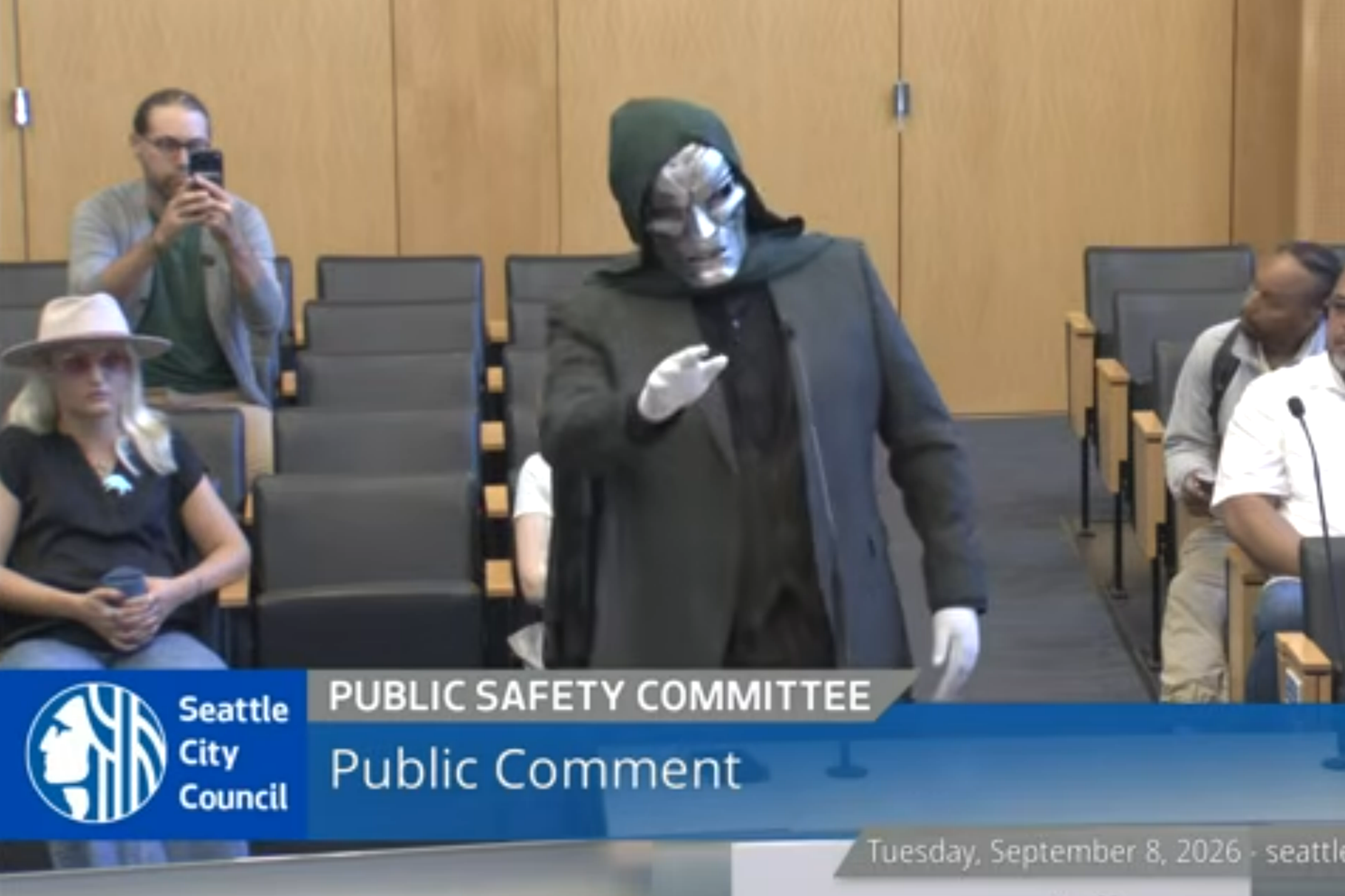
Doctor Doom took the podium at a Public Safety Committee meeting on Tuesday to thank the council for covering the city in surveillance cameras. “Doom took over Axon enterprises […] and now Doom will be watching you. Your continued cooperation expanding Doom’s surveillance network is required,” the Marvel supervillain said.
“This is the first of Doom’s gifts to the city of Seattle. The second gift is this: Doom will expand the real-time crime center to all neighborhoods with over 1,000 cameras watching every move,” Doom said. “Doom has total dominion over the city of Seattle. Doom will be behind the cameras watching those seeking reproductive or gender-affirming care. Doom will be able to find your immigrant neighbors and Doom will be able to ensure the safety of the women of Seattle alongside officers that stalk their exes.”
Doom is actually Clifford Cawthon, a policy advisor for the Washington State Department of Commerce. Cawthorn donned the silver mask and gloves to draw attention to tech-driven mass surveillance in Seattle, an issue he’s been passionate about for years. Cawthon is also a member of Community Not Cameras, a local activist group that’s attempting to reign in Seattle’s use of surveillance systems sold by Flock and Axon.
Seattle’s PD has access to 62 surveillance cameras around the city, many of them hooked up to a real-time crime center (RTCC). “The RTCC takes in information from a vast pool of sources, including CCTV, [body-worn camera], geolocation data, automatic license plate recognition (ALPR), alert sources like shot detection or alarm systems, and computer-aided dispatch (CAD) software,” according to a description on the surveillance company Axon’s website.
Cawthon said he and a colleague got the idea for appearing before the city council as Doctor Doom after seeing an activist in California go viral for dressing as Darth Vader to talk about Flock cameras at a public meeting. They’d also recently visited Seattle’s RTCC and were struck by how much it resembled a super villain’s lair. Cawthon told 404 Media it reminded him of the film Minority Report.
“There is a wall of about nine screens in which they can bring up cameras from around the city at any given time,” Cawthon said. “They can also log in, conceivably, even from their home computers with the right credentials […] I am not reassured by the kind of dazzling scale of this complex communications center.”
After the visit to the RTCC and after Vader appeared in California, one of Cawthon’s colleagues called him with an idea. “What if Doctor Doom went to the city council?” Cawthon said. Community Not Cameras was looking to drive attention to the issue of mass surveillance and had just drafted a petition with specific asks of the city council. A pop-culture infused stunt might get people talking.
“We thought, wouldn’t it be interesting if the Seattle city council meets Victor von Doom, the Lord Emperor of Latveria,” Cawthon told me, adopting the vaguely Eastern European accent of Doctor Doom. “And Victor von Doom shares with this pathetic American municipal council that they are actually doing Doom’s bidding without even realizing it.”
Cawthon is a comics fan and knew that Doom was on people’s radar because he’s the villain in the forthcoming Avengers Doomsday. He told me that pop culture has taught people to identify with heroes like the Jedi, the Avengers, the X-Men, and the Fantastic Four. “Would our heroes really use tools of mass surveillance on a regular basis in a way that’s unaccountable and hurts innocent people? They wouldn’t,” he said.
“The absurdity of the real time crime center and the absurdity of Axon and Flock owning these devices and this data being used around the country to capture and lock up and deport people and to harass women,” Cawthon said in his normal voice. “It was so clear this is a tool of abuse and being used in such villainous ways […] we figured, why not use satire, political theater, to really illustrate what these tools mean.”
Cawthon grandstanded behind the podium at the Seattle city council meeting on Tuesday. “Doom is above all. The means are more than justified by the ends,” he said. “Doom will keep you safe,” and “We must work to crush any dissent to Doom’s vision of public safety.”
On the phone with me, Cawthon ran through the list of his problems with surveillance tech. “The data is not secure, in many cases these companies — and they’re very open about this — work with ICE, work with the US military, and border patrol. There are multiple instances of police officers literally using this data to stalk their partners and abuse everyday people. And, of course, racial profiling,” he said. “The increased potential for racist harassment of black and brown folks like myself.”
Cawthon said reactions to his political theater have been positive and that it’s achieved the goal of driving people to look at the Community Not Cameras petition. The group wants Seattle’s city council to take five actions including redirecting the flow of money away from surveillance tech and back into community-based crime prevention programs.
He said that the council had already agreed to its first demand. Last month a committee voted to move $250,000 away from CCTV expansion. Now the measure just needs approval from the full council.
“Doom will be watching you. Glory to Latveria,” Doom said during the city council meeting on Tuesday.
Last month activist Anthony Ralphs showed up to a San Diego City Council meeting dressed as Darth Vader and explained how much the Empire loved Flock cameras. Footage of the stunt went viral. Ralphs told 404 Media that he’d dressed as Vader after years of attending public meetings as himself and failing to draw attention to the issues of surveillance. Earlier this month, a woman attended a public meeting in Texas in full Joker makeup to complain about decorum at city council meetings.
According to Cawthon, this was all about “donning this pop culture persona and drawing a connection between what is in reality a massive threat to our civil liberties and civil rights.”
“These stories, these ideas about fascism, authoritarianism, they can be very close to home if we let them. Becoming the character and going to city councils is political theater in the best way. It is informing people in a way that is accessible because you know these cultural figures are in the zeitgeist,” he said. “I know plenty of people that, when I talk about public policy, they just throw up their hands and say ‘Okay, well, that’s cool and thank you for sharing with me but politics isn’t my thing,” he said. “But I can talk Marvel with them, I can talk video games, and we have a common language.”