Welcome back to the Abstract! These are the studies this week that pottered around, ate well, shone bright, and went long in the tooth.
First, scientists identified a Bronze Age tradition of pottery as one of the earliest “brands,” revealing that humanity’s love for reliable commodities has deep roots. Then: a meal fit for a galaxy, a multi-camera view of the Sun, and a dizzying deep dive into a narwhal tusk.
As always, for more of my work, check out my book First Contact: The Story of Our Obsession with Aliens, or subscribe to my personal newsletter the BeX Files.
Brands are not brand new
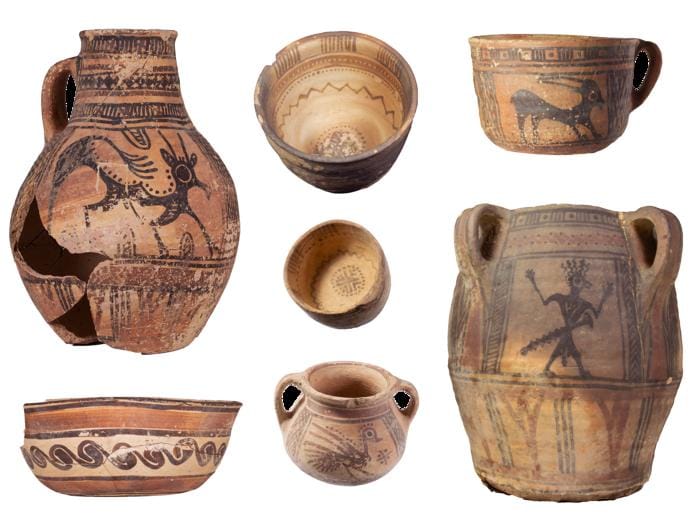
Brands have completely taken over the modern world, from established corporate trademarks to the proliferation of online influencers. But the allure of brands is nothing new, according to a study about an ancient style of pottery called Qurayyah Painted Ware that was a progenitor of branding some 3,200 years ago.
This brand of pottery was popular in what is now Saudi Arabia during the Bronze Age. The tradition is distinguished by distinctive black-and-red geometric designs and stylized animal and human figures. These unique visual properties, along with a consistent production technique and quality, suggest that it was an early branded commodity that was made to be recognizable to the wider community.
“It is now understood that brands and proto-brands existed well before modern economies,” said researchers led by Marta Luciani of the University of Vienna. “In this contribution we analyze the process by which the commodity itself—decorated pottery vessels—was developed into a brand not by added symbols but on the virtue of its visual identity, material consistency, technological continuity, centralized production, export circulation, local imitation, intentional commercial scope, and cultural reputation.”
As such, the study “offers the first investigation of the dynamics leading to the genesis of a brand,” the team concluded.
Now, that’s a vintage brand. Who wants to do the sponsored endorsement on socials?
A low-energy snack for the Milky Way
Our home galaxy, the Milky Way, extends across 100,000 light years and contains hundreds of billions of stars. How did it get so swole? The answer is a healthy diet made up of smaller galaxies that the Milky Way has swallowed over time, adding to its starry heft.
Now, scientists have identified the digested remains of a galaxy that served as cosmic baby food for the Milky Way during its infancy some 12 billion years ago. By studying stars at the center of the galaxy using the Hubble Space Telescope, the team was able to reconstruct this ancient merger between the Milky Way and a dwarf galaxy that has been gifted with the amazing name “Low-energy-Kraken-Heracles” (LKH) after its constituent parts.
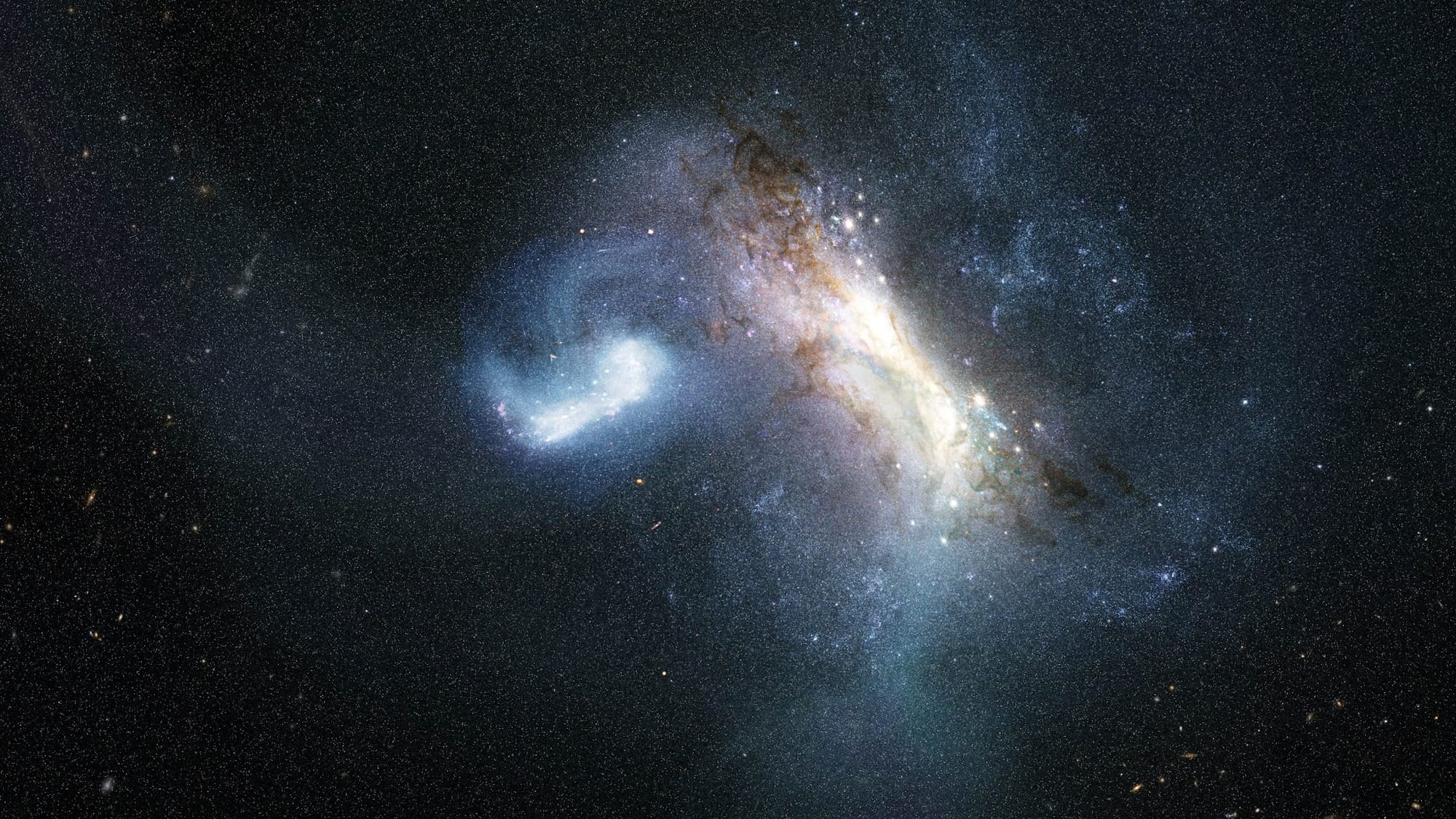
“Our conclusions are strongly supported by cosmological simulations, which typically predict between one and four substantial mergers in the history of a Milky Way-like galaxy,” said researchers led by Davide Massari of the Observatory of Bologna. “The identification of a third merger event in the inner Galaxy puts to rest earlier debates and, honouring previous works, we name the progenitor system Low-energy-Kraken-Heracles, or LKH for short.”
The study explains the origins of a group of metal-poor stars in the galactic center suggesting that they are leftovers from the LKH galaxy, which was about as massive as 500 million Suns. This merger occurred before the engulfment of another fantastically-named galaxy, Gaia-Sausage-Enceladus, which occurred about 10 billion years ago and significantly influenced the Milky Way’s evolution.
It goes to show that you are what you eat (in this case, yummy primordial galaxies).
The Sun goes ka-blowie
It’s time, once again, to pay tribute to the almighty Sun. Our star regularly barfs out enormous streams of solar plasma known as coronal mass ejections (CMEs), which radiate across the solar system and can wreak havoc on satellites and even ground infrastructure in some cases.
But while these solar blowouts are common, their underlying mechanics are still poorly understood. Now, scientists report unprecedented observations of a CME that occurred in December 2024, which was captured by 17 spacecraft. In particular, measurements from NASA’s Europa Clipper, which is on its way to study Jupiter’s icy ocean moon, revealed “a structure far more complex than could be inferred from single-point observations,” according to the study.

“This study demonstrates the power of coordinated multipoint observations to uncover the true complexity of CME evolution in the inner heliosphere,” said researchers led by
Adrienn Luspay-Kuti of Johns Hopkins University Applied Physics Laboratory. “Such structure would not have been resolvable from Sun-Earth line observations alone. As human exploration extends toward Mars, such comprehensive heliospheric coverage will be critical for protecting spacecraft and crew.”
As if future crews to Mars don’t have enough to worry about, they’ll also have to take cover from projectile star vomit. At least the complex workings of CMEs are gradually becoming illuminated, though we may never fully understand these mercurial outbursts.
Taking a tusk to task
Speaking of structures that get more complicated under close inspection, may I interest you in a narwhal’s tusk? These elegant elongated ornaments have inspired many myths and legends due to their unicorn-like appearance, and they have also enraptured scientists for generations.
A team has now unraveled the mysterious layers of the narwhal tusk using advanced X-ray imaging techniques, which allowed them to resolve its structure on atomic, nano, and micro scales. The examination of the tusk confirmed that it consists of a left-facing helix, whereas another interior structure twists to the right. This mesh is sculpted with small deviations that mirror the iconic twisted spiral of the tusk.
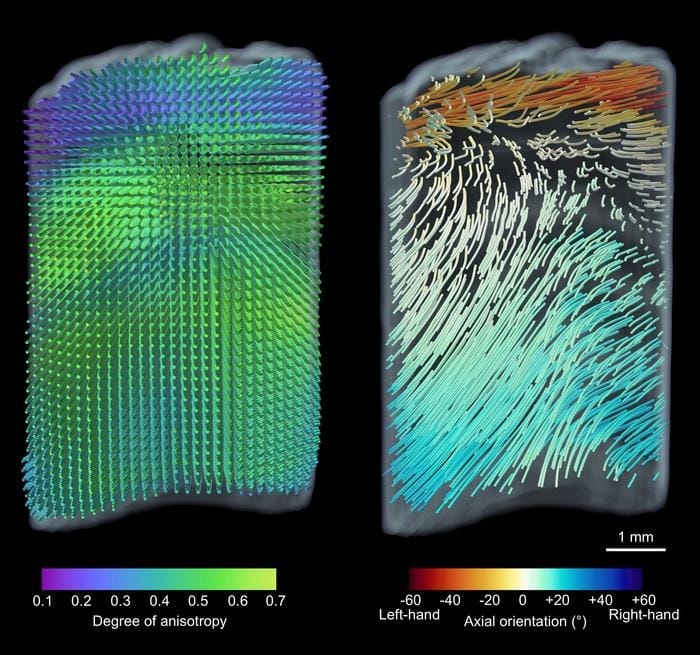
“To finally solve the narwhal helical tusk puzzle, we combine multimodal imaging and multiscale orientation analysis, enabling accurate mapping of the tusk from the atomic to the macroscopic scale,” said researchers led by Adrian Rodriguez-Palomo of Aarhus University.
“The structural anisotropy and the ensuing anisotropic mechanics mean that the tusk can grow straight, unlike, e.g., the curved elephant tusk, providing the narwhal with its majestic, evocative defining characteristic,” the team concluded. “The formation of such a structure remains unknown, as we lack crucial information on narwhal tusk growth and development.”
Shout out to all the aspiring narwhal scientists out there—looks like there’s more work to do.
Thanks for reading! See you next week.