
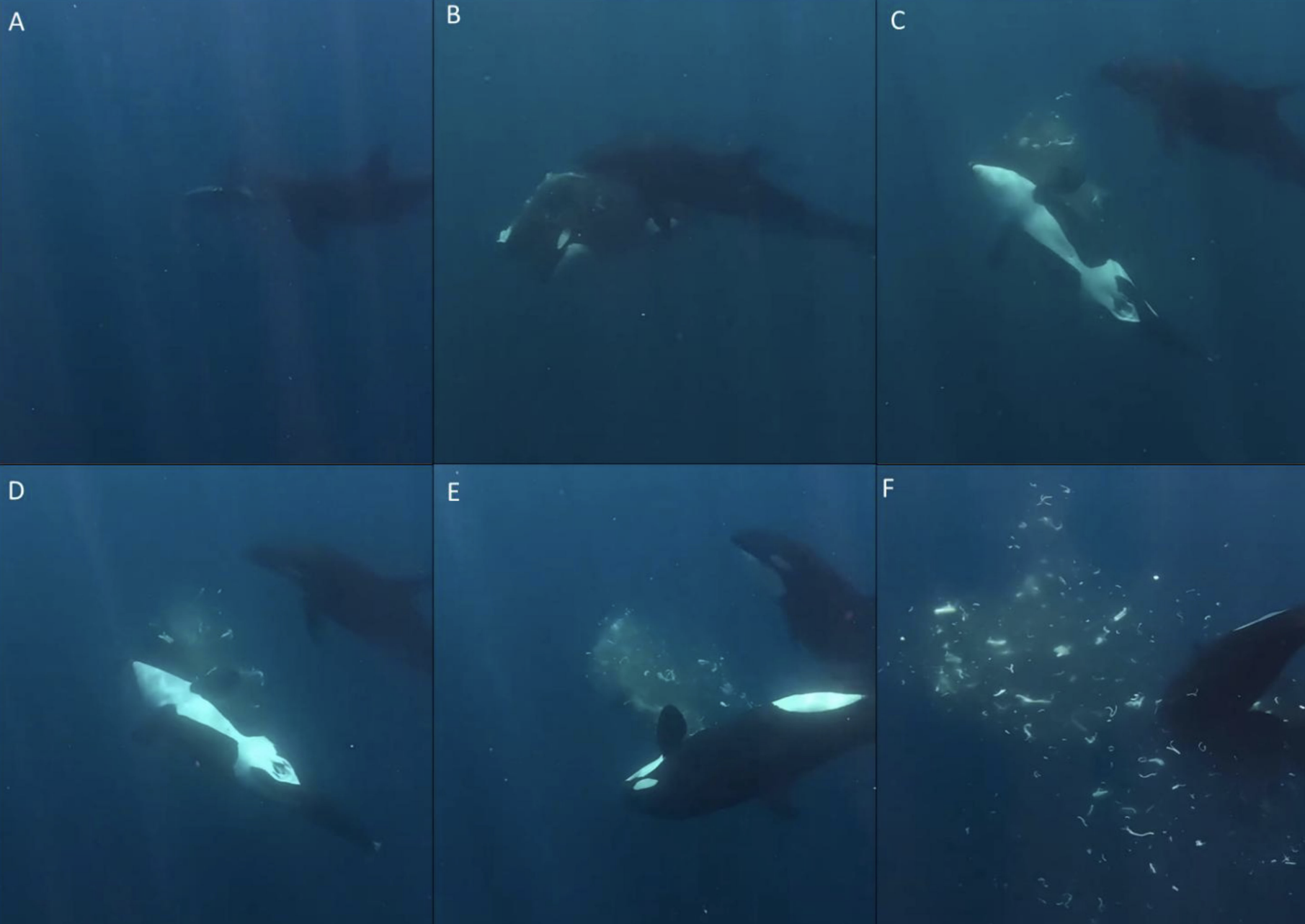
Scientists have discovered a previously unknown behavior in orcas that involves one member of a pod holding up a massive dead sunfish while another charges and rams it, resulting in the dramatic explosion of the carcass into fleshy fragments, according to a study published on Thursday in Frontiers in Ethology.
Orcas often ram or strike prey as a hunting tactic, and some pods are also notorious for ramming boats. But the new study is the first to report such explosive results and sheds light on the mysterious lives of orca pods in the Gulf of California. The hold-and-ram strategy allows juvenile orcas to feed on smaller chunks of tissue and may also serve as a form of social learning and play in these highly intelligent marine mammals.
Erick Higuera, a wildlife cinematographer and marine biologist, first observed orcas detonating a sunfish in 2021. The tactic was captured in follow-up footage by marine biologist Kathryn Ayres in 2024, as well as video from another event in 2025, filmed by Héctor Franz, who works in ecotourism.
“The first time I witnessed it, at that moment, the energy of the impact was astounding because we could hear the sound when the orca ran into the sunfish,” said Higuera, who co-authored the new study, in a call with 404 Media. “Seeing a multi-ton predatory mammal striking a massive fish—because sunfishes can go up to two meters depending on the species—with such a fast speed is breathtaking, and immediately we knew that we were witnessing something highly unusual due to the magnitude of the tissue explosion.”
Orcas are social animals that form tight-knit matrilineal pods that in turn belong to broader “ecotypes” with their own unique cultures and ranges. In the Northeastern Pacific, there are three genetically distinct lineages: resident orcas that primarily eat fish, transient orcas that mainly eat marine mammals, and offshore orcas that prey on sharks.
But less is known about the feeding behaviors of orcas at lower latitudes near the equator, which don’t seem to fall into such clear ecotypes. For years, Higuera and his colleagues have been capturing footage with drones and underwater cameras to better understand the mysterious pods that roam in the Gulf of California. That’s how they were able to fortuitously capture the explosive hold-and-ram strategy on film.
Sunfish are large, but easy to hunt, making them a popular target for orcas and other ocean predators. However, these animals have tough and rubbery flesh that is difficult to tear apart, especially for young orcas. For this reason, Higuera and his colleagues speculate that the ramming technique is primarily intended to loosen nutritious tissue from the carcass for juveniles to consume, noting that the adults focused on eating organs and meat from the body itself, leaving the fishy ejecta for their young. The behavior may also just be fun, as orcas often play with their food.
“Orcas are highly encephalized predators that frequently engage in object manipulation and play behavior with their prey,” Higuera said. “That is very globally well known. Because sunfish are slow-moving and defenseless, they present a low-risk opportunity for the pod, especially subadults, so they can practice strike precision and reinforce social bonds. It’s social play and learning.”
The team plans to continue tracking the pod to better understand the behavior, and to learn whether the sunfish’s microbiome and enzymes might contain special nutrients for the orcas. At the same time, Higuera emphasized that human interactions with orcas should remain as limited as possible, especially since whale watching in the region has become a popular tourist activity.
“This groundbreaking insight was only made possible through a vital collaboration between expert scientists, eco-tourism operators, and citizen scientists equipped with drones and cameras that are willing to provide their footage to us so that we don’t spend that much time in the field,” Higuera said.
“If we can protect these animals by maintaining a respectful distance,” he concluded, “this ongoing partnership will allow us to safely document hidden mysteries of marine life that would otherwise remain completely closed to science.”

