Over the past decade, the AI-focused, for-profit Alpha School has grown from one campus in Austin, Texas, to a growing list of more than 15 schools across the country, including in major cities like New York and San Francisco.
Alpha School joins other AI-centric K-12 private schools, like Unbound Academy and the Khan Lab School, that parents can now choose for their children, paying anywhere from US$40,000 to $75,000 in some cases each year.
Some advocates of AI-driven education use slogans like “School is broken, and we’re here to fix it.”
MacKenzie Price, one of Alpha School’s co-founders, has described her frustration with the “one-size-fits-all” model of schooling, in which all students study the same material, but often learn at different speeds.
Sal Khan, the founder of the online educational platform Khan Academy, has also argued that artificial intelligence could give every student an individual tutor that is responsive to their specific needs.
And Bill Gates is among the tech thought leaders who have speculated that AI will replace many teachers within the next decade.
The argument for more personalized education may be a good one in some cases. But it also risks creating a false dichotomy where all AI programs are seen as responsive and motivating, and all classroom teaching is rote lecturing.
As a scholar of education policy who does research on AI and teachers, I recognize that reality is far more complicated.
The promise of AI tutoring
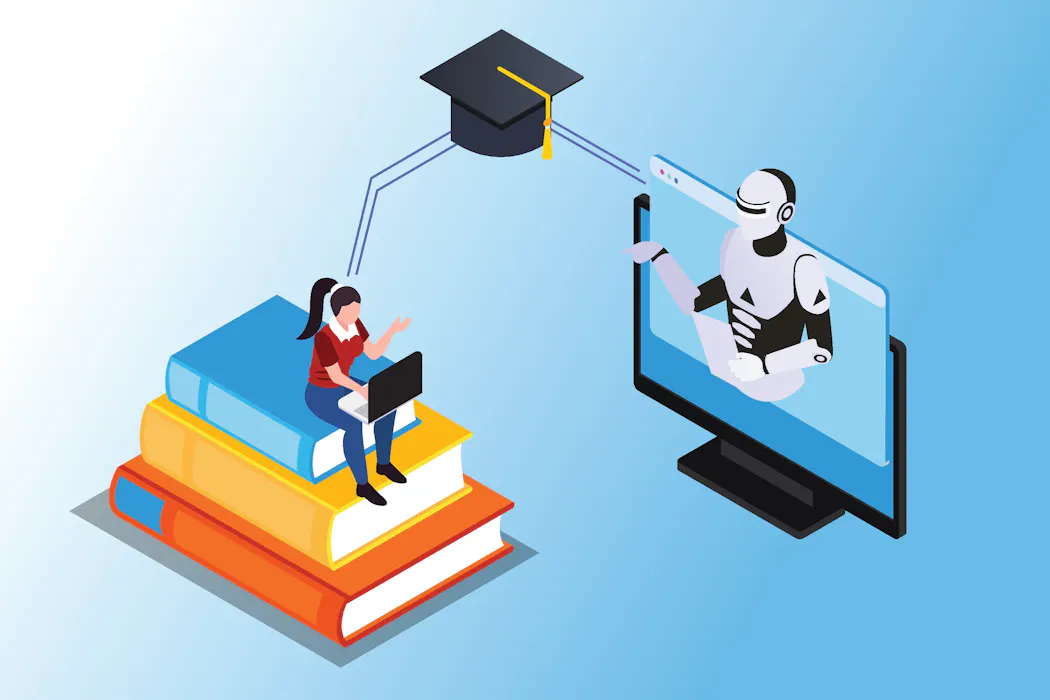
Alpha School replaces traditional, in-person instruction for K-12 students with personalized AI tutoring that condenses reading, math and other subjects into a two-hour study period.
The two-hour AI tutoring block is supplemented with in-person workshops and what the school calls “coaches” or “guides,” who are not necessarily licensed teachers. These sessions can focus on nonacademic life skills, like public speaking and entrepreneurship, as well as art and physical education.
When it comes to the AI portion of this education, it is clear that there are benefits to personalized tutoring. A major review published by the National Bureau of Economic Research in 2020, for example, showed that many different kinds of tutoring provided by humans produced consistent learning gains across subjects and age ranges.
A 2026 study by the Brookings Institution showed that AI improves computer-assisted tutoring by allowing students to interact in everyday language with the program. Generative AI can also modify the tutoring session, based on a student’s progress and challenges with the material.
So far, though, there is no clear evidence that AI or other kinds of computer-based tutors are superior to human tutors, though in many cases they might be cheaper.
Instead of trying to replace teachers with AI, I think that a more promising strategy is to support teachers in using AI to become better educators.
Good tutoring supports classroom learning
One-to-one tutoring with a human teacher, parent or paraprofessional has been shown to be very effective in raising student test scores and to overall improve student learning.
“High-impact” tutoring that involves regular, long-term sessions in small groups held within schools has been shown to be particularly effective.
As Isabelle Hau, the executive director of the Stanford Accelerator for Learning, writes, young students need to develop strong social skills, what she calls “relational intelligence” to flourish in social settings.
To be effective, human tutoring needs to meet certain criteria. For example, tutors and their students should meet consistently, the tutors should be skilled and make sure that what they are teaching is fully integrated with the student’s curriculum.
Relationship-building between tutors and students is also critical for getting students to stay more motivated and focused on their work at hand.
Can AI tutors replace human ones?
Computer-assisted instruction and intelligent tutoring systems have been around since the 1970s.
These systems are designed to provide instruction that adapts to learners as they progress through a series of exercises, problems or questions. They have been shown to increase student achievement when used as a supplement to classroom learning.
However, extensive analysis of different studies found that while these systems increased student achievement, when compared with classroom instruction or students who rely on textbooks or workbooks to study, there was no significant difference in learning between computer tutors and human tutors.
More recently, a 2025 study found significant positive effects of AI tutoring on student achievement, across subjects and different grade levels.
In another widely cited study on AI tutors, researchers in 2025 compared the effect of active learning in class with a specially designed AI tutor they had built for an introductory class in physics at Harvard.
Students who used the AI tutor said they learned the material faster and felt more motivated to learn, compared with students who received specialized in-class instruction.
In this study, not only were the students already highly motivated and had good study skills, but the AI tutor was built by the same professors who taught the course.
AI-supported instruction
Claims that AI tutoring is superior to classroom instruction are only looking at part of the evidence.
But AI tutors could indeed be useful in some cases, if they are used to support human teachers in their work. One 2024 study showed student improvement in middle schools in low-income areas when human tutors had access to AI tutoring support.
And a 2026 study showed that when teachers use AI for lesson plans, experienced teachers tend to critically revise content to better link it to the overall curriculum.
Instead of considering a future where AI tutors replace human teachers, I believe that we need to think about what kind of support and professional development can help teachers make the most of these new and complicated tools.

Gerald K. LeTendre does not work for, consult, own shares in or receive funding from any company or organization that would benefit from this article, and has disclosed no relevant affiliations beyond their academic appointment.