
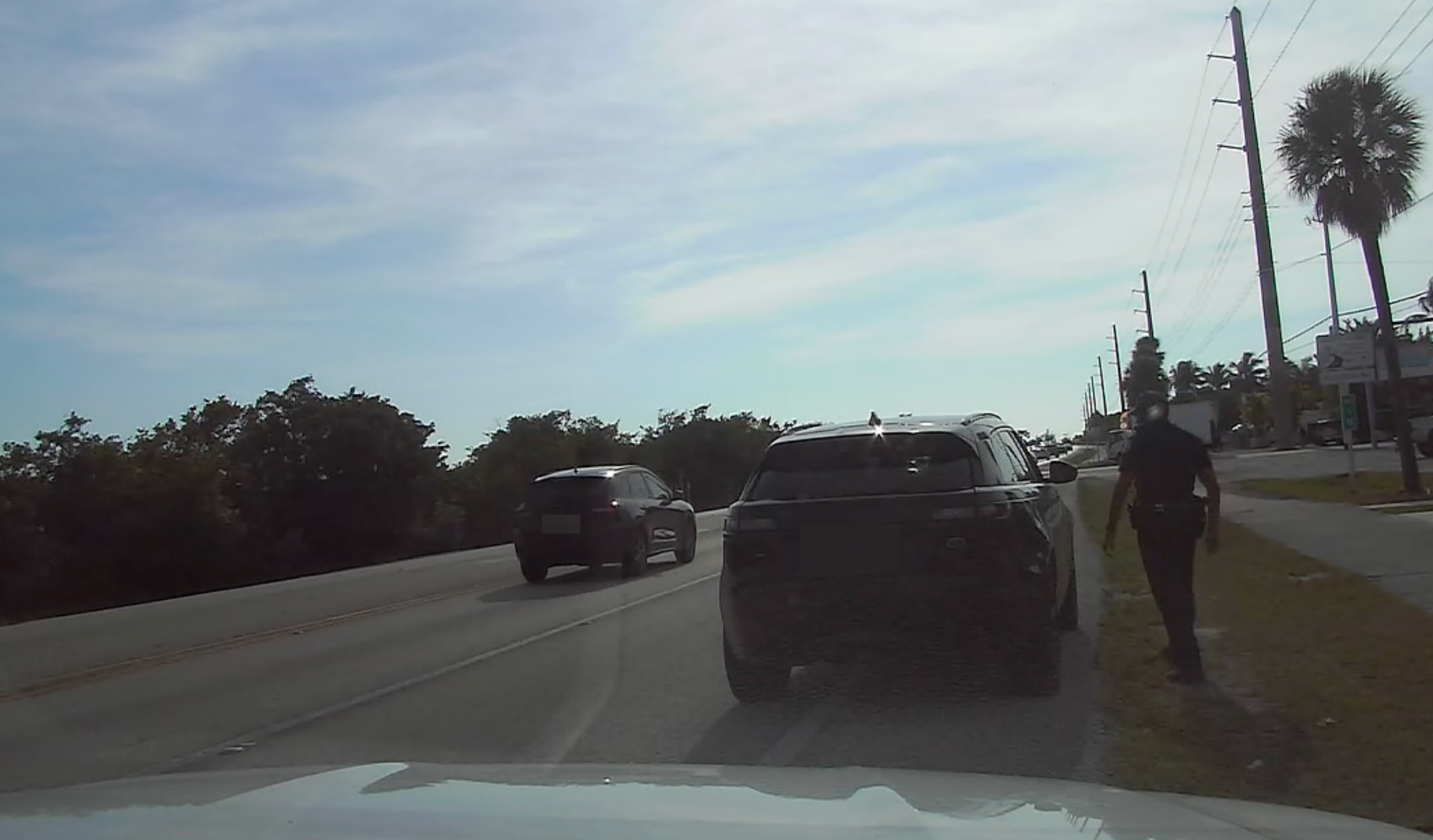
A police officer speeds 70 MPH down a two-lane highway running over a bridge in the Florida Keys. He passes a dump truck in a no-passing zone, then immediately does it again, crossing over a double-yellow line to pass another truck. He passes a third vehicle, nearly causing a head-on collision with a white pickup truck that veers away from him in the oncoming traffic. The cop keeps driving, and sees the SUV he’s been in pursuit of. He flicks his sirens and lights on and pulls it over.
The cop, Lamar Roman, wasn’t trying to pull over a suspected criminal. He was tracking and chasing a woman that he met and harassed on the set of the AppleTV+ show Bad Monkey, which he had worked a security detail shift on a few weeks prior to pulling her over. After meeting the woman, catcalling her and harassing her for her full name and Instagram details, the cop illegally looked up her vehicle information on DAVID, a Florida Department of Motor Vehicles database for law enforcement. He then put her license plate details on a surveillance “hotlist,” meaning he would get a notification in real time anytime she drove by an AI-powered license plate surveillance camera.
Roman told investigators that he saw the woman as a “shiny thing” and knew that using surveillance tools to track her was illegal, according to police records. He told investigators that “I knew that when I put [her into DAVID], I’m like ‘fuck’ and that’s why I stopped right after and nothing else.” But that wasn’t the end of it; he investigated the woman then used a powerful license plate tracking database to find her location and chase her down. In doing so, he also “almost cause[d] a head on collision while passing as a white truck traveling northbound had to veer off the roadway to avoid a collision.”
The shocking and egregious incident highlights the fact that police around the country have abused their access to surveillance tools for their own personal stalking projects, and shows how different law enforcement databases and surveillance tools can be tied together to investigate and follow anyone.
The cop, Lamar Roman, was caught and arrested in March, local news outlets reported. 404 Media has obtained video from Roman’s police cruiser and court records associated with the case that show how Roman met, harassed, investigated, and stalked the woman, who was not suspected of committing any crime, had nothing to do with Roman, and had no idea she was being tracked using a series of police surveillance software, hardware, and government databases.
“he also “almost cause[d] a head on collision while passing as a white truck traveling northbound had to veer off the roadway to avoid a collision,” the police report said.
Earlier this month, we reported on the fact that police around the country have been caught abusing Flock automated license plate cameras. Roman used a very similar system called Guardian; Flock has faced lots of scrutiny from journalists, privacy activists, and the general public over the last year, but it is worth noting that Flock is just one player in the booming AI license plate reader surveillance business and other systems face many of the same privacy problems Flock does.
Roman met the woman while working an off-duty security detail for Bad Monkey in early February. According to police affidavits, arrest warrants, and summaries of police interviews with both Roman and the woman, Roman whistled and “catcalled” the woman as she got off a bus for extras on set. Roman shouted “Oh my God, why didn’t nobody tell me we were bringing models to set,” the woman told investigators. The woman said “she was immediately uncomfortable with the situation,” and she did not know whether Roman was a real cop or whether he was playing a cop on the show. The woman “told Deputy Roman she has a boyfriend,” the warrant said. “Roman stated something along the lines of ‘I need your name and number just in case I pull you over someday.’” Roman pressured the woman into giving him her Instagram handle; she told investigators that she tried to be “standoffish,” to deter him. The woman was “pulled away by other extras who she knew and the others acknowledged Deputy Roman would not leave [her] alone.”
The woman “stated during one interaction Deputy Roman stated, ‘I’m going to pull you over.’ [She] stated she responded, “no your not.’ [sic] [She] stated Deputy Roman repeated himself and appeared to be flirting and joking. [She] stated she advised Deputy Roman that her boyfriend would not like that, and he ‘laughed it off.’”
The court records and arrest warrant detail what happened in the days and weeks after Roman left the set. First, Roman looked the woman up in Master Name Index (MNI), a police database, and “went from there,” he told investigators. With her driver’s license number, he looked her up in DAVID, a Florida Department of Motor Vehicles database for law enforcement. The records say that he looked up several variations of the woman’s name to obtain her “record detail, signature, vehicles, and current photo.” He wrote that the purpose of the search was a “background investigation.” Roman told investigators that he knew it was illegal to look the woman up in DAVID without a valid reason: “Right when I did that, I was like ‘fuck,” he told investigators. He then looked her and her license plate up the Florida Crime Information Center / National Crime Information Center, which are law enforcement information sharing databases, which contained additional information about the woman and her vehicle from Florida Highway Safety and Motor Vehicles.
Roman then took the woman’s license plate and created a “hotlist” in the Guardian automated license plate reader system. A hotlist allows police officers to create a list of “hot plates” of vehicles that they are searching for. Nominally, hotlist systems are supposed to be used for police officers looking for stolen vehicles or for specific people suspected of crimes. Hotlists send a real-time notification when an ALPR system detects a car on the list driving by a surveillance camera. After he got a ping with the woman’s location, Roman sped down the two lane highway toward her pinged location, dangerously and illegally passed three vehicles, almost caused a head-on collision, and illegally pulled her over for no reason. The police records state that Roman was going at least 70 mph (which triggered a cruiser video recording) while doing this; the speed limit in that part of the Florida Keys is 55 mph.
Roman did not have a body camera on nor did his vehicle capture any audio of the encounter, according to the records. He also did not log the stop in the system the department uses to catalog traffic stops. But the woman described what happened after he pulled her over. She told investigators that she “observed a patrol car cut off the truck behind her and she had a feeling it was Deputy Roman.”
“When Deputy Roman approached she stated, ‘I knew it was you’ and asked, ‘does all my information pop up on your screen?’ and further inquired, ‘How did you know it was me?’ She stated Deputy Roman responded, ‘I told you I’d find you and pull you over.’ She stated Deputy Roman also stated, ‘And I was hoping your boyfriend was in the car so I can pull him out and give him a hard time.’ She stated she responded that she did not think that was a good idea,” the police report reads.
She said that Roman asked her why she didn’t follow him back on Instagram, that she needed to leave, and said she would follow him back on Instagram but didn’t want to text and drive. She told investigators that she “said this to get Deputy Roman to leave her alone.” She “advised Deputy Roman she was late to getting where she was going and repeatedly asked if she could leave. [She] stated Deputy Roman eventually told her she could leave.”
The woman told investigators that she had no idea the extent of the surveillance she was under: “I advised [her] the full extent of which Deputy Roman utilized law enforcement databases to search her and obtain personal information about her,” the police investigator wrote. “I advised [her,] Deputy Roman also utilized the LPR to track her vehicle’s movement in the county. [She] was completely unaware of Deputy Romans use of databases to obtain her personal information.”
Roman admitted to extensively surveilling the woman and driving recklessly in an interview with investigators:
‘So you were pursuing her in an effort to just stop her and say ‘hey?’’ Deputy Roman responded, ‘yeah I know it’s stupid.’ I asked if there was any legal reason Deputy Roman put Brock’s vehicle tag in the LPR, was she suspected of anything? Deputy Roman responded no.”

