
In the last few years, the hype around artificial intelligence has become stratospheric. Riding a wave of venture capital, tech leaders promised us AI would revolutionise work, boost productivity and lead to incredible new breakthroughs. OpenAI, the creator of ChatGPT, set a new record when it attained US$110 billion in investments several months ago – and its CEO, Sam Altman, recently claimed Australia could become a “data capital of the world.”
Sky-high promises have been accompanied by sky-high investment in data centres, the sprawling server farms that power the training, execution, and maintenance of these models. A monstrous new hyperscale facility proposed for Sydney’s west – 1 gigawatt across 52 hectares – would rank among the world’s biggest. It will join 162 existing centres and 90 in the works across Australia, which is projected to be the world’s third largest data centre market by the early 2030s.
But if AI backers are all in, public sentiment is far more mixed. A new study ranked Australia equal lowest on the scale of global AI sentiment, with 81% supporting stronger rules for how organisations use AI and 68% worried about losing control over decisions made by AI on their behalf.
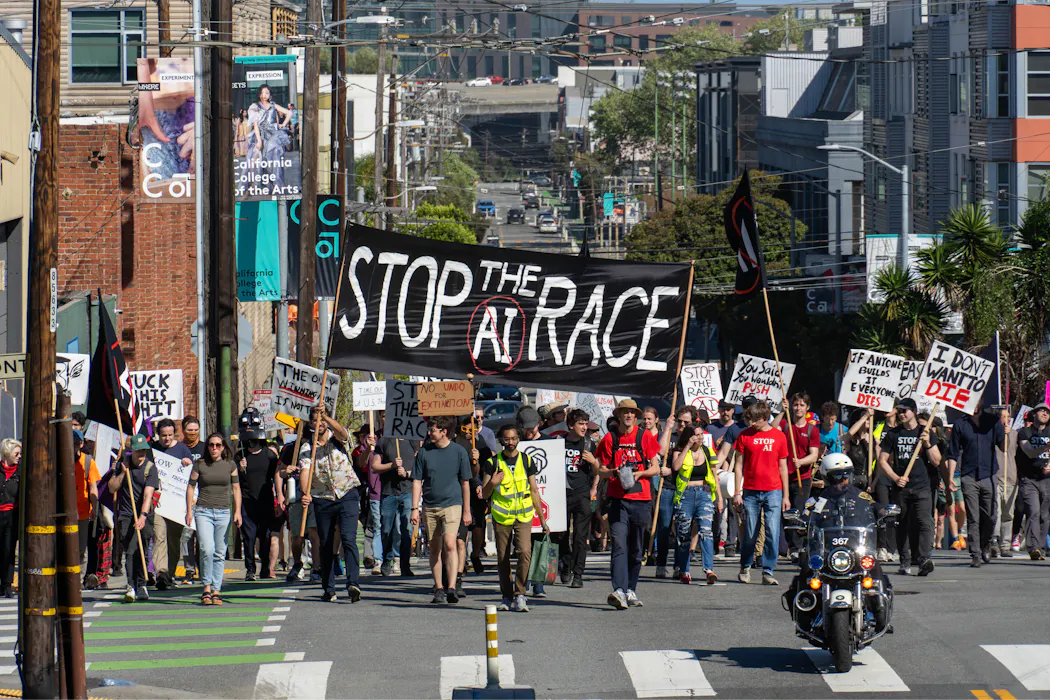
Grassroots movements against AI are growing. Last month, a “Stop the Slop” event challenging the Sydney data centre was relocated to a larger venue due to high interest. It joins other campaigns like StopAI and PauseAI that aim to slow down data centre development, ask how AI is impacting jobs and the environment, and consider more equitable and sustainable alternatives.
And in the last few months, videos have begun surfacing of students at commencement ceremonies booing speakers like former Google chief executive Eric Schmidt, who speak in rapturous tones about “standing on the edge of technological transformation” and how AI will touch “every profession”, “every classroom”, and “every relationship”.
Faith in these monumental claims – and the monumentally expensive infrastructure they rely on – is slipping.
What is the AI business model?
AI’s financial costs are astronomical. As tech critic Ed Zitron has shown over and over again, the major players are burning billions to keep models running, while lucrative profits remain tantalisingly out of reach. Some enterprises now spend more on rapidly rising token costs, the per-use cost of a model, than human workers. Even by cynical economic standards, the numbers don’t add up.
What exactly is the AI business model? Where is the killer app that will deliver genuine value and see millions of individuals or thousands of corporates pay costly subscription fees? “We have no idea how we may one day generate revenue,” admitted OpenAI CEO Sam Altman in 2019, “once we build a generally intelligent system, we can ask it to figure out a way to generate an investment return.” While the landscape has certainly shifted since then, use cases and revenue remain murky.
Hard evidence of AI’s contribution – rather than the vacuous claims of pitch decks and industry keynotes – remains largely elusive.
A recent survey of 6,000 senior business executives across the United States, United Kingdom, Germany and Australia found positive perceptions but a disappointing reality: around 90% of firms said AI has had no impact on employment or productivity over the past three years. Another study, from MIT last year, found that 95% of generative AI pilots failed to deliver tangible financial value to the organisation, so were abandoned.
If the upsides are unclear, the negatives are increasingly apparent. Politically, generative AI provides the perfect weapon to “flood the zone” with misleading or outright false content, muddying the informational waters and amplifying division. Is Netanyahu alive or dead? AI fakes make it harder and harder to tell.
Socially, AI companions and models, gaining enormous trust with users via long-term conversations, have been cited in a growing series of court cases around suicides and mass shootings. A lawsuit filed this year described ChatGPT as an intimate and persuasive “suicide coach” who convinced a man in Colorado to end his own life.
And environmentally, the turn to the far higher computation that AI requires means massive impacts as data centres demand more power and more water, creating hundreds of millions of tonnes of CO² emissions. If the 41 planned data centres in Sydney are built, they will directly use 15–20% of Sydney’s water supply within a decade, predicts environmental accounting associate professor Michael Vardon.
Even if its social, environmental and political fallout is dismissed, AI hype and investment misses what is happening on the technical level. Models in the last decade became “smarter” essentially by training on larger and larger data sets. But this paradigm yields diminishing returns.
Yann LeCun, former chief AI scientist at Meta, has warned that the correlation-based “learning” of models is both inefficient and insufficient when compared to human learning. Models require trillions of tokens to train. Even then, they reproduce patterns without deeper understanding, while children learn in a generalised manner from a handful of examples.
“Training is waning” is the new mantra, notes one Silicon Valley insider, as the brute force approach to foundational models gets left behind. It’s far from clear whether massive models, and the massive data centres that underpin them, will even be needed.
Where does this leave us? The possibility of the AI bubble bursting has shifted from a niche pocket of tech critics to mainstream policy wonks. “It’s time to start asking not whether there will be an AI crash, but what we should do today so that we are best prepared to respond to one tomorrow,” wrote two commentators in TIME magazine earlier this year.
What will this look like? Any answer here would include speculation. And yet we can garner some insights from previous bubble bursts, from tech development trends, and by extrapolating from the socio-cultural fallout we’ve already witnessed. Let’s step through each.
Another dot-com bubble
First, we can compare the AI bubble with the dot-com bubble of the late 1990s. Indeed, investment leaders – including The Big Short’s Michael Burry, who famously anticipated the collapse of the subprime mortgage market – are already seeing disturbing parallels between the two. Burry warns that venture capitalists are funding “loss-mak[ing] companies like never before in history”. As this suggests, the investments in this current AI bubble dwarf its dot-com analogue. If this bubble follows the blueprint of the last, we should expect to see massive layoffs in personnel and liquidations of AI startups with no discernible revenue.
Of course, like the first bubble, the deletion of a company doesn’t mean the technologies themselves disappear. Indeed, in the orthodox economic canon, the dot-com bubble was a “baptism of fire”: a painful but necessary rebirth. The trivial players, buoyed by “irrational” valuations, disappeared, but the network infrastructure they helped expand was the foundation for the truly innovative tech products to come.
Part of this “soft pop” future is almost certainly correct: the infrastructure will persist, even if underused. AI will continue being baked into a multitude of products, testing the market. And tech titans, sitting on data hoards and advertising monopolies, will march on. As scrutiny is increased, belt-tightening will occur. Companies will distil their product offerings, quietly begin limiting token use, and raise their subscription prices – all moves we’re already seeing play out.
But the larger question is whether tech companies – now just as then – actually contribute in meaningful ways to our broader world, or even merely our economies. As one Nobel-prize-winning economist famously quipped in the 1980s: “you can see the computer age everywhere except in the productivity statistics.”
More recent analyses of contemporary technologies have echoed this finding, suggesting the internet has little impact on economic growth. If this is the case for AI – as the numbers, the lack of products and even the rhetoric of its chief pundits suggests – then we have a social question, not just a financial one. What price are we paying for a technology that fails to deliver even on its own terms?
Small is beautiful
Second, tech development is moving away from the “bigger is better” mantra. Models are becoming much smaller and more efficient. The push is from the cloud to the so-called “edge”: the far more mobile and low-powered devices, like your phone, where data is actually created and used. And there’s a push to move the focus from “capture it all” quantity to quality, with targeted or carefully curated data.
Some of this is a welcome — and long-needed — shift. A deluge of critical AI research in the last few years has extensively documented the major issues with bias in foundational models. In a not-so-shocking twist, indiscriminate training on a massive archive of social material with almost no oversight creates models that reproduce significant harms.
To take just two well known examples: AI models discriminate based on race and gender, while AI-generated images consistently privilege white people over people of colour.
Given these issues, the slower and more careful construction of models actually tailored to their communities and attuned to their language, needs, and desires can only be beneficial.
Some languages, for example Indigenous languages with strong oral traditions, are considered “low-resource”, or underrepresented, with much less material in standard training sets. Switch away from English, and see the accuracy of your response plummet.
Future developers might work closely with communities to create their own archive of material that better reflects their ideas and beliefs. Here we start to see a meaningful idea of data sovereignty, where groups maintain control over their models and the data that underpins them, slowly disconnecting from corporate cloud regimes.
Of course, if the “small and mobile is beautiful” approach attains real traction, this will mean today’s massive investment in highly centralised data centres is the wrong move.
What will happen to this massively overbuilt – and, we anticipate – soon underused infrastructure? In an ironic twist, dead shopping malls have been converted into data centres in the last two years to satisfy demand – yet these data centres might themselves become empty shells, physical reminders of an obsolete vision.
Post-AI pathologies
Third, AI cannot be stuffed back into Pandora’s box. Even if AI development takes another path, the socio-cultural, political and environmental fallout of a post-AI world will continue – or even become exacerbated.
In education, researchers warn that students who constantly turn to generative AI models exhibit a kind of “doom loop” of dependence: offloaded thinking gradually causes atrophy in critical thinking and reasoning. “When kids use generative AI that tells them what the answer is […] they are not thinking for themselves,” state the authors of a Brookings Institution study.
They’re not learning to parse truth from fiction. They’re not learning to understand what makes a good argument. They’re not learning about different perspectives in the world because they’re actually not engaging in the material.
In politics, cutting-edge image and video models make it increasingly difficult to parse fact from fiction. Gravity glitches and six-fingered hands are gone; new generative models like Nano Banana boast physically-aware rendering. Models can now produce photo-realistic news reports, for instance, that seem to show Ukraine president Zelensky surrendering.
The result is a growing pervasiveness of the “liar’s dividend”, where muddied lines mean even genuine material is doubted or dismissed as being synthetic. The ability of evidence to document atrocity and persuade the public is undermined, with each side accusing the other of fabricating media.
In the environmental sphere, the AI-driven boom in data centre construction will have long-term impacts. While society has begun to lower carbon emissions via electrification and renewables, AI’s voracious demands threaten to reverse this progress. Sustainable generative AI is a fallacy. “AI datacenters are single-handedly leading to a major reversal in climate progress globally,” declared tech critic Karen Hao, citing a recent UN report.
From the extraction of rare-earth minerals to the burning of dirty diesel as backup, the strain on local power grids, and the siphoning of millions of gallons of freshwater in a warming world — the damaging effects of AI supply chain capitalism – will be felt by the ecosystems and generations to come.
Rage against the machine
“I’m here to tell you the mission of your generation is to destroy AI,” Daily Show comedian Ronny Chieng told Harvard graduates recently, to approving cheers — a far cry from the boos and anger that met AI evangelists advocates at similar ceremonies.
One strand of rising anti-AI sentiment is directed at data centres. A report found that US$64 billion of data projects have now been blocked or delayed amid local opposition. In one sense, of course, these wins are localised and limited: the “cloud” means data centres elsewhere can still run AI. But to see them as distractions from the bigger anti-tech battle is to miss the point. As tech critic Astra Taylor and community organiser Saul Levin argue,
This brewing populist resistance isn’t just about limiting local development – it represents a critical new front in the fight against tech-enabled authoritarianism. Where else can people push back on job-eating algorithms, distorting deep fakes, and autonomous drone strikes?
These protests and campaigns signal a gulf between the current AI vision — “tokenmaxxing” in an “AI everywhere” world — and the desires of everyday individuals. Of course, this disparity alone doesn’t signal the death of the AI boom dream: history is full of examples of elites rolling out exploitative technologies that run roughshod over the wishes of the people.
But combined with other economic, social and environmental factors, these pushbacks begin to destabilise Big Tech’s future-on-rails. There are other possibilities — slower, smaller, more convivial, more sustainable — for technologies that contribute to our lives, our society and our world.

Luke Munn does not work for, consult, own shares in or receive funding from any company or organisation that would benefit from this article, and has disclosed no relevant affiliations beyond their academic appointment.

