
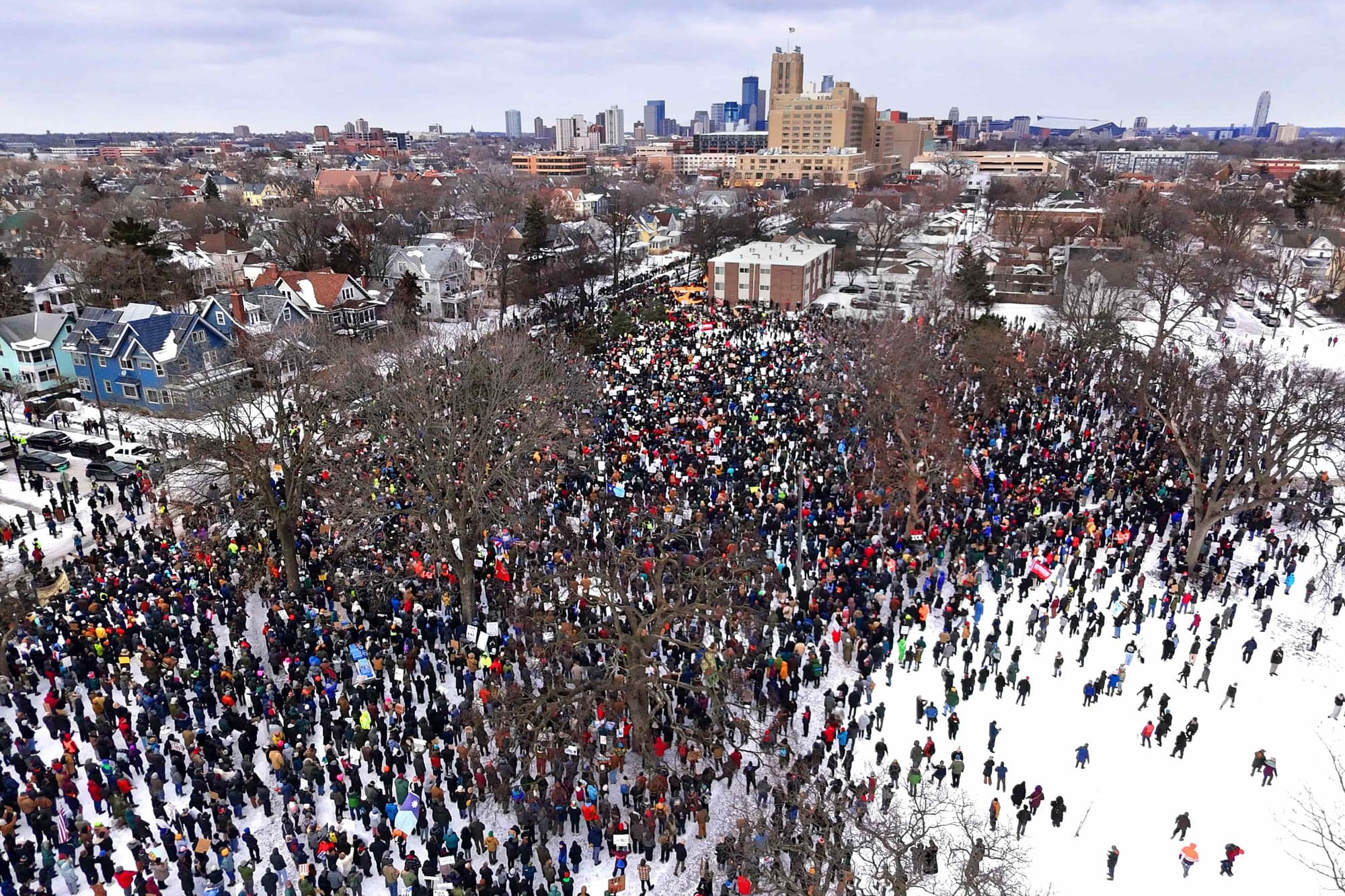
On Wednesday the Federal Aviation Administration rescinded a temporary flight restriction (TFR) that created a no-fly zone within 3,000 feet of “Department of Homeland Security facilities and mobile assets.” The new restriction softened the language of the original and abandoned the threat of civil or criminal penalties but added the Department of Justice to the list of protected agencies.
A 2025 TFR restricted the presence of drones around Department of Energy and Pentagon assets. The FAA added ICE and CBP to the list of restricted agencies in January as ICE began operations in Minneapolis. The no-fly zone covered 3,000 feet around any ICE vehicle. Anyone who was caught violating it could be fined or jailed. Because ICE agents often drive through the city in unmarked vehicles it was impossible for drone operators to know if they were violating the order and local journalists who use drones to take pictures and monitor law enforcement activities were grounded.
Earlier this month, Minnesota journalist Rob Levine sued the FAA over the TFR. In a motion filed earlier this week, Levine’s lawyers argued that the FAA had violated his rights and should rescind the restrictions. Core to their argument was the unmarked vehicles which they said created a “flotilla of invisible, moving bubbles,” according to court documents. “Under any standard, the TFR’s chilling sweep violates the First Amendment as applied to the Petitioner’s use of drones in photojournalism.”
The FAA replaced the TFR this week after Levine’s lawyers filed the motion. The new advisory lessened restrictions, including dropping the language around 3,000 feet and criminal penalties, but expanded the amount of protected assets.
“UAS operators are advised to avoid flying in proximity to: Department of War, Department of Energy, Department of Justice, and Department of Homeland Security covered mobile assets,” the new TFR said. “UAS operators who fly within this airspace are warned that…DOW, DOE, DOJ, or DHS may take action that results in the interference, disruption, seizure, damaging, or destruction of unamended [aircraft] deemed to pose a credible safety or security threat to covered mobile assets.”
Despite the threat to shoot journalist’s drones out of the sky, Levine and his lawyers see the new TFR as a victory. “This is a big win. It was heartbreaking to have my drones grounded at a time of such importance to my community, but I’m looking forward to getting back up there and getting back to my journalism as soon as possible,” Levine said in a statement provided to 404 Media.
Grayson Clary, a lawyer with Reporters Committee for Freedom of the Press who took on Levine’s case, said there is still work to do. “We’re glad to see the FAA rescind its original order, which was an egregious overreach that had serious consequences for reporters nationwide. But this kind of arbitrary back-and-forth from the FAA is exactly the problem, and we intend to make clear to the D.C. Circuit that this restriction never should have been implemented in the first place,” he said.

