
Welcome back to the Abstract! Here are the studies this week that rolled with it, went out on a limb, gravitationally waved, and spotted relics in our midst.
First, hundreds of prehistoric dice sets shed light on the dawn of gambling. Then: these disembodied arms are horny, the forbidden fruits of supernovae, and baby food for the Milky Way.
As always, for more of my work, check out my book First Contact: The Story of Our Obsession with Aliens or subscribe to my personal newsletter the BeX Files.
Rolling the dice in the Ice Age
Thousands of years before prediction markets, sports betting, and poker nights, Native Americans were playing the odds with dice and other games of chance.
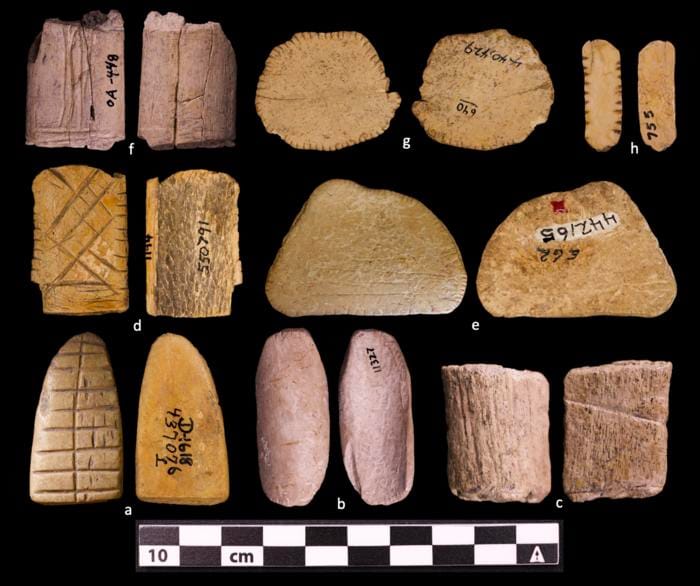
An analysis of nearly 300 ancient artifacts related to gambling—especially two-sided dice known as “binary lots”—has revealed that Native Americans have played games of chance for at least 12,000 years, many millennia before any other known cultures in the world.
“Historians of mathematics frequently identify the invention of dice and games of chance as a crucial early step in humanity’s evolving discovery and understanding of randomness and the probabilistic nature of the universe,” said study author Robert Madden of Colorado State University.
“The findings presented here suggest that some of the earliest steps on this intellectual journey were taken not by complex societies in the Near East and Eastern Europe around 5,500 years ago but rather by Native American hunter-gatherers in western North America in the waning centuries of the Pleistocene, no later than 12,000 years ago,” he continued.
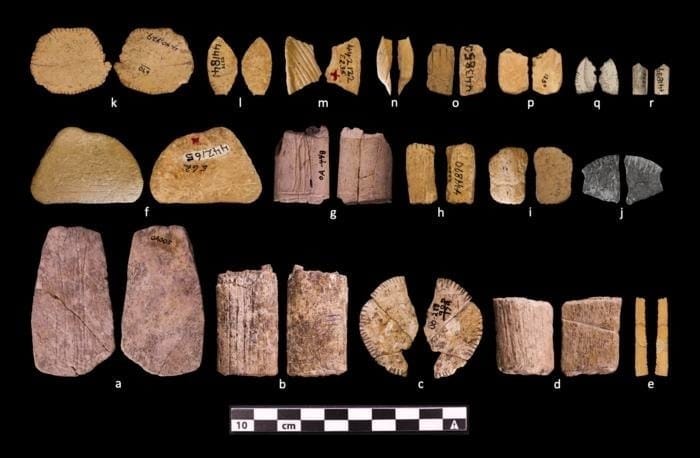
Scholars have marveled at the prevalence of Native American games of chance for more than a century, but Madden is the first to systematically trace their origins. He set out to study prehistoric dice in museum collections at the Smithsonian Institution, the University of Wyoming Archaeological Repository, and the Denver Museum of Nature and Science, which were documented in a landmark compendium called Games of the North American Indians published in 1907 by the ethnographer Stewart Culin.
The most common dice games involved players taking turns throwing sets of binary lots, with a score that was assigned based on a count of the “up”-facing side thrown by each player on their turn. Cumulative scores were tracked with counting sticks; the first to reach a predesignated number were the winners.
Madden identified dice at 57 archaeological sites across 12 states, with the oldest appearing in the territories of western Great Plains cultures. The finds clearly indicate a complex understanding of probability, which played a role not only in social cohesion, but also in cosmologies.
“Numerous ethnographic accounts of Native American traditions depict dice playing as a sacred activity that was inherently pleasing to the gods and celestial powers (who were themselves dice players), with ceremonial and secular dice games being played at festivals and seasonal events,” Madden said.
The study chronicles many fascinating myths and legends about gods playing dice on the surface of Earth and the creation of humans as the outcome of a cosmic dice game. Albert Einstein famously remarked that god “does not throw dice” in response to the probabilistic realm of quantum physics. It would seem these prehistoric cultures were way ahead of the game on this point.
In other news…
Eight-armed and ready
Villar, Pablo S., Jiang, Hao et al. “A sensory system for mating in octopus.” Science.
Male octopuses are real suckers for sex, reports a new study about the “hectocotylus,” which is a special arm that serves a dual purpose as both sensory and mating organ.
During copulation, males use the hectocotylus to probe the female’s intricate oviducts in order to deposit sperm, but the mechanisms behind this strategy have been shrouded in tentacled mystery. To get a better handle on the process, scientists coated tubes with different substances and discovered that octopuses only released sperm when sucker cups on the hectocotylus made contact with progesterone, a female hormone produced in the ovaries.
“Whereas nonmating arms are used for chemotactile exploration and predation, the hectocotylus is almost exclusively used for mating and often even protected during hunting,” said researchers co-led by Pablo S. Villar of Harvard University and Hao Jiang of the University of California San Diego.
In a wild twist, the hectocotylus can even work its magic when it is entirely severed from the male’s body, allowing detached arms to autonomously inseminate females! It’s proof that romance is not dead, it’s just occasionally dismembered.
Mind the black hole gap
Tong, Hui et al. “Evidence of the pair-instability gap from black-hole masses.” Nature.
You’ve heard of forbidden planets, but what about forbidden black holes? For years, scientists have theorized that black holes with masses between approximately 50 and 130 times the mass of the Sun fall into a “forbidden range” that cannot exist.
The reason is that colossal stars that are 100 to 260 times more massive than the Sun experience a special kind of stellar death known as “pair‑instability supernovae” in which they completely self-destruct, preventing the formation of black holes. Stars that are both bigger and smaller than this range, in contrast, explode in supernovae that do collapse into black holes.
Now, scientists have discovered evidence for this gap using dozens of gravitational waves, which are ripples in spacetime formed by cataclysmic events such as mergers of black holes. In binary black holes—systems where two of these massive objects orbit each other—the smaller objects never fell into this range. Some of the larger black holes had forbidden masses, but that’s likely because they had merged with other black holes in the past, not because they were initially at that mass after the deaths of their progenitor stars.
“We interpret these findings as evidence for a subpopulation of hierarchical mergers: binaries in which the primary component is the product of a previous black-hole merger and thus populates the gap,” said researchers led by Hui Tong of Monash University. “As the number of detections increases, it will be possible to gain new insights into the pair-instability gap.”
From my perspective, all black holes are forbidden, because they are terrifying cosmic death traps. But it’s nice to know that the universe has limits, too.
I’m so hungry, I could eat a galaxy
Last, it’s time to pay respect to our stellar elders. A new study reveals that a weird population of 20 stars orbiting within a few thousand light years of the Sun have basically no metals, the astronomical term for elements that are heavier than hydrogen and helium. Since new generations of stars become more enriched with metals over time, these stars must be extremely ancient relics. So where did they come from?
Scientists think they have the answer: These metal-light Methusalehs are the last remnants of an ancient dwarf galaxy, which the team dubs “Loki.” Despite its powerful Norse namesake, Loki appears to have been swallowed by the Milky Way early on in our galaxy’s 13-billion-year history. While it is common to find very metal-poor (VMP) stars orbiting all around our galaxy’s core, it’s much rarer to find them all the way out here in the galactic exurbs, hidden in the “plane” (the flattened disk of a galaxy).
“This work provides, for the very first time, a dedicated detailed chemical abundance analysis of a sample of VMP stars with orbits close to the Milky Way plane,” said researchers led by Federico Sestito of the University of Hertfordshire. “A plausible scenario, supported by cosmological zoom-in simulations, is the early accretion of a single system.”
It goes without saying that eating a whole galaxy is pretty metal, even if the stars within it are not.
Thanks for reading! See you next week.

