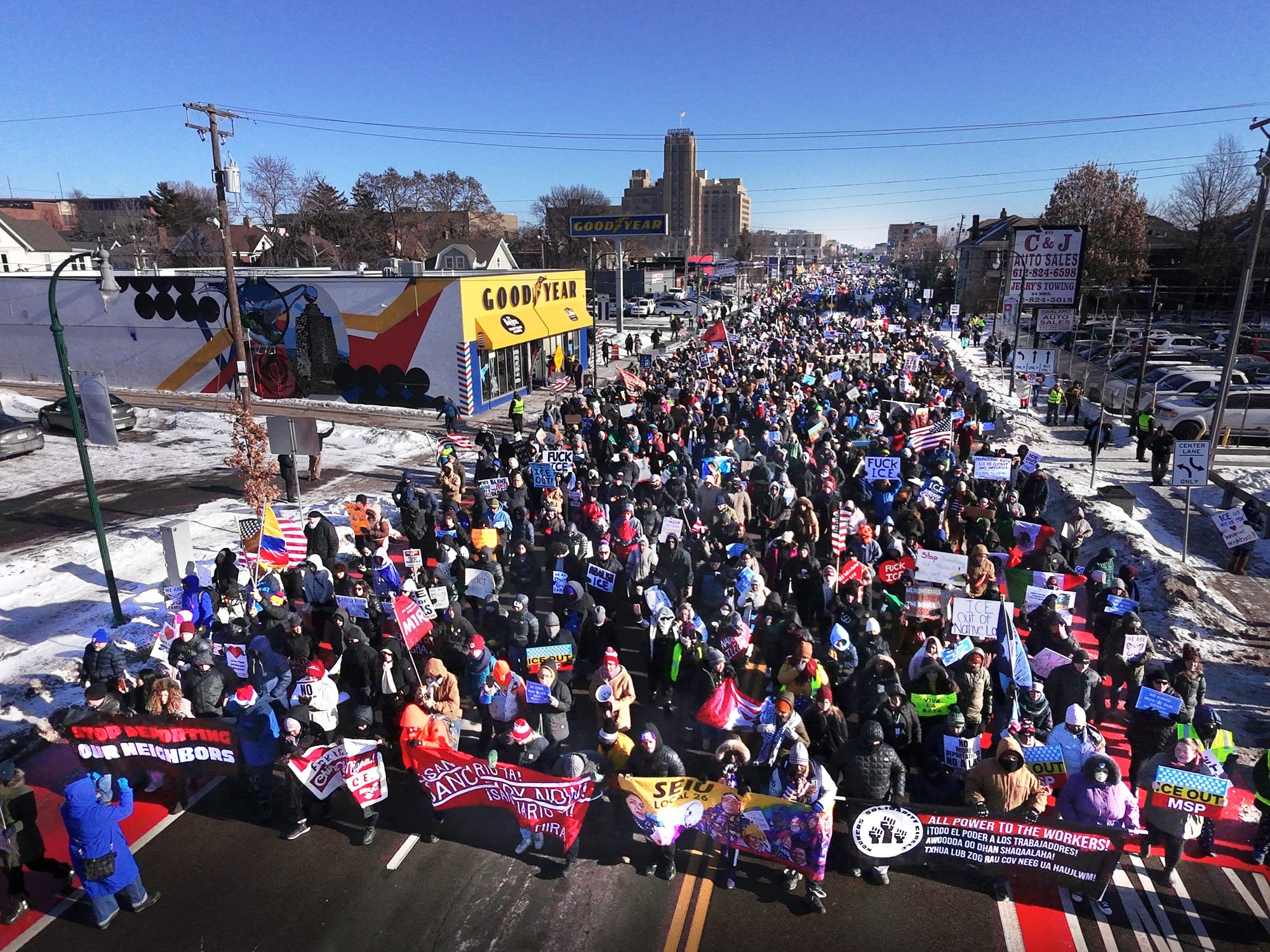
Minnesota photojournalist Rob Levine and the Reporters Committee for Freedom of the Press are suing the Federal Aviation Administration over a recently issued restriction that prevents drones from flying within 3,000 feet of Department of Homeland Security buildings and vehicles, an amorphous no-fly zone that encompasses Immigrations and Customs Enforcement agents.
The FAA issued the temporary flight restriction (TFR) in January as ICE agents flooded the streets of Minneapolis. The rule established a no fly zone of 3,000 feet around “Department of Homeland Security facilities and mobile assets,” a restriction that Levine and his lawyers argue is impossible to follow and is aimed at curtailing the First Amendment rights of journalists.
“Because there is no means of verifying in advance whether DHS vehicles—such as unmarked cars driven by Immigration and Customs Enforcement agents—are operating in a given location, the practical consequence is that drone pilots nationwide cannot know whether a flight will expose them to liability,” Levine’s lawyers argued in a court document.
Levine lives in Minneapolis and spent the early days of Operation Metro Surge using his drone to capture footage of protests and ICE agents. Then the TFR hit. “It sent a shiver down my spine,” he told 404 Media. “I’m like ‘Oh my god.’ In a city like Minneapolis at the time with, I don’t know, three or four thousand DHS agents in various stages of uniform or undercoverness or civilian cars that they had switched license plates on? Masquerading as delivery men? They were everywhere here. I immediately grounded myself because there was no way you could know in advance whether or not you were violating that [flight restriction]. And when you’re flying they could drive by and you might not even know it.”
Grayson Clary, a lawyer with Reporters Committee for Freedom of the Press who is representing Levine, told 404 Media that the FAA has previously used flight restrictions in ways that seem designed to prevent newsgathering. “The FAA has a long history of imposing these temporary flight restrictions over newsworthy events in ways that frustrate journalists’ ability to cover protests, law enforcement’s response to protests, you name it, and this is sort of the newest escalation in that story,” he said.
This new no fly zone is a modification of an old TFR from 2025 that restricted drone pilots from operating within 3,000 feet of Department of Defense and Department of Energy bases.
“When you think about the old restriction, it’s essentially don’t fly within 3,000 feet of an enormous Naval vessel or a Department of Energy convoy that’s ferrying nuclear weapons around,” Clary said. “They just sort of added DHS to the end of that without taking stock of just how much more difficult it is to know whether you’re within 3,000 feet of a DHS ground vehicle as opposed to within 3,000 feet of a destroyer sitting in a Naval base.”
DHS isn’t forthcoming about the number of ICE agents in a given city or where they are operating. They often wear plainclothes, patrol cities in unmarked vehicles, and don’t announce themselves to people in the neighborhoods they patrol. Clary and Levine argued that the secretive nature of DHS has made it impossible for journalists to comply with the FAA’s no fly zone.
The penalties for violating the FAA restriction are severe. “They can take your drone and destroy it. They could shoot it down if they wanted to. They can arrest you and throw you in jail…and they can also make it so you can never fly a drone again,” Levine said. “It seems purely to prevent photo journalism and to chill photo journalists because the rule is so vague they could even charge you after the fact if they determined that you were somewhere and they had been near there.” The FAA has a history of trying to enforce drone restrictions against operators after the fact, based on footage or images posted on YouTube or social media sites.
Clary agreed. “That’s part of what makes this such a First Amendment problem is that it has a real chilling effect. When you don’t know where exactly the line is, you’re going to play it more carefully to make sure that you don’t accidentally cross it,” he said.
Levine has fought the FAA before on this issue and won. In 2016, just as he was first learning how to pilot drones for his photojournalism work, he traveled to North Dakota to cover the anti-oil pipeline protests at Standing Rock. At the time, the FAA had issued a TFR over the area but Levine was able to push the agency into granting him a waiver on First Amendment grounds.
DHS operates its own drones to aid its surveillance efforts. Last year it flew Predator drones above protests in Los Angeles and Minneapolis residents have taken a lot of footage capturing drones flying above homes in Minnesota.