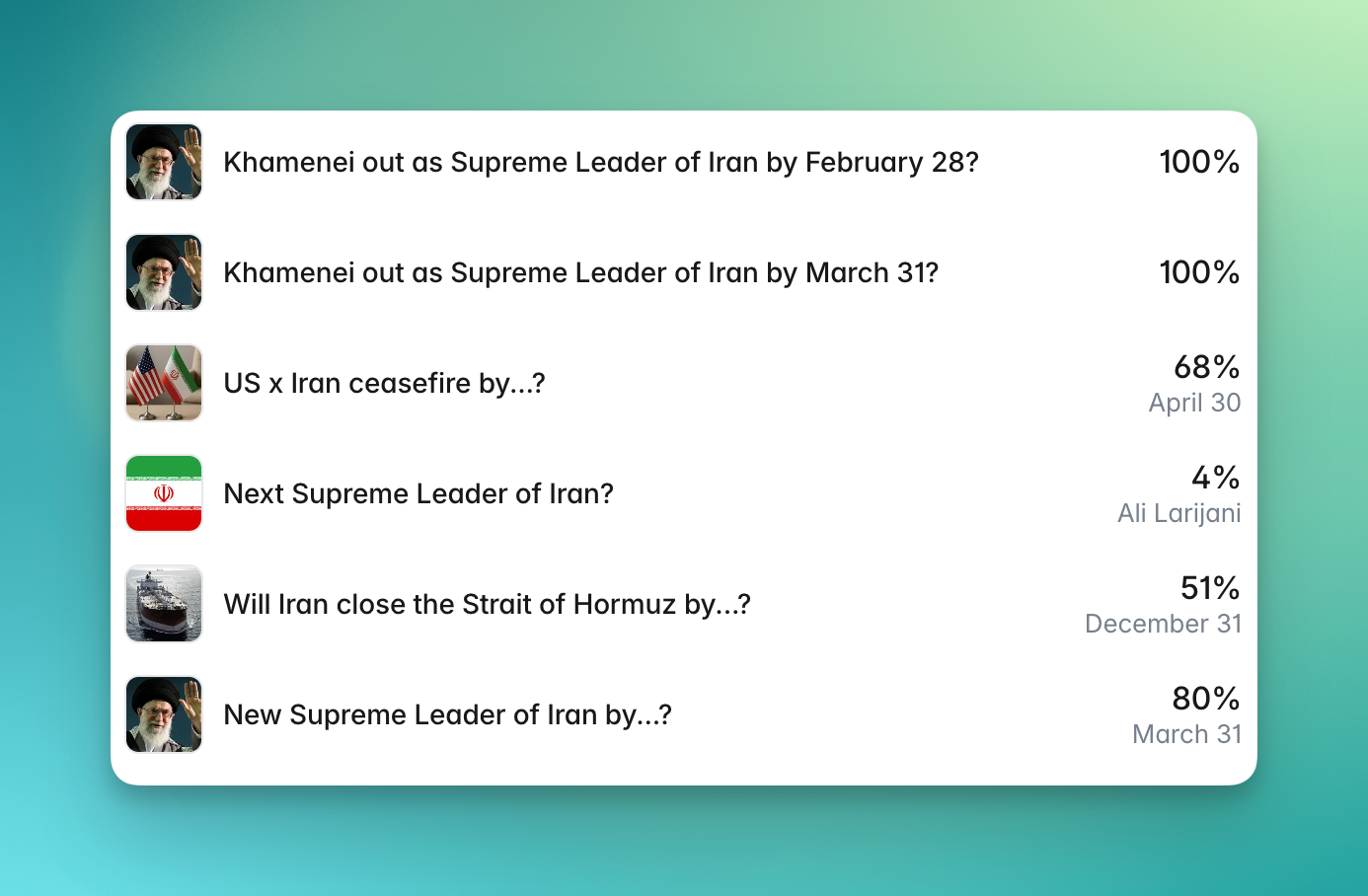
The main bet on the front page of Polymarket right now is “Will the Iranian regime fall by June 30?” The site has this at a 41 percent chance of happening as I write this.
On Polymarket, more than $5 million has been spent gambling on this question. On Kalshi, a competing prediction market where users can bet on almost anything, $54 million was spent on “Ali Khamenei out as Supreme Leader?,” a bet whose results somehow ended up ambiguous even after Khamenei’s assassination.
In a series of tweets over the weekend, Kalshi’s CEO and founder Tarek Mansour repeatedly twisted himself into pretzels attempting to explain how the absurd, grotesque exercise of allowing people to bet on politics, geopolitics, and world events is not supposed to allow people to profit from death.
“We don’t list markets directly tied to death. When there are markets where potential outcomes involve death, we design the rules to prevent people from profiting from death,” he wrote. He then posted the underlying rules of the bet, which read “If <leader> leaves solely because they have died, the associated market will resolve and the Exchange will determine the payouts to the holders of long and short positions based upon the last traded price (prior to the death).”
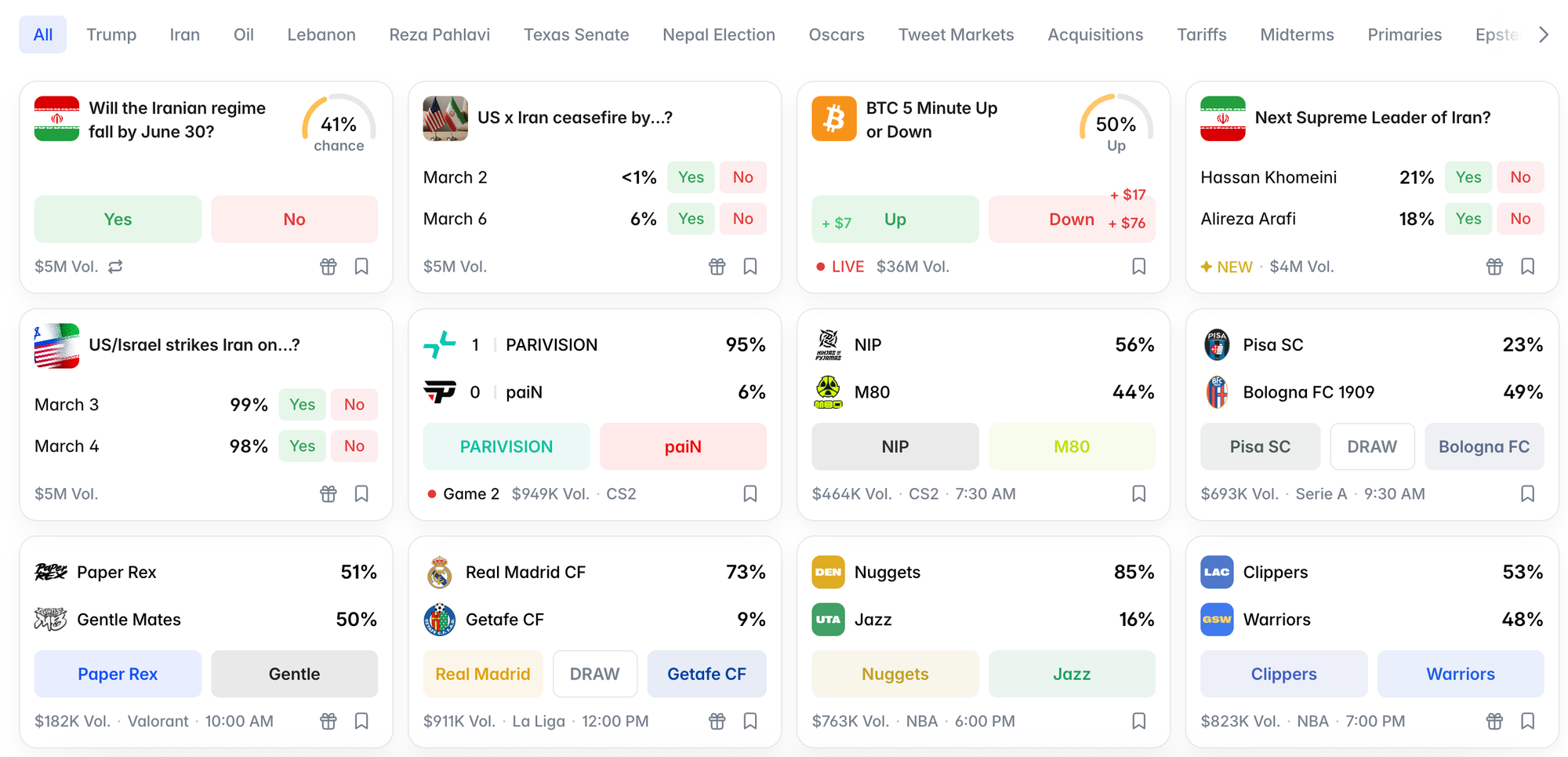
That we are discussing the ins-and-outs of which random gamblers get paid out during an illegal war in which already hundreds of school children have been bombed to death feels like the type of grotesque sideshow that is only possible because the U.S. government is only interested in regulating its perceived political enemies, and which only feels possible because much of the American economy feels held together by cope and the gobs of money being thrown into AI, data centers, and gambling. All of this is part of the perverse Silicon Valley, AI, crypto, and X-adjacent hustlebro gambling economy, which was legalized by companies like DraftKings and FanDuel, who spent eyewatering sums lobbying states to allow their gambling apps, and has been “legitimized” by sports leagues who wanted to print money and media companies desperate for the advertising dollars that came from gambling and has turned this all into a massive industrial complex that is not-so-slowly bankrupting a generation of underemployed people addicted to gambling. Polymarket and Kalshi took the DraftKings and FanDuel model and let people bet on basically anything, so now you can bet on which countries Iran will launch missiles against on the same app you bet on the Nuggets/Jazz game or the winner of the Best Picture Academy Award. The new model is so good at parting people from their money that DraftKings and FanDuel themselves have been anxious to get into prediction markets.
This is how we end up with extremely underregulated companies more or less making up rules on the fly as they hop from crisis to crisis trying to determine the nature of reality, such as whether a suit is a suit or whether a dead guy is still in charge of the government, with each disputed bet having millions of dollars on the line. Both Polymarket and Kalshi have decided to go with the line that letting people bet on war, politics, and the general nature of reality will not distort reality through the insider trading we’ve already repeatedly seen, but will somehow improve public trust in the reporting of news. Polymarket has added a note to all Iran-focused bets that says “The promise of prediction markets is to harness the wisdom of the crowd to create accurate, unbiased forecasts for the most important events to society. That ability is particularly invaluable in gut-wrenching times like today. After discussing with those directly affected by the attacks, who had dozens of questions, we realized that prediction markets could give them the answers they needed in ways TV news and X could not.”
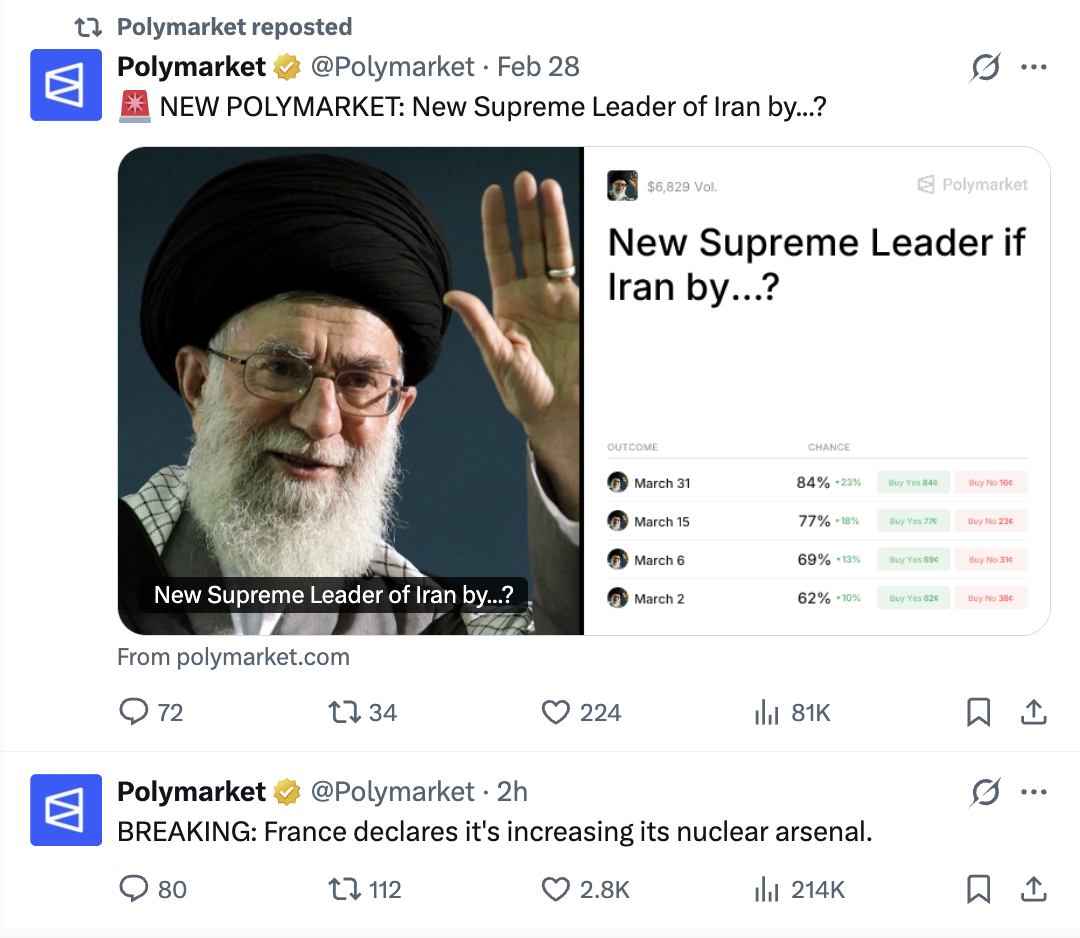
This is, conveniently, a stance that allows Polymarket to continue to profit from death and war, and allows its customers to continue to bet on it. Polymarket’s X feed is kind of like a fucked up newswire service for degenerates, its tweets today including things like ““BREAKING: 41% of all scheduled flights to the Middle East have been cancelled today” and “NEW POLYMARKET: New Supreme Leader of Iran by…?” Polymarket’s recent integration with Substack means, I guess, that we’re about to see a generation of people who “get their news from gambling apps,” which is sure to lead to a healthy society. A recent interview on Polymarket’s own Substack valorizes a gambler named “Betwick” who lost 70 percent of his money largely because he “lost quite a bit on ‘Israel strikes Iran’ at the last minute, where it looked like they were going to negotiate for a few more days and Israel did the surprise attack” but was confident he could rebuild it by continuing to bet on various Iran war scenarios.
That these gambling apps will do anything to restore trust in how society operates or will in any way make it healthier is obviously, blatantly untrue. We have seen people manipulate maps to win Polymarket bets on the war in Ukraine, what appeared to be obvious insider trading on the U.S. attack on Venezuela, and numerous people banned or fired for insider trading on companies that they work at. Already there are allegations from lawmakers that there has been insider trading on the Iran markets. We have seen early research, meanwhile, that shows the resurgent gambling industry is sucking in huge numbers of young people and that people lose their money faster on these prediction markets than they do on sports gambling platforms. Missed out on Bitcoin? Missed out on GameStop? Missed out on NFTs and memecoins and dropshipping? Polymarket and Kalshi are here now.
The obvious farce of all of this is that Kalshi’s line that “we design the rules to prevent people from profiting from death” is obviously untrue on its face, it’s just that the company would rather let you bet on the deaths and suffering of civilians rather than dictators and presidents. Betting that Khamenei would stay in power is an explicit bet that he would be allowed to continue silencing dissent and killing those who oppose him; betting that he would be deposed is an explicit bet on what has already become a very deadly, illegal regional war. Even bets on things like “Will Iran close the Strait of Hormuz” and gas prices are explicit bets on the escalation or deescalation of this war and thus a bet on people’s deaths, which is obvious on its face but becomes more clear as you dig into the “rules” of any given bet.
Winning the Khamenei bet required any number of things that definitely would involve the deaths of many people and “requires a broad consensus of reporting indicating that core structures of the Islamic Republic (e.g. the office of the Supreme Leader, the Guardian Council, IRGC control under clerical authority) have been dissolved, incapacitated, or replaced by a fundamentally different governing system or otherwise lost de facto power over a majority of the population of Iran. This could occur via revolution, civil war, military coup, or voluntary abdication, but only qualifies if the Islamic Republic no longer exercises sovereign power. Routine political events such as elections, reforms, or leadership succession do not qualify. Internal coups or power shifts that preserve the Islamic Republic’s core structures also do not qualify. Only a clear break in continuity—such as a new provisional government, revolutionary council, or constitution replacing the Islamic Republic will qualify.”
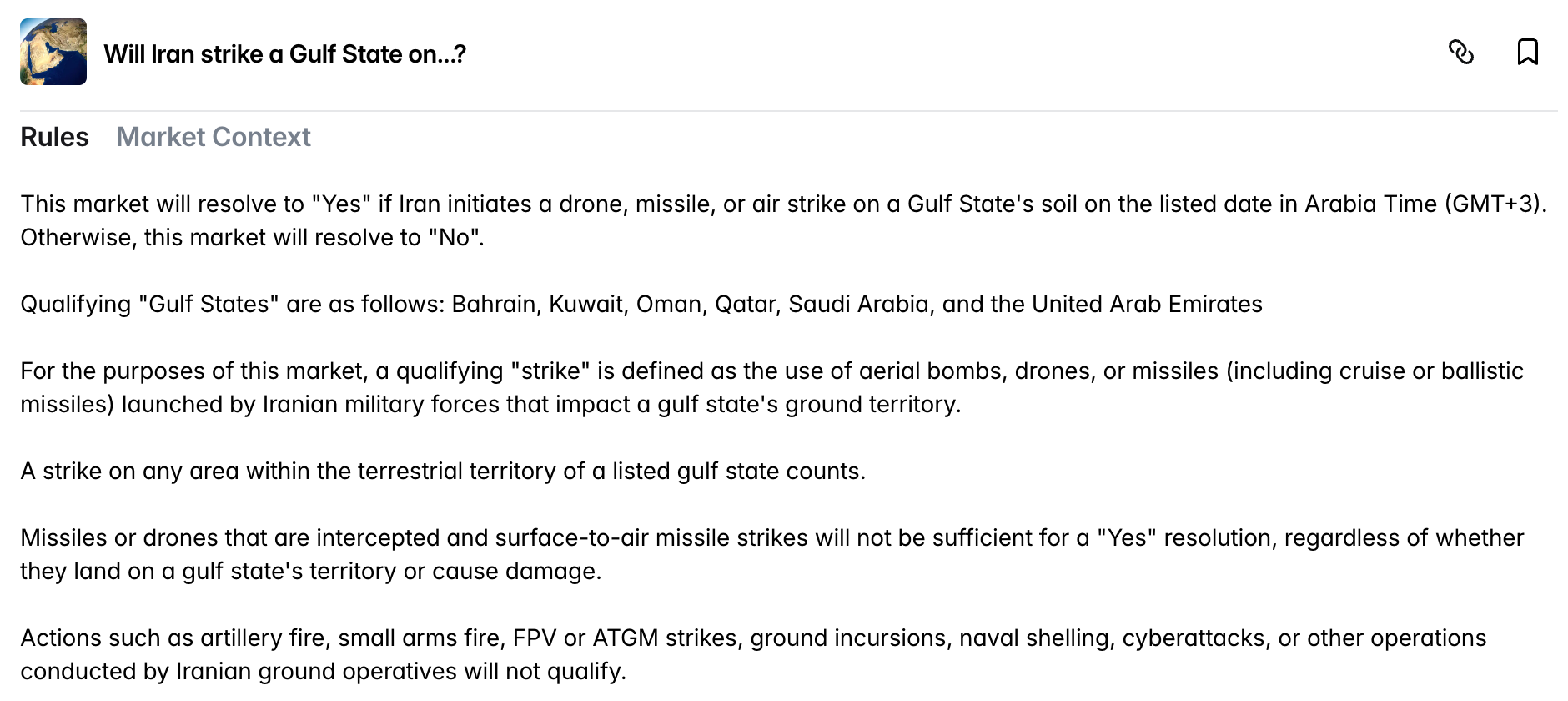
Meanwhile, over on Polymarket, “Will Iran strike a Gulf State on March 2” requires the definition of a “qualifying strike,” which is “the use of aerial bombs, drones, or missiles (including cruise or ballistic missiles) launched by Iranian military forces that impact a gulf state’s ground territory.” In case you’re wondering, “Missiles or drones that are intercepted and surface-to-air missile strikes will not be sufficient for a ‘Yes’ resolution, regardless of whether they land on a gulf state’s territory or cause damage. Actions such as artillery fire, small arms fire, FPV or ATGM strikes, ground incursions, naval shelling, cyberattacks, or other operations conducted by Iranian ground operatives will not qualify.”
There is no chance any of this ends well. It’s already a disaster. Wanna bet?