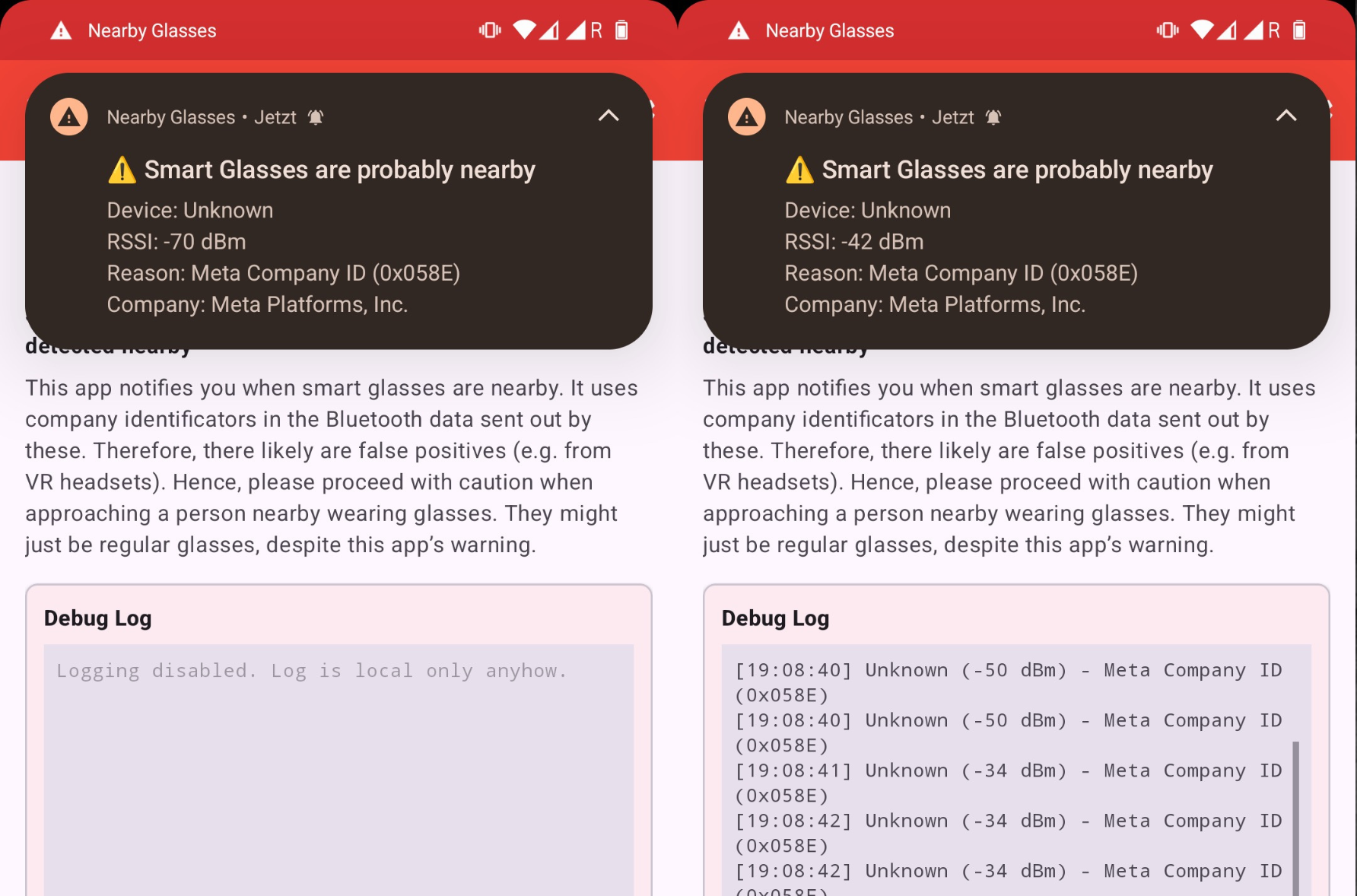
A new hobbyist developed app warns if people nearby may be wearing smart glasses, such as Meta’s Ray-Ban glasses, which stalkers and harassers have repeatedly used to film people without their knowledge or consent. The app scans for smart glasses’ distinctive Bluetooth signatures and sends a push alert if it detects a potential pair of glasses in the local area.
The app comes as companies such as Meta continue to add AI-powered features to their glasses. Earlier this month The New York Times reported Meta was working on adding facial recognition to its smart glasses. “Name Tag,” as the feature is called, would let smart glasses wearers identify people and get information about them from Meta’s AI assistant, the report said.
“I consider it to be a tiny part of resistance against surveillance tech,” Yves Jeanrenaud, the hobbyist developer and sociologist who made the app, told 404 Media.
To use the app, called Nearby Glasses, users download it from the Google Play Store or GitHub. They may need to tweak some settings such as “enable foreground service” to keep the app scanning. Then they press “Start Scanning” and a debug log will show the app’s activity. If it detects what it believes to be a pair of smart glasses, the app will send a notification: “⚠️ Smart Glasses are probably nearby,” it reads, according to a screenshot posted to the app’s Play Store page.
The app works by looking for Bluetooth “advertising frames,” which are small bits of data devices regularly broadcast as part of their normal operation. Jeanrenaud said he referenced a directory of Bluetooth Low Energy (BLE) manufacturers, then made the app scan for Meta, Luxottica Group S.p.A which partners with Meta on its smart glasses, and Snap, which has its own smart glasses offering.
“If it sees an advertising frame of these manufacturers, it notifies you. That’s basically it,” Jeanrenaud said. The Play Store page says the app likely generates false positives, such as from VR headsets. That is what happened in 404 Media’s test too: We ran the app near a Meta Quest 2 headset; the app detected the device, with its debug log saying “Meta Quest 2,” and the app sent a notification saying smart glasses were nearby. Of course, when walking around in public, it is less likely that someone is going to be wearing a VR headset than a pair of smart glasses.
“This is a tech solution to a social problem exaggerated by tech. I do not want to promote techsolutionism nor do I want people to feel falsely secure. It’s still imperfect,” Jeanrenaud added.
Jeanrenaud said he decided to make the app after reading some of 404 Media’s coverage of how people are using Meta’s Ray-Ban smart glasses. He specifically pointed to this article, about how men are filming women inside massage parlors seemingly without their consent. Jeanrenaud also referenced 404 Media’s coverage showing multiple Customs and Border Protection (CBP) officials wore the AI glasses during immigration raids, including with the recording light clearly illuminated.
“Obviously, surveillance tech is not only abused by government thugs, it’s also a tech boosting misogynist behaviour and rape culture,” Jeanrenaud said.
404 Media has also reported how two students coupled Meta’s Ray-Bans with off-the-shelf facial recognition technology and people search sites to turn them into glasses that instantly doxed people; and shown how a $60 mod easily disables the privacy-protecting recording light in the glasses, making it easier for wearers to film people without them knowing.
Neither Meta nor Google responded to a request for comment about the new app.
When Google released Google Glass, the first substantive pair of consumer smart glasses more than ten years ago, some people heckled or ripped the glasses from wearers’ faces. Those glasses looked very distinct. Meta’s Ray-Ban glasses, meanwhile, are designed to look just like any other pair of glasses, making it more difficult for passersby to know if someone is wearing a smart device or not. Not impossible, though: in December, a woman on the New York subway allegedly broke a man’s pair of Meta’s smart glasses while he was filming a piece of content.
The app’s Play Store page says after identifying a device, a user “may act accordingly.”
Jeanrenaud said he can imagine that including what the woman on the subway allegedly did. “Or people just tell them politely to fuck off.”